Ministry of Home Affairs Budget and Internal Security Allocations
Source:The Hindu ↗
Why It Matters
Allocations under the MHA budget directly map to the GS3 syllabus covering 'Security Challenges and their Management in Border Areas', 'Role of External State and Non-State Actors', and 'Various Security Forces and Agencies'. The initiation of a digital and caste census heavily informs GS1 and GS2 topics involving social empowerment, demographic dynamics, and affirmative action policies.
Summary
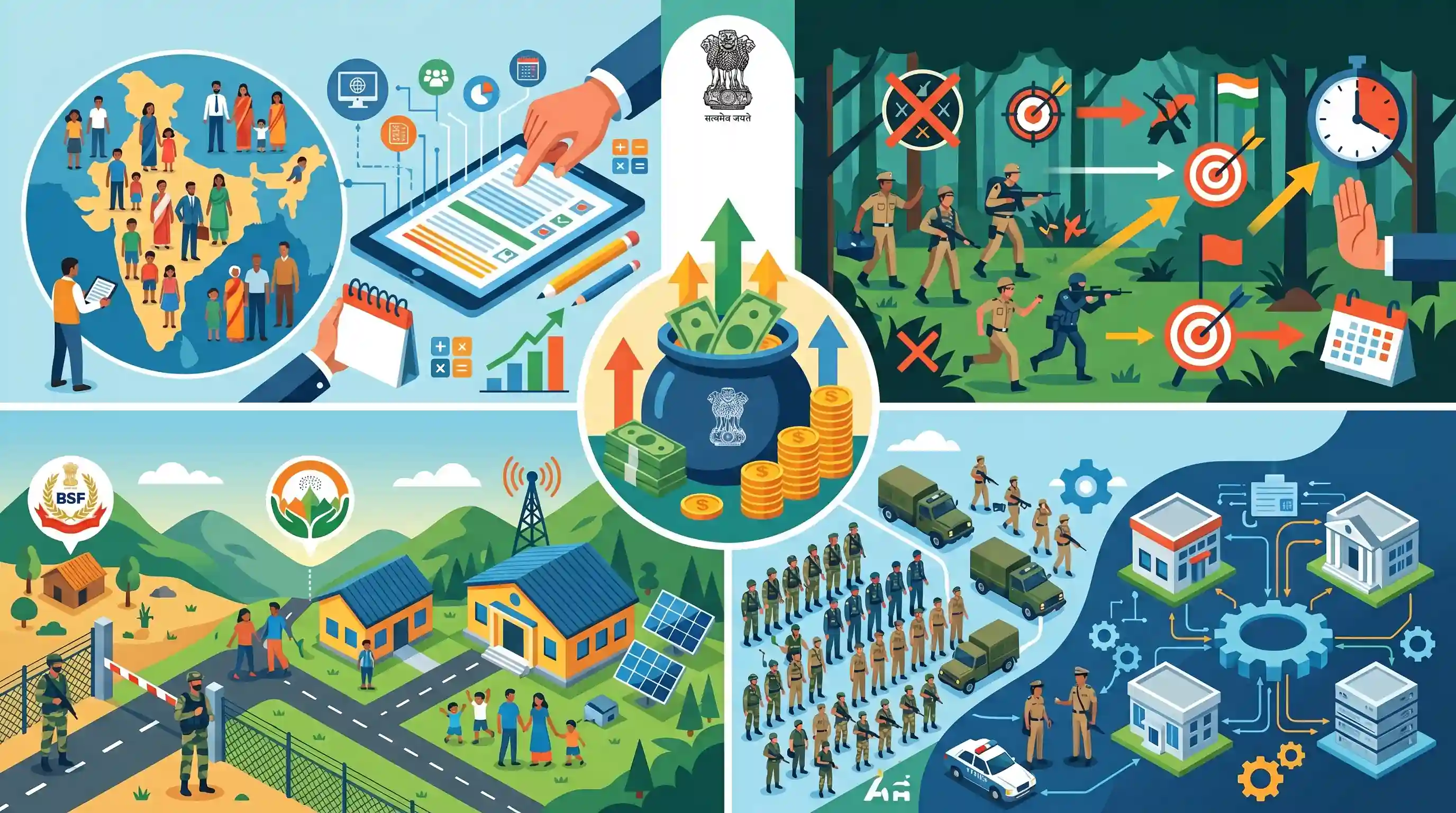
The Union Budget for 2026-27 has hiked the Ministry of Home Affairs' (MHA) allocation by over 9%, directing funds largely toward internal security intelligence, border area development, and demographic administration. A centerpiece of this budget is the massive allocation to the Population Census 2027, which will be India's first digital and caste-based census since independence. Furthermore, the Intelligence Bureau's budget has seen a steep rise, alongside targeted funding to eradicate Left Wing Extremism, modernize the criminal justice system via platforms like ICJS, and secure strategic borders through the Vibrant Villages Programme and CAPF infrastructure enhancements.
Key Points
- The MHA budget for 2026-27 saw a 9.44% increase to ₹2,55,233.53 crore, highlighting an enhanced focus on internal security and intelligence.
- The Population Census 2027 received ₹6,000 crore to conduct India's first digital census, which will distinctively include caste enumeration for the first time in independent India.
- The Intelligence Bureau’s budget was heavily augmented, rising to ₹6,782 crore to strengthen domestic intelligence collection and threat analysis.
- Border infrastructure and internal security remain priorities, with significant outlays for CAPF infrastructure (₹5,040 crore), the Vibrant Villages Programme (₹300 crore), and anti-Naxal initiatives (₹3,610.80 crore).
- Technological integration of policing and judiciary gets continued backing via allocations for the Interoperable Criminal Justice System (ICJS) and CCTNS.
Important Terms
Population Census 2027

India's 16th decennial census and the first to be fully digital. It uniquely includes comprehensive caste enumeration for the first time since 1931 to aid socio-economic policy and resource allocation.
UPSC context
GS Paper I (Population/Demography) and GS II (Governance). Tests understanding of data-driven policy and federalism.
Vibrant Villages Programme (VVP)
A scheme for the holistic development of villages along India's international borders. It improves infrastructure and livelihoods to prevent out-migration and empowers residents as "eyes and ears" for border guarding forces.
UPSC context
GS Paper III (Internal Security/Border Management). Tests strategies for securing frontiers and developmental interventions in sensitive regions.
Interoperable Criminal Justice System (ICJS)
A national platform integrating five criminal justice pillars—Police, e-Forensics, e-Courts, e-Prosecution, and e-Prisons. It operates on a "one data, one entry" principle to enable seamless information sharing and speedier justice delivery.
UPSC context
GS Paper II/III (Governance/Security). Tests e-governance in policing and technology's role in criminal justice reforms.
Security Related Expenditure (SRE)
A Home Ministry scheme that reimburses states for recurring costs in extremist-affected areas. It covers operational needs, ex-gratia payments, community policing, and rehabilitation of surrendered cadres to strengthen anti-extremist capacities.
UPSC context
GS Paper III (Internal Security). Tests the fiscal and operational partnership between Centre and States in managing Left Wing Extremism.
Intelligence Bureau (IB)
India's premier internal intelligence agency under the Ministry of Home Affairs. It gathers domestic intelligence, executes counter-terrorism tasks, and monitors border security to maintain national security and internal stability.
UPSC context
GS Paper III (Internal Security). Tests knowledge of India's security architecture and the mandates of intelligence bodies.
Special Infrastructure Scheme (SIS) for LWE Areas
A sub-scheme of 'Modernization of Police Forces' providing funds to extremist-affected states. It focuses on strengthening state intelligence branches, special forces, and constructing fortified police stations to enhance security infrastructure.
UPSC context
GS Paper III (Internal Security). Tests tactical measures and infrastructure-led strategies to combat domestic extremism.
Prelims Trap
The decennial population census is a statutory duty placed in the Concurrent List, making states equal partners.
The Census falls exclusively under the Union List (Entry 69). While state machinery helps execute it, the mandate, methodology, and legal framework belong entirely to the Union under the Census Act, 1948.
Static Concepts Connected
What is the constitutional and statutory backing for the Census of India?
- Union List: Entry 69 of the Seventh Schedule places the Census exclusively under the Union government's legislative and executive jurisdiction.
- Statutory Framework: Conducted under the Census Act of 1948, which guarantees respondent data confidentiality and outlines penalties for non-compliance by citizens or officials.
- Periodicity Rule: The Constitution and the 1948 Act do not explicitly mandate a rigid 10-year cycle, technically allowing the Centre flexibility in scheduling, despite the historical decennial convention.
What are the core pillars integrated under the Inter-operable Criminal Justice System (ICJS)?
- Five Pillars: It seamlessly integrates Police (via CCTNS), e-Prisons, e-Courts, Forensics (FSL), and Prosecution systems onto a single unified digital platform.
- Nodal Agencies: The project is implemented by the National Crime Records Bureau (NCRB) with technical infrastructure and support provided by the National Informatics Centre (NIC).
- Data Principle: It operates on the principle of 'one data, one entry', ensuring that information entered at the police station level is instantly available to courts and prisons without manual re-entry.
Cross-Topic Patterns
Census 2027 and Electoral Delimitation
The upcoming demographic data will serve as the baseline for the impending delimitation of Lok Sabha constituencies, directly linking this MHA budget to federalism and political representation debates.
Caste Enumeration & Affirmative Action
Official caste data from the 2027 Census could provide the empirical basis needed to challenge the 50% reservation ceiling set by the Indira Sawhney judgment, intertwining demography with Constitutional law.
Vibrant Villages vs Xiaokang Villages
The Vibrant Villages Programme counters China's 'Xiaokang' border settlements. Preventing out-migration from Indian border villages transforms local populations into strategic intelligence assets and physical security buffers.

Expect a 2026 Prelims question integrating Census 2027’s Union List status, digital methodology, and the Census Act's periodicity rules.
Linked PYQs · 4
Linked PYQs · 4
- 2023MainsGS3
What are the internal security challenges being faced by India? Give out the role of Central Intelligence and Investigative Agencies tasked to counter such threats.
- 2022MainsGS3
Naxalism is a social, economic and developmental issue manifesting as a violent internal security threat. In this context, discuss the emerging issues and suggest a multilayered strategy to tackle the menace of Naxalism.
- 2024MainsGS3
India has a long and troubled border with China and Pakistan fraught with contentious issues. Examine the conflicting issues and security challenges along the border. Also give out the development being undertaken in these areas under the Border Area Development Programme (BADP) and Border Infrastructure and Management (BIM) Scheme.
- 2020MainsGS3
For effective border area management, discuss the steps required to be taken to deny local support to militants and also suggest ways to manage favourable perception among locals.
