Home Ministry Budget Rises With Focus on Internal Security
Source:The Hindu ↗
Why It Matters
The article provides crucial data points on the government's internal security allocations, insights into border development programs like the Vibrant Villages Programme, and details about the historic 2027 digital caste census, which are highly relevant for GS-1, GS-2, and GS-3 answers.
Summary
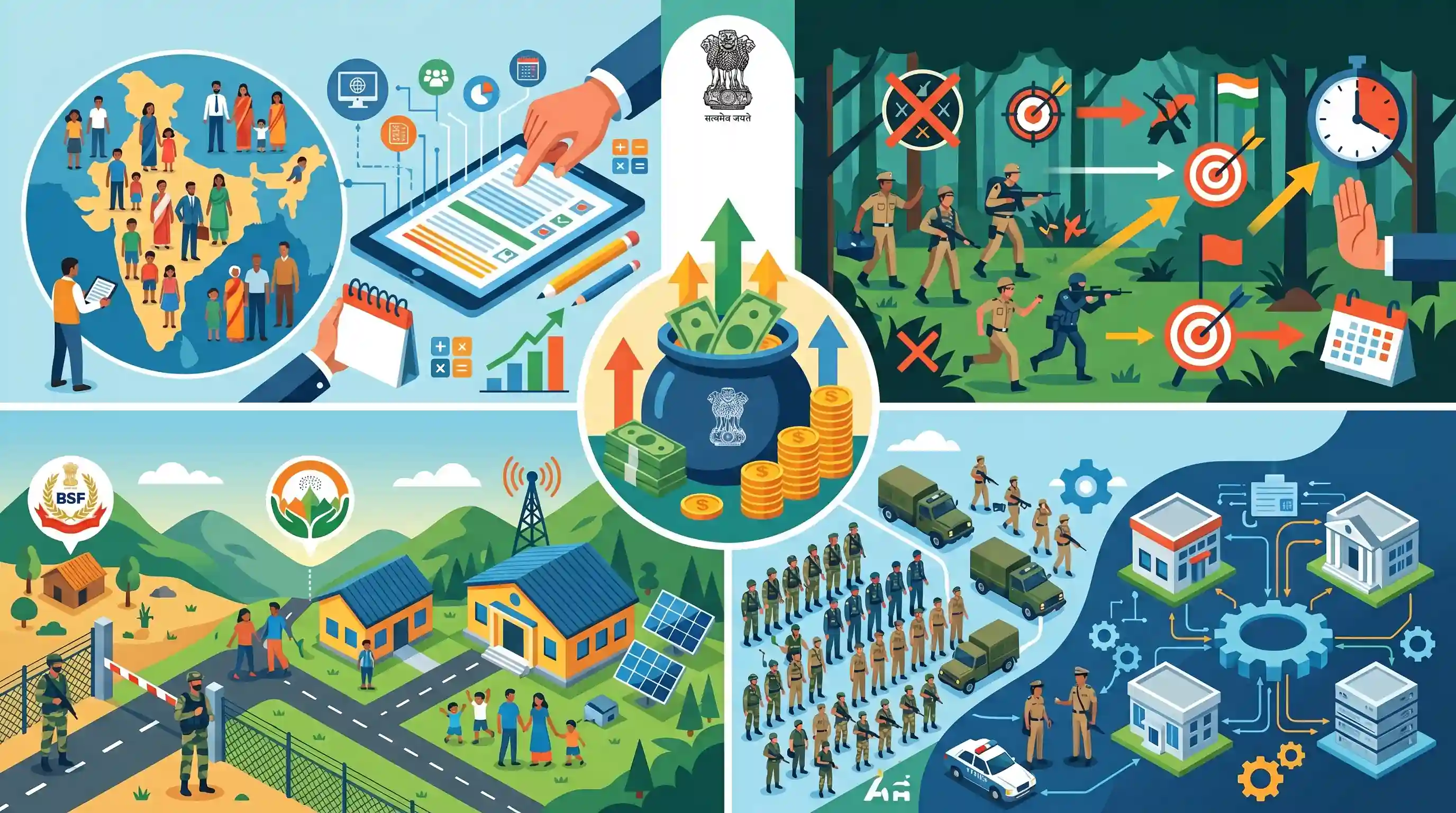
The Union Budget 2026-27 outlines a 9.44% increase in the Ministry of Home Affairs' allocation to ₹2.55 lakh crore, reinforcing India's internal security and strategic priorities. Major allocations include ₹6,000 crore for the landmark Population Census 2027, set to be the nation's first digital and caste-based census. The budget aggressively targets internal security challenges, setting aside ₹3,610.80 crore to meet a March 31 deadline for eradicating Left Wing Extremism (Naxalism). Additionally, border infrastructure gets a boost with ₹300 crore for the Vibrant Villages Programme, while the CAPFs receive robust support totaling ₹1.73 lakh crore. Significant funds are also directed towards modernizing state police forces and implementing the Interoperable Criminal Justice System (ICJS).
Key Points
- The MHA's budget for 2026-27 has increased by 9.44% to ₹2,55,233.53 crore, with the Intelligence Bureau (IB) seeing an enhanced allocation of ₹6,782 crore.
- ₹6,000 crore has been earmarked for the Population Census 2027, which will be India's first digital census and the first to enumerate caste in independent India.
- To combat Left Wing Extremism (LWE), ₹3,610.80 crore is allocated, supporting the government's March 31 deadline to eradicate Naxalism.
- Border management and security have been fortified with ₹300 crore for the Vibrant Villages Programme (VVP) and a massive ₹1.73 lakh crore outlay for CAPFs.
- ₹550 crore was allocated to the Interoperable Criminal Justice System (ICJS) to enhance data sharing between police, courts, and prisons under the new criminal laws.
Important Terms
Population Census 2027

India's 16th decennial census and first fully digital count. It features mobile-based data collection and includes comprehensive caste enumeration (beyond SC/STs) for the first time since 1931.
UPSC context
GS Paper 1 (Demographics) & Paper 2 (Governance); tests understanding of social data and evidence-based policymaking.
Vibrant Villages Programme (VVP)
A centrally sponsored scheme for holistic development of villages along the northern border. It aims to boost infrastructure and livelihoods to prevent outmigration and enhance security resilience.
UPSC context
GS Paper 3 (Border Management); crucial for understanding strategic infrastructure and community-led security.
Interoperable Criminal Justice System (ICJS)
A national platform integrating five pillars—Police, e-Forensics, e-Courts, e-Prosecution, and e-Prisons. Phase II employs the 'one data, one entry' principle for seamless information sharing among criminal justice agencies.
UPSC context
GS Paper 2 (Governance) & Paper 3 (Internal Security); relevant for police reforms and digitizing the judiciary.
Special Infrastructure Scheme (SIS) for LWE Areas
A sub-scheme of 'Modernization of Police Forces' providing funds for strengthening State Intelligence Branches, Special Forces, and constructing fortified police stations in regions affected by Naxalism.
UPSC context
GS Paper 3 (Internal Security); tests knowledge of counter-insurgency strategies and infrastructure gaps in extremist zones.
Central Armed Police Forces (CAPF)
Collective name for seven security forces (BSF, CRPF, CISF, ITBP, SSB, NSG, AR) under the Ministry of Home Affairs, tasked with border guarding, counter-insurgency, and internal security.
UPSC context
GS Paper 3 (Security Forces and their Mandate); fundamental to India's internal security architecture.
Intelligence Bureau (IB)
India's premier domestic intelligence agency under the Ministry of Home Affairs. It is responsible for internal security, counter-terrorism, counter-intelligence, and gathering intelligence within the country.
UPSC context
GS Paper 3 (Security Forces and their Mandate); central to understanding India's intelligence-led security operations.
Prelims Trap
"The Vibrant Villages Programme aims to develop border villages across all of India's international land borders."
VVP specifically targets only the Northern border (facing China) across four states (AR, SK, UK, HP) and one UT (Ladakh). It does not cover other borders.
Static Concepts Connected
What is the Interoperable Criminal Justice System (ICJS)?
- Five Pillars: Seamlessly integrates IT systems of five pillars: Police (CCTNS), e-Forensics, e-Courts, e-Prosecution, and e-Prisons.
- Implementing Agency: Implemented by the National Crime Records Bureau (NCRB) with technical assistance from the National Informatics Centre (NIC).
- Core Objective: Enables national-level search of records across all pillars, reducing delays in trial and investigation.
What are the constitutional and statutory backings for the Indian Census?
- Statutory Backing: Conducted under the provisions of the Census Act, 1948, which ensures confidentiality of the data collected.
- Constitutional Mandate: Article 246 empowers the Union to conduct the census (Entry 69 of the Union List in the 7th Schedule).
- Nodal Ministry: Executed by the Office of the Registrar General and Census Commissioner, under the Ministry of Home Affairs.
Cross-Topic Patterns
China's border strategy vs VVP
VVP acts as a strategic counter to China's 'Xiaokang' (model villages) along the LAC, transforming civilian demographic presence into a geopolitical border defense tool.
Judicial tech & new criminal laws
ICJS funding directly supports the technology infrastructure needed to implement the mandatory digital timelines and evidence sharing mandated by the new Bharatiya Nyaya Sanhita (BNS).
Security-Development Nexus in LWE
The aggressive deadline to eradicate Left Wing Extremism ties security enforcement with GS2 developmental schemes like the Aspirational Districts Programme, reflecting the security-development nexus.

A 2026 Prelims question will likely test the exact states covered under VVP alongside the statutory provisions governing the 2027 Census.
Linked PYQs · 5
Linked PYQs · 5
- 2022MainsGS3
Naxalism is a social, economic and developmental issue manifesting as a violent internal security threat. In this context, discuss the emerging issues and suggest a multilayered strategy to tackle the menace of Naxalism.
- 2018MainsGS3
Left Wing Extremism (LWE) is showing a downward trend, but still affects many parts of the country. Briefly explain the Government of India's approach to counter the challenges posed by LWE.
- 2024MainsGS3
India has a long and troubled border with China and Pakistan fraught with contentious issues. Examine the conflicting issues and security challenges along the border. Also give out the development being undertaken in these areas under the Border Area Development Programme (BADP) and Border Infrastructure and Management (BIM) Scheme.
- 2020MainsGS3
For effective border area management, discuss the steps required to be taken to deny local support to militants and also suggest ways to manage favourable perception among locals.
- 2016MainsGS3
Border management is a complex task due to difficult terrain and hostile relations with some countries. Elucidate the challenges and strategies for effective border management.
