Madhya Pradesh Implements PM E-DRIVE Scheme for Electric Vehicles
Source:the-tribune ↗
Why It Matters
MPPSC Prelims consistently tests candidates on state-level achievements under central government schemes, the objectives of major economic programs like PLI and PM E-DRIVE, and their financial outlays. Understanding the transition policies towards electric mobility is critical for both the Economy and Environment sections.
Summary
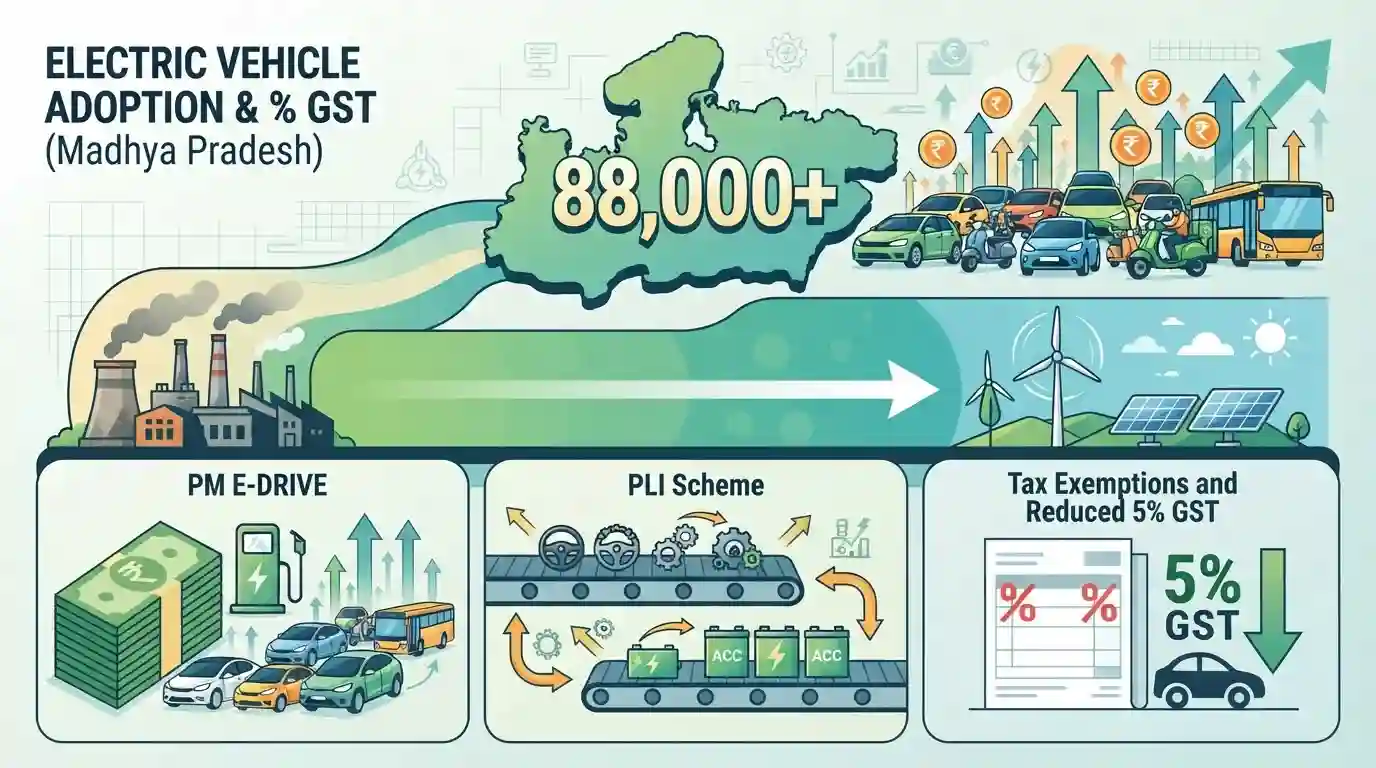
More than 88,000 electric vehicles were subsidized in Madhya Pradesh in the 2025-26 financial year under the newly launched PM E-DRIVE scheme. Replacing the FAME India Phase-II initiative, the PM E-DRIVE scheme has a financial outlay of ₹10,900 crore. To further support EV adoption, the central government has also introduced Production Linked Incentive (PLI) schemes for automobile components and Advanced Chemistry Cell (ACC) battery manufacturing, alongside tax exemptions and a reduced 5% GST on EVs.
Key Points
- A total of 88,209 electric vehicles (EVs) were subsidized in Madhya Pradesh during FY 2025-26 under the PM E-DRIVE scheme out of 94,277 EVs deployed in the state.
- No electric buses were allocated to Madhya Pradesh under the PM E-DRIVE scheme.
- The FAME India Phase-II scheme operated from April 1, 2019, to March 31, 2024, with a budget outlay of ₹11,500 crore to promote electric mobility.
- The PM E-DRIVE (Electric Drive Revolution in Innovative Vehicle Enhancement) scheme was approved in September 2024 with a financial outlay of ₹10,900 crore over two years.
- The government has also implemented PLI schemes for Automobile (₹25,938 crore) and Advanced Chemistry Cell (ACC) Battery Storage (₹18,100 crore) to build a domestic EV ecosystem.
- EVs and their chargers benefit from a reduced GST rate of 5%, exemption from road tax in multiple states, and the mandate of green license plates.
Important Terms
PM E-DRIVE Scheme

An initiative with an initial ₹10,900 crore outlay (recently extended with ₹11,900 crore) replacing FAME-II to accelerate EV adoption. It subsidizes electric two/three-wheelers, buses, and trucks, and funds widespread charging infrastructure.
UPSC context
GS-3 (Environment/Economy). Crucial for India's e-mobility transition, reducing fossil fuel dependence, and achieving Net-Zero 2070 goals.
FAME India Phase-II
The Faster Adoption and Manufacturing of (Hybrid &) Electric Vehicles Phase-II was a central scheme (2019-2024) with an ₹11,500 crore outlay that subsidized over 1.6 million EVs and deployed public charging stations.
UPSC context
GS-3. Tests knowledge of the foundational policy framework and historical evolution of India's push for hybrid and electric vehicle adoption.
PLI Scheme for Automobile and Auto Component Industry
A ₹25,938 crore Production Linked Incentive scheme launched to boost domestic manufacturing of Advanced Automotive Technology (AAT) products, including electric and hydrogen fuel cell vehicles, requiring minimum 50% domestic value addition.
UPSC context
GS-3 (Economy/Manufacturing). Highlights India's Atmanirbhar Bharat push, industrial policy, and transition towards advanced global automotive supply chains.
PLI Scheme for National Programme on Advanced Chemistry Cell (ACC) Battery Storage
An ₹18,100 crore PLI scheme aiming to establish 50 GWh of domestic advanced chemistry cell manufacturing capacity. It seeks to reduce India's heavy import reliance for EV batteries and grid storage.
UPSC context
GS-3 (Science & Tech/Energy). Critical for evaluating India's energy security, technological self-reliance, and localized EV supply chains.
PM e-Bus Sewa-Payment Security Mechanism (PSM) Scheme
A ₹3,435 crore initiative facilitating the deployment of over 38,000 electric buses. It establishes a dedicated fund to guarantee payments to e-bus operators, mitigating default risks by public transport authorities.
UPSC context
GS-3 (Infrastructure/Urbanization). Tests knowledge of innovative financial mechanisms and public-private partnerships driving sustainable urban mass transit.
Prelims Trap
Electric vehicles and their charging infrastructure are fully exempted from Goods and Services Tax (GST) in India.
EVs and chargers attract a reduced GST rate of 5%, not a full exemption. It is the state-level road taxes and registration fees that are often fully exempted.
Static Concepts Connected
What are the key pillars of India's EV promotion strategy?
- Demand Incentives: Schemes like PM E-DRIVE (replacing FAME-II) subsidize upfront purchasing costs for consumers and fleet operators.
- Supply-side Push: Production Linked Incentive (PLI) schemes for Automobiles and Advanced Chemistry Cells (ACC) localize manufacturing.
- Tax Rationalization: Lowering GST to the 5% slab and mandating green license plates for preferential state-level road tax waivers.
What is the Advanced Chemistry Cell (ACC) Battery Storage PLI Scheme?
- Nodal Ministry: Administered by the Ministry of Heavy Industries to build a domestic EV ecosystem.
- Target Capacity: Aims to achieve 50 GWh of domestic battery manufacturing capacity.
- Core Objective: Reduce import dependency on critical minerals and components necessary for EV batteries, buffering against global supply shocks.
Cross-Topic Patterns
EV Policy + Critical Minerals
The success of the ACC Battery PLI directly hinges on securing Lithium and Cobalt, tying EV adoption to India's mining joint venture KABIL and international critical mineral partnerships.
Fiscal Federalism in Green Transition
Central schemes (PM E-DRIVE, PLI) provide capital and manufacturing subsidies, while states manage revenue foregone via road tax exemptions, illustrating joint fiscal burdens in climate action.

A 2026 prelims question will likely contrast PM E-DRIVE against FAME-II, specifically targeting eligible vehicle categories and GST slabs.
Linked PYQs · 2
Linked PYQs · 2
- 2025MPPSC_PRELIMSGS1
What is the main goal of the Udayam Kranti Yojna?
- 2024MPPSC_PRELIMSGS1
UNNATI (Agri-GISl project of Madhya Pradesh Government is for :
