Urban Infrastructure Resilience and Monsoon Challenges in Ahmedabad
Source:Indian Express ↗
Why It Matters
Frequent failure of urban infrastructure during monsoons is a recurrent issue in Indian cities. It connects to GS-3 (Infrastructure and Disaster Management) and GS-2 (Role of Urban Local Bodies), highlighting the need for climate-resilient planning and administrative accountability.
Summary
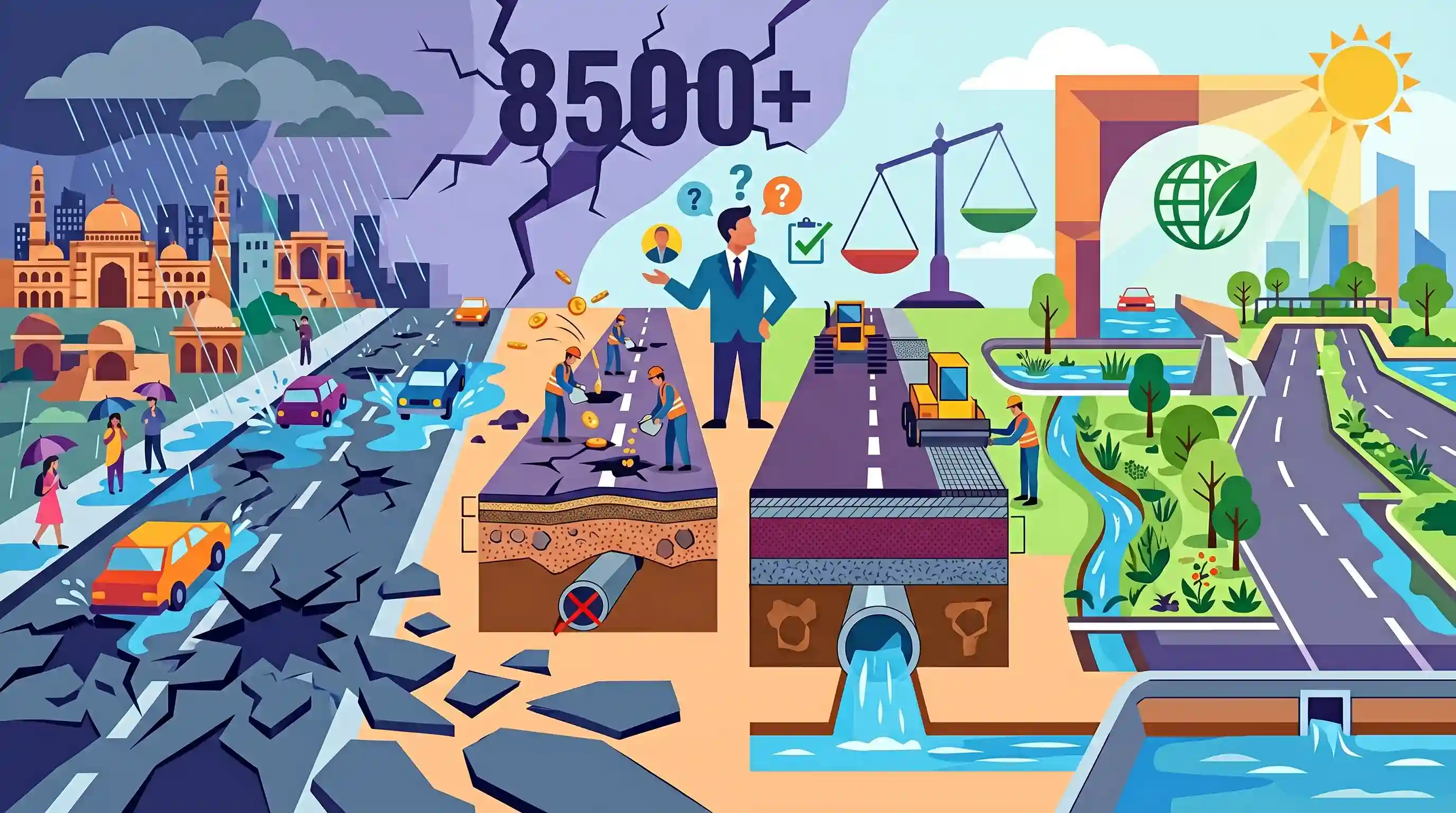
The emergence of over 8,500 potholes in Ahmedabad following the monsoon season has exposed the vulnerability of urban road infrastructure to extreme weather events. The widespread damage highlights a pressing need for long-term road resilience, focusing on superior construction quality, effective drainage systems, and climate-adaptive urban planning. Furthermore, the recurring infrastructure failure brings into question the accountability of Urban Local Bodies (ULBs) and the economic cost of repeated, short-term road repairs.
Key Points
- The monsoon season has severely damaged road infrastructure in Ahmedabad, leading to the formation of over 8,500 potholes.
- The recurring damage underscores the need for long-term, climate-resilient road infrastructure rather than temporary, reactive repairs.
- The situation raises concerns regarding the quality of materials used, construction standards, and the accountability of Urban Local Bodies (ULBs).
- Effective urban planning, including robust drainage systems, is essential to mitigate the impact of changing monsoon patterns on city infrastructure.
Important Terms
Urban Local Bodies (ULBs)

Constitutional third-tier of government in India (Articles 243P-243ZG) responsible for local urban governance and providing basic civic amenities like water, sanitation, and urban planning.
UPSC context
GS Paper II (Governance); tests understanding of democratic decentralization, the 74th Amendment, and challenges like fiscal autonomy and parallel agencies.
Climate Resilience
The capacity of urban systems to withstand, adapt to, and recover from climate-related shocks—such as extreme rainfall or heatwaves—while maintaining essential functions and services.
UPSC context
GS Paper III (Environment/Disaster Management); tests knowledge of sustainable urban planning and long-term adaptation strategies against climate change.
Urban Infrastructure
The physical and organizational systems—including roads, drainage, and transport—essential for a city's economic functioning and societal well-being.
UPSC context
GS Paper III (Infrastructure); tests analysis of infrastructure deficits, funding models, and their impact on India's economic growth targets.
Ahmedabad Municipal Corporation (AMC)
The specific Municipal Corporation responsible for Ahmedabad's civic administration and infrastructure, operating under the Bombay Provincial Municipal Corporation Act, 1949.
UPSC context
GS Paper II (Governance); serves as a case study for evaluating the efficiency and accountability of major Indian Municipal Corporations.
Drainage Systems
Integrated systems designed to manage surface runoff in cities; it is a mandatory municipal function under the Twelfth Schedule of the Indian Constitution.
UPSC context
GS Paper III (Disaster Management); critical for discussing man-made disasters like urban flooding and the maintenance of road durability.
Disaster Management
The systematic process of preparing for, mitigating, and responding to urban hazards, shifting from reactive relief to proactive resilience-building.
UPSC context
GS Paper III; tests familiarity with frameworks like the Sendai Framework and NDMA guidelines for managing urban-specific disasters.
Prelims Trap
The 12th Schedule grants Urban Local Bodies exclusive maintenance jurisdiction over all roads, including National Highways, within municipal limits.
While the 12th Schedule lists "roads and bridges," National and State Highways within city limits are generally maintained by NHAI or State PWDs, not ULBs.
Static Concepts Connected
What is the constitutional mandate for urban infrastructure under the 74th Amendment?
- 12th Schedule: Added by the 74th CAA 1992, it contains 18 functional items devolved to municipalities.
- Roads and Bridges: Explicitly listed as Item 4, placing the primary onus of city road construction and maintenance on ULBs.
- Urban Planning: Item 1 includes town planning, mandating the integration of road networks, drainage, and spatial growth into broader city master plans.
How does the Sendai Framework for Disaster Risk Reduction address critical urban infrastructure?
- Target D: Aims to substantially reduce disaster damage to critical infrastructure and disruption of basic services (like transport networks) by 2030.
- Build Back Better: Promotes integrating disaster risk reduction measures into the restoration and upgrading of physical infrastructure post-disaster.
- Local DRR Strategies: Target E requires local governments (including ULBs) to develop and implement their own localized disaster risk reduction strategies.
Cross-Topic Patterns
Climate shifts + Obsolete IDF curves
Changing rainfall intensity renders historical Intensity-Duration-Frequency (IDF) curves obsolete, linking climate change directly to municipal drainage failure and subsequent bitumen degradation on roads.
Solid waste + Road infrastructure lifespan
Poor municipal solid waste disposal chokes stormwater drains, causing waterlogging. Prolonged water stagnation strips bitumen, directly connecting urban sanitation failures to massive infrastructure and economic losses.

Expect a 2026 Prelims statement linking 12th Schedule municipal mandates with the Sendai Framework's Target D for resilience.
Linked PYQs · 5
Linked PYQs · 5
- 2024MainsGS3
Flooding in urban areas is an emerging climate-induced disaster. Discuss the causes of this disaster. Mention the features of two such major floods in the last two decades in India. Describe the policies and frameworks in India that aim at tackling such floods.
- 2024MainsGS3
What is disaster resilience? How is it determined? Describe various elements of a resilience framework. Also mention the global targets of Sendai Framework for Disaster Risk Reduction (2015–2030).
- 2024MainsGS2
Analyse the role of local bodies in providing good governance at local level and bring out the pros and cons merging the rural local bodies with the urban local bodies.
- 2016MainsGS1
Major cities of India are becoming more vulnerable to flood conditions. Discuss.
- 2020MainsGS1
Account for the huge flooding of million cities in India including the smart ones like Hyderabad and Pune. Suggest lasting remedial measures.
