Swasth Nari Sashakt Parivar Abhiyaan and Grassroots Health Screenings
Source:The Hindu ↗
Why It Matters
Public health screening at a massive scale serves as a crucial metric for evaluating India’s preventative healthcare capabilities and success toward Universal Health Coverage (UHC). The reliance on community-level institutions like Ayushman Arogya Mandirs makes this directly applicable to Mains questions assessing state capacity in tackling NCDs and maternal healthcare delivery.
Summary
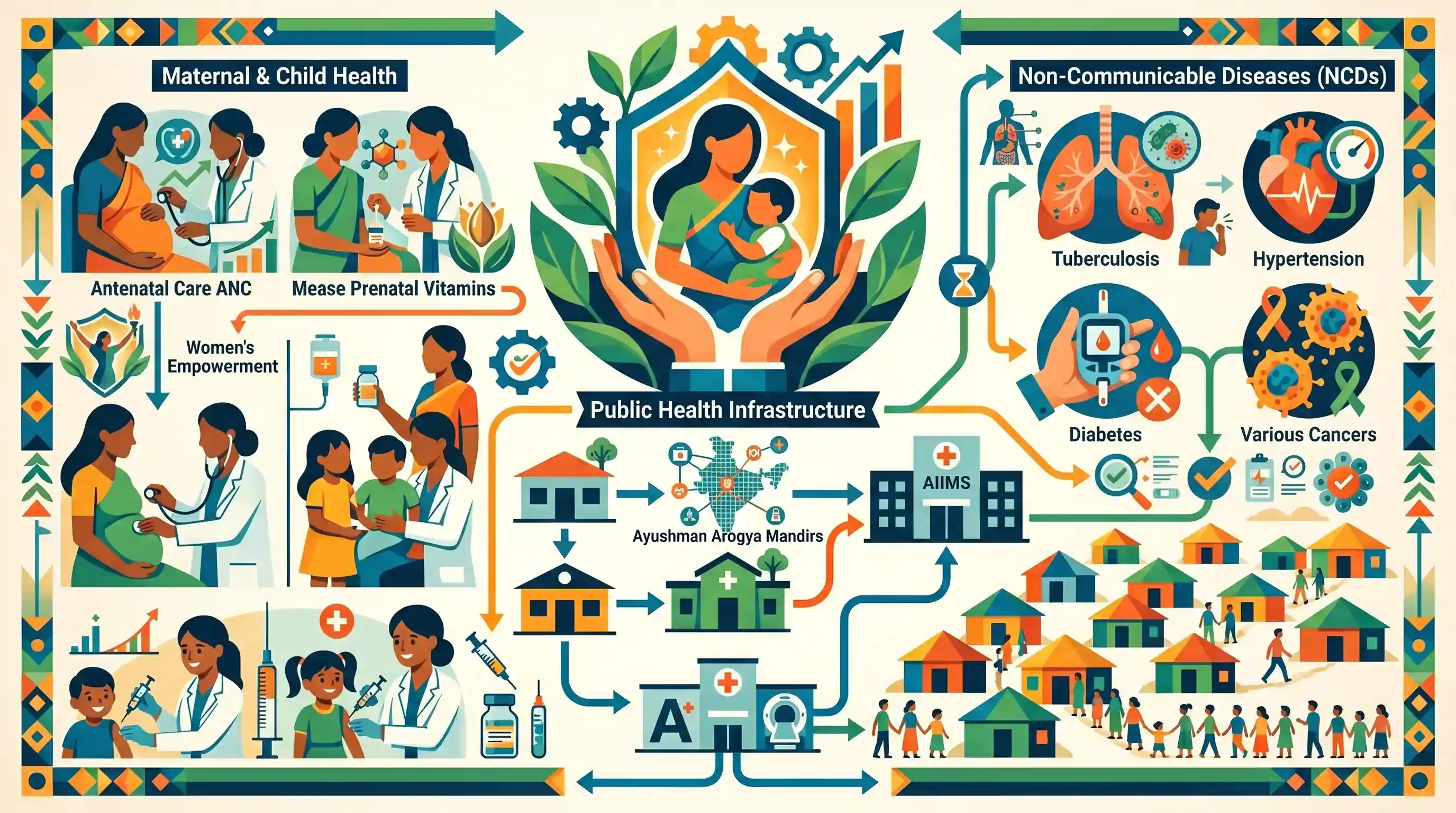
The Union Health Ministry’s ‘Swasth Nari, Sashakt Parivar Abhiyaan’ has successfully mobilized grassroots healthcare infrastructure to conduct mass screenings and health interventions across India. Over 2.83 lakh camps successfully brought preventative diagnostics to local populations, screening millions for diabetes, hypertension, tuberculosis, and various cancers. Utilizing the footprint of Ayushman Arogya Mandirs, AIIMS, and NHM, the initiative also heavily focused on empowering women and maternal health through extensive antenatal care and immunization delivery.
Key Points
- Since its launch on September 17, the 'Swasth Nari, Sashakt Parivar Abhiyaan' has facilitated over 2.83 lakh health camps across India, attracting more than 76 lakh citizens.
- The initiative targets early screening and intervention for non-communicable diseases (NCDs) like hypertension, diabetes, and cancers (breast, cervical, oral).
- Significant progress was also reported in combating communicable diseases and genetic blood disorders, screening millions for tuberculosis, anaemia, and sickle cell disease.
- Maternal and child healthcare was bolstered through 18 lakh+ antenatal check-ups and 51 lakh+ childhood vaccinations, in addition to the issuance of 4.7 lakh new Ayushman/PM-JAY cards.
Important Terms
Swasth Nari, Sashakt Parivar Abhiyaan

A joint initiative by the Health and WCD Ministries focused on women's and children's health. It utilizes mass camps for NCD screening, nutrition, and maternal care under a "Jan Bhagidaari" (public participation) approach.
UPSC context
GS Paper II (Health/Government Schemes); tests understanding of gender-specific health interventions and administrative convergence.
Ayushman Arogya Mandirs
The rebranded name for Ayushman Bharat Health and Wellness Centres (AB-HWCs). These facilities provide Comprehensive Primary Health Care (CPHC), focusing on preventive, promotive, and palliative services at the grassroots level.
UPSC context
GS Paper II (Social Sector-Health); tests knowledge of primary healthcare infrastructure and the transition from curative to wellness-centric models.
National Health Mission (NHM)
India's flagship umbrella health program that subsumes the Rural (NRHM) and Urban (NUHM) missions. It provides a framework for strengthening health systems and improving maternal, neonatal, and child health indicators.
UPSC context
GS Paper II (Government Policies); essential for questions on institutional frameworks, public health delivery, and national health targets.
Non-Communicable Diseases (NCDs)
Chronic conditions like diabetes, hypertension, and cancer that are not transmissible. They account for a majority of India's disease burden and are a primary target of screenings in community health camps.
UPSC context
GS Paper II (Issues relating to Health); tests awareness of India’s epidemiological shift and preventative healthcare challenges.
Antenatal Care (ANC)
Comprehensive healthcare for pregnant women aimed at ensuring safe delivery. It includes at least four clinical visits for screenings (BP, blood, urine), tetanus vaccination, and iron-folic acid supplementation.
UPSC context
GS Paper II (Health/Women); critical for discussions on Maternal Mortality Ratio (MMR) and Sustainable Development Goal 3.
Ministry of Health and Family Welfare (MoHFW)
The nodal central ministry responsible for formulating health policy, implementing national health programs, managing family planning, and overseeing medical education and public health infrastructure in India.
UPSC context
GS Paper II (Ministries/Departments); tests knowledge of the administrative structure responsible for social sector development.
Prelims Trap
"Swasth Nari, Sashakt Parivar Abhiyaan is exclusively implemented by the Health Ministry to provide tertiary care for women."
The campaign is a joint initiative by MoHFW and MoWCD, integrated with Rashtriya Poshan Maah. It focuses heavily on primary and preventive care, not tertiary treatment.
Static Concepts Connected
What are the two foundational pillars of the Ayushman Bharat initiative?
- Primary Healthcare: Ayushman Arogya Mandirs (formerly HWCs) deliver comprehensive primary healthcare, including free essential drugs, diagnostics, and mandatory NCD screenings.
- Financial Protection: PM-JAY provides a cashless health insurance cover of ₹5 lakh per family per year for secondary and tertiary hospitalization to vulnerable households.
What are the characteristics and targets associated with Sickle Cell Disease in India?
- Genetic Disorder: It is an inherited autosomal recessive blood disorder that deforms red blood cells into a crescent shape, causing chronic anaemia and pain.
- Vulnerable Demography: It disproportionately affects India's tribal populations, particularly in states like Madhya Pradesh, Maharashtra, Chhattisgarh, and Gujarat.
- 2047 Target: The National Sickle Cell Anaemia Elimination Mission targets eradicating the disease as a public health problem by 2047.
Cross-Topic Patterns
Health-Nutrition Convergence Strategy
Merging the campaign with Rashtriya Poshan Maah shows a shift towards multi-sectoral convergence. It acknowledges that maternal nutrition (MoWCD) is the foundation for preventing communicable diseases like TB and maternal anaemia (MoHFW).
Epidemiological Transition in Rural India
Shifting rural healthcare from purely maternal/reproductive services to comprehensive NCD screening (cancers, diabetes) directly addresses the rising epidemiological transition burden in India's villages.

Multi-statement Q likely in 2026 linking Ayushman Arogya Mandirs' NCD mandate, Sickle Cell targets (2047), and MoHFW-MoWCD convergence.
Linked PYQs · 3
Linked PYQs · 3
- 2024MainsGS2
In a crucial domain like the public healthcare system the Indian State should play a vital role to contain the adverse impact of marketisation of the system. Suggest some measures through which the State can enhance the reach of public healthcare at the grassroots level.
- 2018MainsGS2
Appropriate local community-level healthcare intervention is a prerequisite to achieve 'Health for All' in India. Explain.
- 2020MainsGS2
In order to enhance the prospects of social development, sound and adequate health care policies are needed particularly in the fields of geriatric and maternal health care. Discuss.
