Government Primary School Closures and Education Infrastructure in UP
Source:thehindu ↗
Why It Matters
The condition of primary education infrastructure and learning outcomes in India's most populous state is crucial for human capital development. This issue touches upon SDG 4 (Quality Education), state-level governance efficacy, inclusivity for marginalized communities (SC, ST, OBC, minorities), and socio-economic indices evaluated by think tanks like NITI Aayog.
Summary
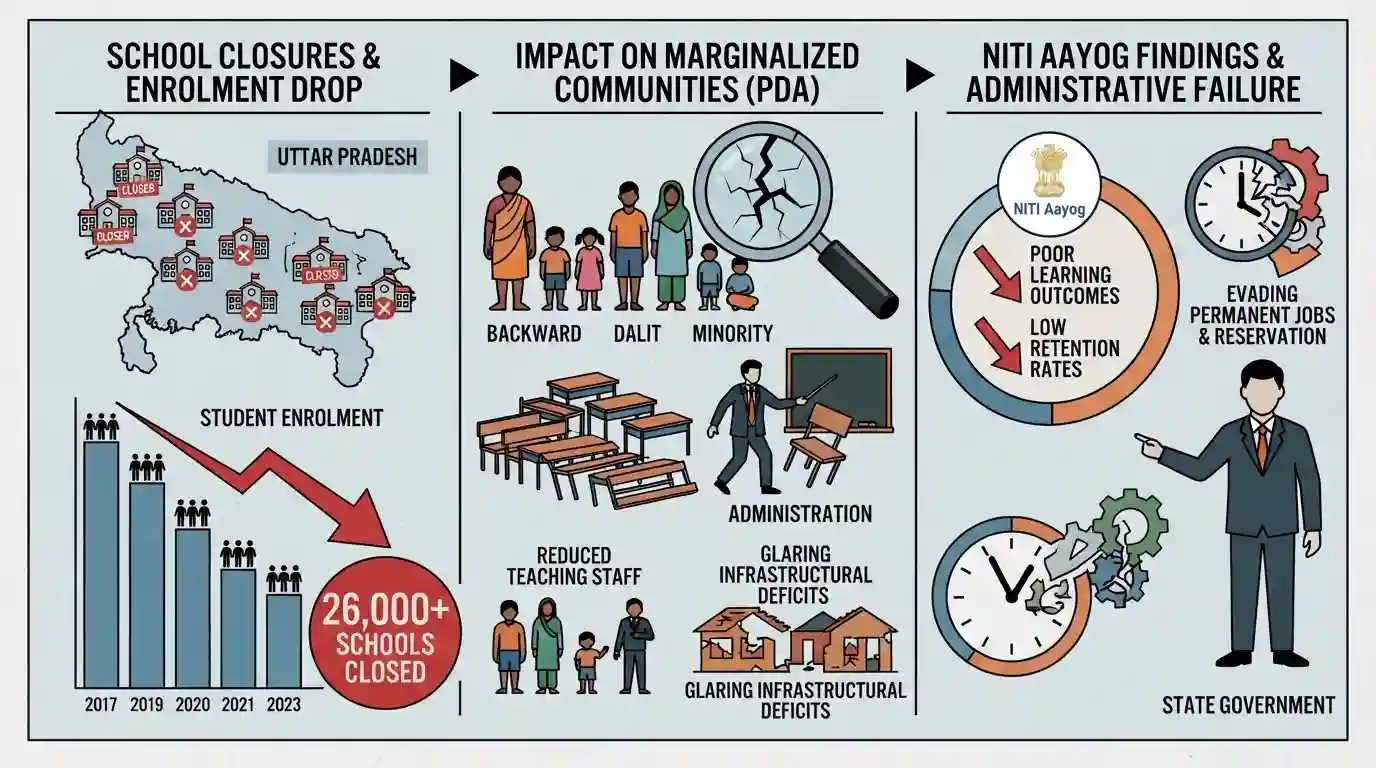
Samajwadi Party President Akhilesh Yadav alleged that the Uttar Pradesh government has closed over 26,000 government primary schools since 2017, severely impacting basic education. Citing a massive drop in student enrolment, a reduction in teaching staff, and glaring infrastructural deficits, Yadav accused the ruling BJP of intentionally undermining education to marginalize backward, Dalit, and minority communities (PDA) and evade providing permanent jobs or implementing reservations. He also pointed to NITI Aayog's findings on poor student retention and learning outcomes in the state as evidence of administrative failure.
Key Points
- Over 26,000 government primary schools have allegedly been shut down in Uttar Pradesh since 2017, with the highest numbers in Lakhimpur Kheri, Sitapur, Prayagraj, and Gorakhpur.
- Student enrolment in government primary schools dropped significantly from 1.17 crore in 2017 to approximately 89 lakh.
- There is a severe infrastructural deficit, with thousands of schools lacking electricity, girls' toilets, drinking water, and computers.
- The number of teachers has fallen from 4 lakh to 3.40 lakh, leaving roughly 81,000 vacancies.
- A NITI Aayog report was cited highlighting poor student retention and low learning outcomes in the state's schools.
- The school closures are alleged to disproportionately affect the PDA (Pichhde, Dalit, Alpasankhyak) communities, hindering their educational opportunities and access to government employment.
Important Terms
NITI Aayog

The premier policy think tank of the Government of India, established in 2015 to replace the Planning Commission, promoting cooperative federalism and sustainable development.
UPSC context
GS Paper II: Statutory, regulatory, and quasi-judicial bodies; planning, federalism, and policy formulation.
School Education Quality Index (SEQI)
An index developed by NITI Aayog to evaluate the performance of Indian States and Union Territories in the school education sector, emphasizing outcome-focused policy reforms.
UPSC context
GS Paper II: Issues relating to development and management of Social Sector/Services relating to Education.
Right to Education (RTE) Act, 2009
A landmark parliamentary act that operationalizes Article 21A, making free and compulsory elementary education a fundamental right for children aged 6 to 14.
UPSC context
GS Paper II: Welfare schemes, fundamental rights, and social sector management relating to education.
Bharatiya Janata Party (BJP)
A prominent national political party in India, recognized by the Election Commission of India, historically tracing its roots to the Bharatiya Jana Sangh founded in 1951.
UPSC context
GS Paper II: Representation of People’s Act and the role of national political parties in India’s democratic structure.
Samajwadi Party
A recognized state-level political party primarily active in Uttar Pradesh, founded in 1992 by Mulayam Singh Yadav, practicing a center-left socialist ideology.
UPSC context
GS Paper II: Regional political parties, voter representation, and federal-state dynamics in elections.
Prelims Trap
"NITI Aayog publishes the Annual Status of Education Report (ASER) to track foundational learning."
ASER is published by the NGO Pratham, not the government. NITI Aayog publishes the School Education Quality Index (SEQI). Do not conflate the two.
Static Concepts Connected
What are the core statutory mandates for primary schools under the RTE Act, 2009?
- Pupil-Teacher Ratio: Mandated at 30:1 for primary (Classes I-V) and 35:1 for upper primary (Classes VI-VIII) levels.
- Basic Infrastructure: Requires an all-weather building, separate functional toilets for boys and girls, barrier-free access, and safe drinking water.
- Instructional Hours: Minimum of 200 working days or 800 instructional hours per academic year for primary classes.
Which Constitutional provisions govern basic educational rights and duties in India?
- Article 21A: Added by the 86th Amendment (2002), making free and compulsory education for children aged 6-14 a Fundamental Right.
- Article 45 (DPSP): Directs the State to provide early childhood care and education for all children until they complete the age of six years.
- Article 51A(k): Places a Fundamental Duty on parents or guardians to provide educational opportunities to their children aged 6-14 years.
Cross-Topic Patterns
Demographic Dividend vs Burden
Poor foundational learning and mass school closures in populous states risk converting India's demographic dividend into a demographic disaster, directly impacting long-term macroeconomic growth and employment generation.
Competitive Federalism via Indices
NITI Aayog uses indices like SEQI and the Aspirational Districts Programme to rank states, shifting the governance model from input-based fund allocation to data-driven competitive federalism in social sectors.

Expect a 2026 Prelims multi-statement question linking RTE statutory Pupil-Teacher Ratios, NITI Aayog's SEQI metrics & ASER findings.
Linked PYQs · 3
Linked PYQs · 3
- 2024UPPSC_PRELIMSGS1
Which measures are essential to achieve Goal 4 of the Sustainable Development Targets, 2030? 1. Making education free and compulsory 2. Improving basic school infrastructure and embracing digital transformation 3. Expansion of agricultural programmes 4. Increasing investment in technology Select the correct answer from the codes given below:
- 2021UPPSC_PRELIMSGS1
How many districts of Uttar Pradesh has been covered under the Aspirational District Programme run by NITI Aayog, up to June, 2021?
- 2020UPPSC_PRELIMSGS1
According to the Report released by NITI Aayog in December 2019 on 'Sustainable Development Goals India Index 2019-20', the Uttar Pradesh is grouped under which of the following categories ?
