Shahapur Tribal Villages Cremation Ground Infrastructure Deficit
Source:etvbharat ↗
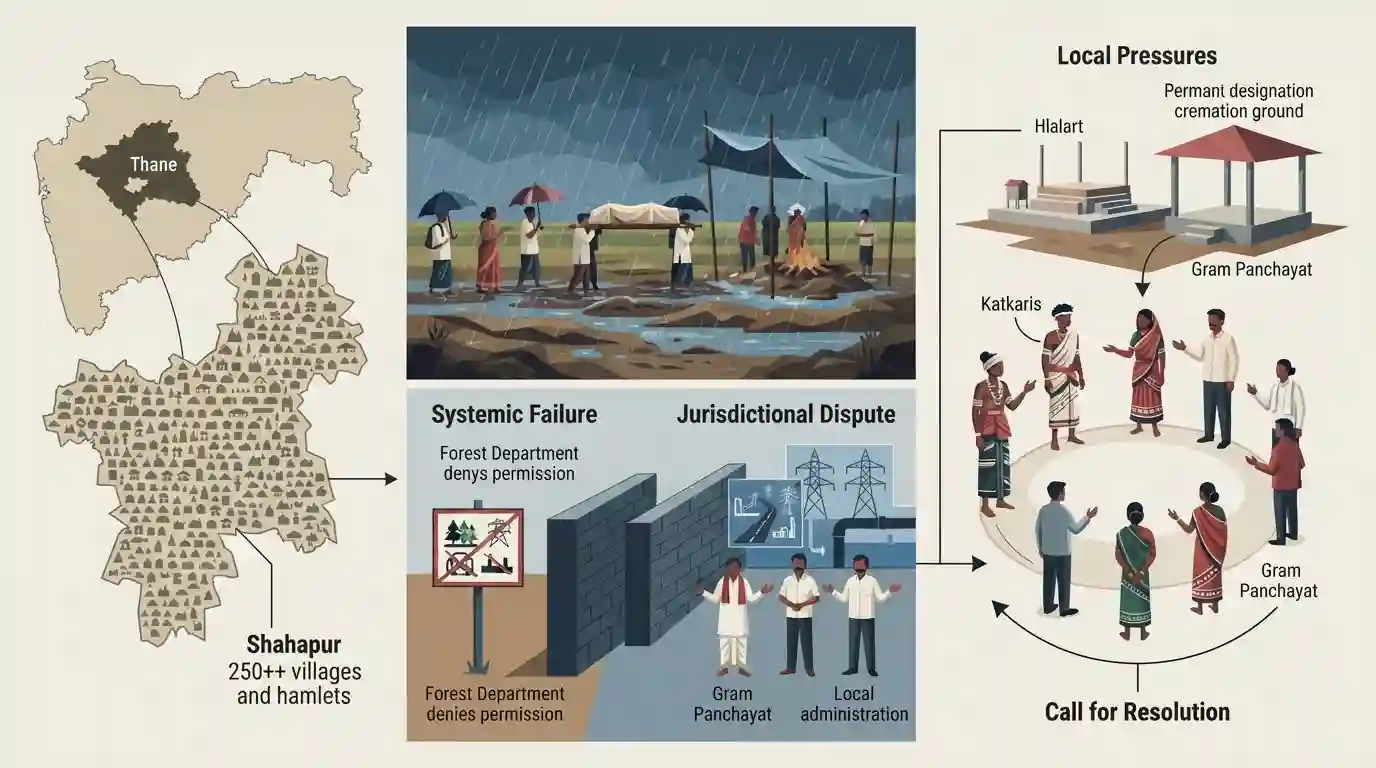
Why It Matters
This issue is highly relevant for MPSC Combined Prelims as it bridges multiple core topics: local self-governance (Panchayati Raj capabilities and land allocation), the geography and demographics of Maharashtra (Thane district's tribal population and forest cover), and the socio-economic challenges faced by marginalized communities like the Katkaris. It highlights real-world governance friction between local bodies and forest departments.
Summary
The article sheds light on a critical infrastructure deficit in Maharashtra's Shahapur taluka (Thane district), where over 250 villages and hamlets, predominantly inhabited by tribal communities like the Katkaris and Adivasis, lack basic cremation grounds. Residents face significant hardships during monsoons and extreme weather, often forced to perform last rites in the open or under temporary structures. The systemic failure is compounded by jurisdictional disputes with the Forest Department over land ownership, which also stalls the development of other essential amenities like roads, electricity, and water supply. Local organizations are pressing the local administration and Gram Panchayats for an immediate resolution to ensure dignity for the deceased and better living conditions for these marginalized groups.
Key Points
- Over 250 villages and tribal hamlets in Maharashtra's Shahapur taluka lack dedicated cremation grounds.
- The infrastructure deficit severely impacts tribal communities, including Adivasis and Katkaris, forcing them to perform last rites in the open under extreme weather conditions.
- The severity of the issue was highlighted when the last rites of a Gram Panchayat member had to be conducted in a temporary tin shed amid heavy rain.
- Jurisdictional disputes with the Forest Department, which owns much of the land in the district, hinder the allocation of land for cremation grounds and other basic facilities like roads.
- Local outfits like Shramajivi and Prahar Sanghatana are actively demanding urgent intervention from the local administration and Tehsildar to address these persistent infrastructural gaps.
Important Terms
Katkari Tribe

A Particularly Vulnerable Tribal Group (PVTG) located primarily in Maharashtra's Thane, Raigad, and Palghar districts. Historically forest-dwelling catechu makers, they largely work as marginalized, landless laborers today.
UPSC context
Crucial for Prelims (Tribes of India) and GS2 (Welfare schemes for vulnerable sections).
Particularly Vulnerable Tribal Groups (PVTGs)
A sub-category of Scheduled Tribes identified by pre-agricultural technology, declining populations, extreme low literacy, and subsistence-level economies. India has 75 recognized PVTGs.
UPSC context
Highly tested in Prelims and GS2 (Social Justice/Tribal Development).
Gram Panchayat
The grassroots tier of India's Panchayati Raj system, constitutionally mandated by the 73rd Amendment to provide and maintain basic village infrastructure, including roads, water, and cremation grounds.
UPSC context
Core topic in GS2 (Polity: Local Self-Government and Devolution of Powers).
Forest Land Disputes
Conflicts arising between local tribal communities and state administration over the classification and use of forest land, often obstructing rural infrastructure development like roads or crematoriums.
UPSC context
Important for GS2 (Governance/Forest Rights Act) and GS3 (Environment vs. Development debates).
Shramajivi Sanghatana
A civil society organization active in Maharashtra that advocates for the fundamental rights, basic amenities, and welfare of marginalized groups, particularly tribal communities.
UPSC context
Serves as a relevant case study for GS2 (Role of NGOs, SHGs, and civil society).
Prelims Trap
Under the Forest Rights Act 2006, forest land can be automatically diverted for village cremation grounds upon Gram Sabha recommendation.
Cremation grounds are NOT among the 13 specified public utilities under Sec 3(2). Tribes must use Community Forest Rights under Sec 3(1) for graveyards.
Static Concepts Connected
Who are the recognized PVTGs of Maharashtra?
- Three specific tribes: Maharashtra recognizes the Katkari (Kathodi), Kolam, and Madia Gond as Particularly Vulnerable Tribal Groups (PVTGs).
- Katkari livelihoods: Traditionally known for making 'Katha' (catechu) from Khair wood, they primarily reside in the Raigad and Thane districts of Maharashtra.
What are the exemptions for forest land diversion under FRA 2006?
- 13 specific utilities: Section 3(2) allows diversion for schools, hospitals, drinking water, and fair price shops, but notably excludes cremation grounds and graveyards.
- Strict conditions: Diversion requires a Gram Sabha recommendation, must be under 1 hectare, and involve felling of less than 75 trees per hectare.
Cross-Topic Patterns
PESA vs Forest Conservation laws
Strict forest land rules often collide with local governance under PESA, creating severe infrastructural deficits for marginalized tribes residing in Scheduled Areas.
PVTG multidimensional deprivation
Lack of dignity in death highlights how PVTG marginalization extends beyond income poverty to acute socio-cultural infrastructure gaps, necessitating schemes like PM-JANMAN.

Expect a 2026 prelims MCQ distinguishing between FRA Sec 3(1) community rights and Sec 3(2) public utility land diversion exemptions.
Linked PYQs · 5
Linked PYQs · 5
- 2010MPSC_PRELIMSGS1
Who is preside the first meeting of Gram Sabha after General Election of Gram Panchayat ?
- 2011MPSC_PRELIMSGS1
Which of the following sentences is not applicable to Gram Sabha ?
- 2026MPSC_PRELIMSGS1
Match the following forest circles with their share in percentage to total forest area of Maharashtra. | (Forest circles of Maharashtra) | (Percentage to total forest area Economic survey of Maharashtra (2024)) | |---|---| | (a) Gadchiroli | (1) 12.5 | | (b) Nagpur | (2) 20.8 | | (c) Dhule | (3) 9.5 | | (d) Thane | (4) 10.4 | Code: (a) (b) (c) (d)
- 2026MPSC_PRELIMSGS1
As per the Government Resolution dated October 9, 2024, what is the minimum population requirement for establishment a 'Gram Panchayat' in Banjara/Laman/Labhan Tanda areas ?
- 2026MPSC_PRELIMSGS1
Which of the following matters are included in the 12th schedule of the Constitution of India ? (a) Promotion of artistic vision, fire fighting services (b) Cremation ground and electric crematorium (c) Market | fairs, rural housing (d) Protection of the interest of the handicapped and mentally retarded, protection of the environment. Answer Options :
