Impact of US Foreign Aid Cuts on Global Public Health
Source:The Hindu ↗
Why It Matters
Drastic cuts in foreign assistance by developed countries significantly undermine global health architecture. For UPSC aspirants, this highlights the intersection of international relations, foreign policy shifts in the West, and their direct socio-economic impacts on developing nations (GS2 IR and Social Justice).
Summary
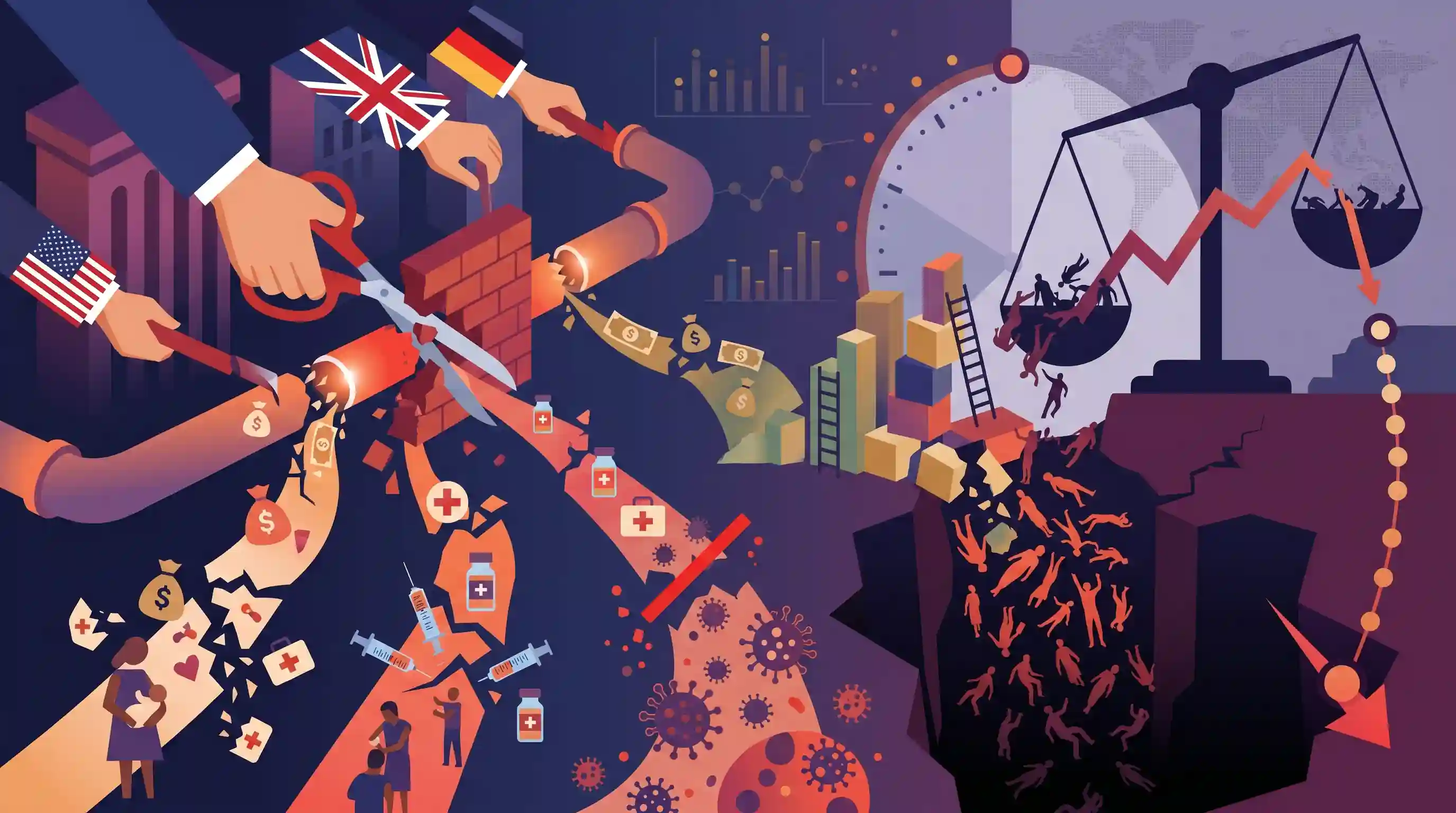
A recent study published in The Lancet warns that severe cuts to the United States' foreign aid budget could cause more than 14 million preventable deaths by 2030. Following the Trump administration's decision to slash USAID and global health funding by 83%, essential global health programs—including maternal and child care, vaccinations, and disease prevention—are at critical risk. With other major donor countries like Germany and the UK also reducing their foreign assistance, low- and middle-income nations face a severe funding shortfall, threatening decades of progress in global health and poverty reduction.
Key Points
- A study published in The Lancet projects that deep cuts to US foreign assistance could result in over 14 million preventable deaths by 2030.
- The Trump administration recently slashed the budget for USAID and global health funding by 83%, a move anticipated to have catastrophic ripple effects worldwide.
- The US has historically provided roughly a quarter of all global health funding, supporting essential programs such as vaccines and treatments for HIV, tuberculosis, and malaria.
- Other major donor nations, including Germany, the UK, and France, are also cutting foreign aid budgets amidst domestic challenges, compounding the crisis for low- and middle-income countries.
Important Terms
USAID

A premier independent agency of the U.S. federal government responsible for administering civilian foreign aid and development assistance to support global health, stability, and disaster relief.
UPSC context
Relevant for GS Paper-II (International Relations) regarding the effect of policies of developed countries on developing nations.
Gavi, the Vaccine Alliance
A public-private global health partnership that increases access to immunization in lower-income countries, notably through its role in the COVAX facility.
UPSC context
Important for GS Paper-II (Social Justice/Health) and international institutional frameworks.
The Global Fund
An international financing organization and partnership designed to accelerate the end of AIDS, tuberculosis, and malaria as epidemics through strategic global investment.
UPSC context
Pertinent to GS Paper-II and GS Paper-III (Health and Science) regarding infectious disease control.
The Lancet
One of the world's oldest and most prestigious peer-reviewed medical journals, frequently publishing research that influences global health policy and provides critique on socio-political health impacts.
UPSC context
Recognized in GS Paper-II as a critical source for global health data and policy advocacy.
Official Development Assistance (ODA)
Government aid designed to promote the economic development and welfare of developing countries, serving as the standard measure of foreign assistance flows.
UPSC context
A core concept in GS Paper-II (International Relations) and GS Paper-III (Economy) concerning international funding mechanisms.
Prelims Trap
The Global Fund and Gavi, the Vaccine Alliance, are specialized agencies of the United Nations.
Both are independent global public-private health partnerships. While they collaborate extensively with the WHO and UNICEF, they are not formal UN agencies.
Static Concepts Connected
What constitutes Official Development Assistance (ODA)?
- Definition: Government aid provided by official agencies explicitly designed to promote the economic development and welfare of developing countries.
- UN Target: The UN urges developed nations to allocate 0.7% of their Gross National Income (GNI) to ODA, though only a handful of countries consistently achieve this.
- Exclusions: Military aid, peacekeeping operations, and anti-terrorism activities are explicitly excluded from being classified as ODA.
What are Gavi and The Global Fund?
- Gavi: A global public-private partnership focused on expanding equitable access to new and underused vaccines for children living in the world's poorest countries.
- Global Fund: An international financing mechanism designed to accelerate the end of AIDS, tuberculosis, and malaria as epidemics.
- Governance: Both operate as independent financial instruments, pooling sovereign and private donor funds outside traditional UN structures to directly finance health interventions.
Cross-Topic Patterns
Developed policies vs Global South debt
Western fiscal tightening shrinks health infrastructure in the Global South, exacerbating debt traps as developing nations must borrow more heavily to fund their primary healthcare sectors.
Philanthropy replacing sovereign aid
As traditional state-led foreign aid collapses, global health governance relies increasingly on private philanthropies (like the Gates Foundation), significantly altering accountability, transparency, and priority-setting.

Shrinking Western ODA and the rise of private philanthropies in global health is a high-probability GS-2 mains theme for 2026.
Linked PYQs · 3
Linked PYQs · 3
- 2014MainsGS2
Some of the International funding agencies have special terms for economic participation stipulating a substantial component of the aid to be used for sourcing equipment from the leading countries. Discuss on merits of such terms and if, there exists a strong case not to accept such conditions in the Indian context.
- 2021MainsGS2
“Besides being a moral imperative of a Welfare State, primary health structure is a necessary precondition for sustainable development.” Analyze.
- 2020MainsGS2
In order to enhance the prospects of social development, sound and adequate health care policies are needed particularly in the fields of geriatric and maternal health care. Discuss.
