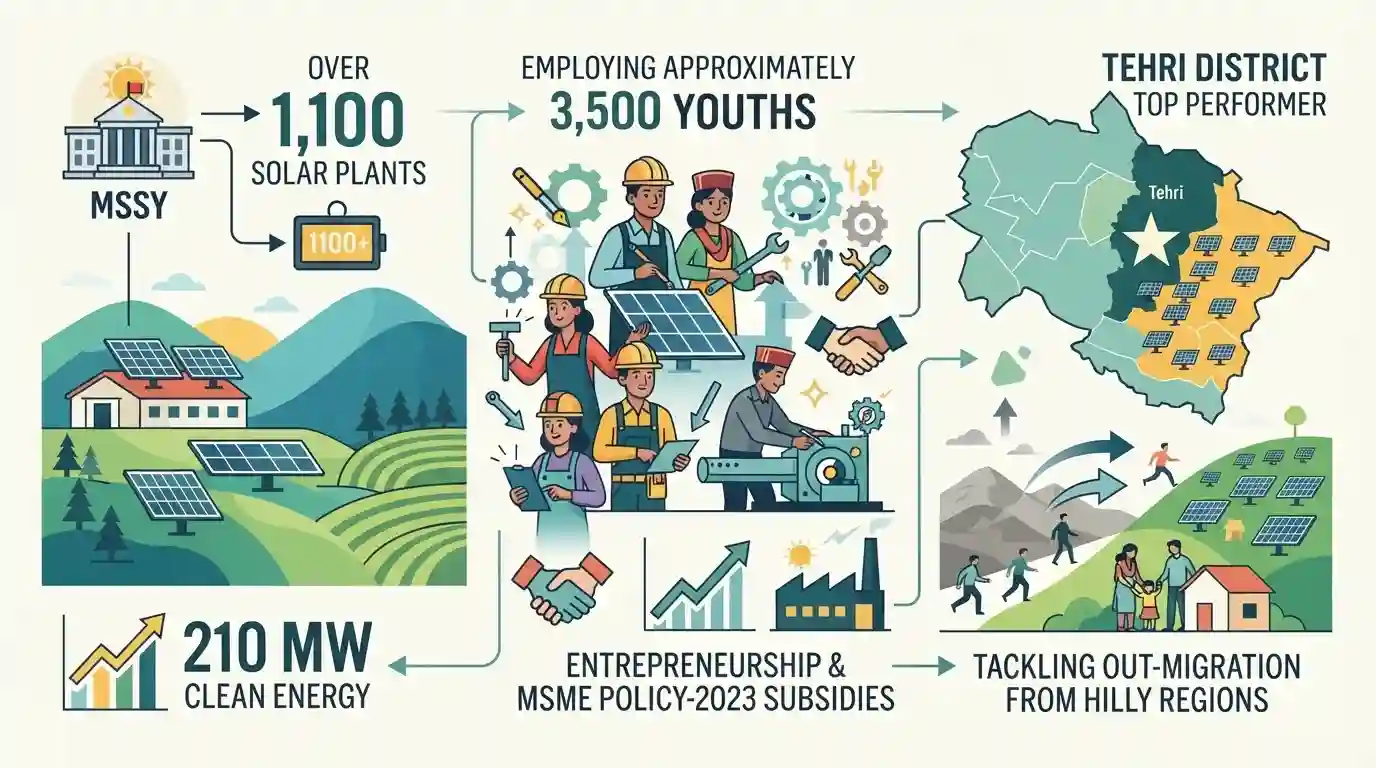
MSSY implementation and district solar plant installation progress
Source:economictimes ↗
Why It Matters
MSSY is a flagship scheme of Uttarakhand designed to address critical local challenges: out-migration from hill districts and youth unemployment, while contributing to India's renewable energy targets. Candidates must know district-level performance (Tehri leading) and integration with MSME subsidies for Prelims.
Summary
Over 1,100 solar plants have been established in Uttarakhand under the Mukhyamantri Saur Swarojgar Yojana (MSSY), generating 210 MW of clean energy and employing approximately 3,500 youths. Tehri district is the top performer in installations. The initiative aims to tackle out-migration from hilly regions by encouraging entrepreneurship through subsidies aligned with the state's MSME Policy-2023.
Key Points
- The Mukhyamantri Saur Swarojgar Yojana (MSSY) has facilitated the establishment of over 1,100 solar power plants in Uttarakhand, providing self-employment to about 3,500 people.
- The state aims to achieve a total solar capacity of 250 MW under the scheme, with 210 MW already installed as of June 2026.
- Tehri district leads the state with 369 solar plants generating 69,050 kW, followed by Uttarkashi and Champawat districts.
- Eligible youth and entrepreneurs can set up solar plants ranging from 20 kW to 200 kW and avail subsidies of up to 40% under the MSME Policy-2023.
- The dual objective of MSSY is to promote green energy production while mitigating out-migration (palayan) from the hilly areas through localized entrepreneurship.
Important Terms
Mukhyamantri Saur Swarojgar Yojana (MSSY)

A Uttarakhand government initiative promoting self-employment and green energy. It provides loans and subsidies to local residents, youth, and farmers to set up solar power plants (20-200 kW), enabling them to sell electricity to the state grid.
UPSC context
Relevant for GS Paper 2 and 3 (Government Schemes, Renewable Energy). Highlights state-level socio-economic interventions addressing rural out-migration and clean energy.
MSME Policy-2023
A comprehensive industrial framework by the Uttarakhand government to promote micro, small, and medium enterprises. It offers financial incentives, interest subsidies, and infrastructure support to develop MSME clusters and foster local entrepreneurship in hilly regions.
UPSC context
Important for GS Paper 3 (Economic Development). Demonstrates regional policy approaches to creating sustainable employment and industrial growth in geographically challenging terrains.
Prelims Trap
"Mukhyamantri Saur Swarojgar Yojana (MSSY) is a sub-component of the central PM-KUSUM scheme designed for Himalayan states."
It is an independent state-specific initiative by Uttarakhand to combat out-migration ('ghost villages'), not a centrally sponsored sub-scheme, despite thematic overlaps with PM-KUSUM.
Static Concepts Connected
What are the three core components of the PM-KUSUM scheme?
- Component A: Setting up decentralized ground-mounted grid-connected renewable power plants (up to 2 MW) by farmers on barren/fallow land.
- Component B: Installation of stand-alone solar agriculture pumps to replace diesel pumps in off-grid areas.
- Component C: Solarization of existing grid-connected agriculture pumps, allowing farmers to use solar power and sell surplus to the grid.
What drives the phenomenon of 'Ghost Villages' in Himalayan states?
- Push Factors: Fragmented landholdings, human-wildlife conflict, tough terrain, and a lack of secondary sector employment opportunities drive mass out-migration.
- Strategic Impact: Leaves settlements abandoned and agricultural lands fallow, posing threats to border security and hollowing out local hill economies.
- Policy Response: Governments are promoting decentralized micro-entrepreneurship—like solar plants, homestays, and high-value horticulture—to create localized retention economies.
Cross-Topic Patterns
Green energy as a demographic stabilizer
Deploying decentralized solar to create localized MSME jobs merges GS3 energy transition targets with GS1 demographic challenges (curbing out-migration from hills).
Fiscal federalism in climate action
Uttarakhand's GST registration exemption for small solar entrepreneurs highlights how states use local fiscal levers to ease doing business and boost grassroots green investments.

Expect a GS3 Mains question linking decentralized renewable energy micro-grids with checking rural out-migration in Himalayan/border areas.
Linked PYQs · 2
Linked PYQs · 2
- 2016UKPSC_PRELIMSGS1
The biggest Hydro-Electric Project of Uttarakhand State is:
- 2025UKPSC_PRELIMSGS1
Arrange the following social welfare schemes in chronological order: i. Integrated Rural Development Programme (IRDP) ii. Rural Employment Generation Programme (REGP) iii. Prime Minister Rojgar Yojana (PMRY) iv. Rural Landless Employment Guarantee Programme (RLEGP)
