Railway Stretches Identification for Wildlife Conservation
Source:The Hindu ↗
Why It Matters
The intersection of linear infrastructure (railways, highways) and wildlife corridors is a major cause of biodiversity loss in India. Understanding mitigation measures, particularly technological solutions like AI and DAS-IDS, provides critical examples for GS-3 answers on balancing economic development with ecological conservation.
Summary
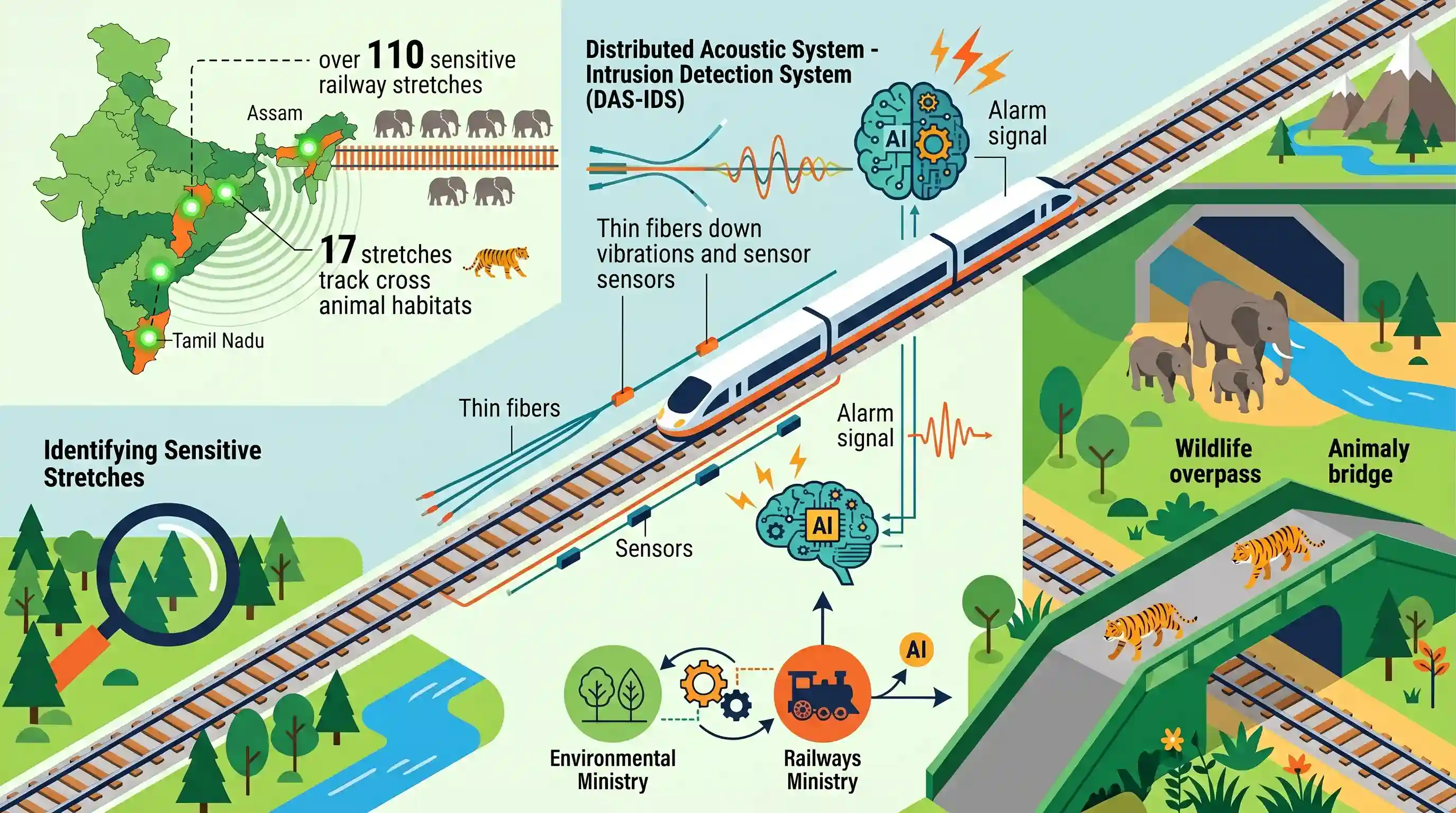
In a major step to reduce human-wildlife conflict along linear infrastructure, the Environment Ministry has identified over 110 sensitive railway stretches in elephant habitats and 17 in tiger habitats. To mitigate wildlife mortalities from train collisions, the Ministry of Railways will deploy the Distributed Acoustic System - Intrusion Detection System (DAS-IDS) alongside physical structures like underpasses and overpasses in crucial corridors across states like Chhattisgarh, Assam, and Tamil Nadu. The initiative highlights a growing emphasis on utilizing artificial intelligence and collaborative governance between environmental and infrastructure ministries to balance development with conservation.
Key Points
- The Environment Ministry and Ministry of Railways have identified over 110 sensitive railway stretches in elephant ranges and 17 in tiger-range states to curb wildlife-train collisions.
- A major technological intervention, the Distributed Acoustic System - Intrusion Detection System (DAS-IDS), will be deployed along these stretches to provide early warnings.
- The Northeast Frontier Railway has already successfully demonstrated an AI-based early-warning system to prevent elephant mortalities.
- Physical mitigation measures such as underpasses, overpasses, ramps, and solar fencing are being constructed across key corridors like Achanakmar-Amarkantak and Rani-Garbhanga-Deepor Beel.
Important Terms
Distributed Acoustic System - Intrusion Detection System (DAS-IDS)

An AI-based surveillance technology that uses existing optical fiber cables to detect ground vibrations (acoustic signatures) of elephants, alerting railway officials in real-time to prevent collisions.
UPSC context
GS Paper 3: Science and Technology and Environment; tests knowledge of tech-led conservation and human-wildlife conflict mitigation.
Wildlife Institute of India (WII)
An autonomous institution under the Environment Ministry that conducts research on biodiversity and provides technical guidance for identifying wildlife corridors and sensitive infrastructure stretches.
UPSC context
GS Paper 3: Conservation; important institutional body for wildlife management and environmental impact assessments.
Elephant Corridors
Narrow strips of forested land that connect larger elephant habitats, enabling seasonal migration and gene flow while reducing human-wildlife conflict in fragmented landscapes.
UPSC context
GS Paper 3: Conservation and Biodiversity; critical for understanding habitat fragmentation and protected area networks.
Linear Infrastructure
Man-made structures like roads, railways, and power lines that cut through natural habitats, often acting as barriers to wildlife movement and increasing mortality risks.
UPSC context
GS Paper 3: Infrastructure and Environment; focuses on balancing developmental projects with ecological sustainability.
Northeast Frontier Railway (NFR)
A railway zone headquartered in Guwahati that covers biodiversity-rich Northeast India; it successfully piloted the AI-based 'Gajraj' system and 'Plan Bee' to protect elephants.
UPSC context
GS Paper 3: Infrastructure; relevant for regional development and environmental challenges in sensitive zones.
Ministry of Environment, Forest and Climate Change (MoEFCC)
The nodal agency responsible for planning, promoting, and coordinating India's environmental, forest, and wildlife policies, including 'Project Elephant' and 'Project Tiger'.
UPSC context
GS Paper 3: Conservation and Environmental Governance; tests knowledge of executive bodies and national conservation schemes.
Prelims Trap
"The Gajraj System uses AI-enabled camera traps and satellite tagging to track elephant movements near railway lines."
The Gajraj System (DAS-IDS) does not use cameras, sensors, or GPS collars. It detects acoustic vibrations from elephant footsteps using existing underground Optical Fibre Cables (OFC) along the tracks.
Static Concepts Connected
Why is Deepor Beel ecologically significant in the context of Assam?
- Ramsar Site: It is Assam's only Ramsar site, functioning as a vital permanent freshwater lake and bird sanctuary.
- Elephant Corridor: It acts as a crucial passage for elephants moving between the adjacent Rani and Garbhanga Reserve Forests.
- Infrastructure Vulnerability: It is highly vulnerable to habitat fragmentation and pollution from linear infrastructure like the adjacent railway line.
What are the key geographical features of the Achanakmar-Amarkantak Biosphere Reserve?
- Location: It spans across Madhya Pradesh and Chhattisgarh, situated prominently in the Maikal hill ranges.
- Crucial Watershed: It serves as a critical watershed and the origin point for three major river systems: the Narmada, Johilla, and Son rivers.
- Landscape Connectivity: It acts as a vital habitat link connecting the Kanha and Achanakmar tiger reserves.
Cross-Topic Patterns
Dual-use tech in Conservation
The use of existing railway Optical Fibre Cables (OFC) for acoustic detection (Gajraj System) highlights a trend of dual-use infrastructure, minimizing new ecological footprints while actively solving human-wildlife conflicts.
EIA and Linear Infrastructure
Mandating 'Eco-Bridges' and 'Eco-Ducts' reflects a shift in Environmental Impact Assessments, treating landscape connectivity as a non-negotiable metric for clearing highway and railway projects in protected areas.

Expect a 2026 Prelims multi-statement question linking specific wetlands (Deepor Beel) or biospheres (Achanakmar) to infrastructure threats.
Linked PYQs · 3
Linked PYQs · 3
- 2020PrelimsGS1
With reference to Indian elephants, consider the following statements: 1. The leader of an elephant group is a female. 2. The maximum gestation period can be 22 months. 3. An elephant can normally go on calving till the age of 40 years only. 4. Among the States in India, the highest elephant population is in Kerala. Which of the statements given above is/are correct?
- 2024MainsGS3
What role do environmental NGOs and activists play in influencing Environmental Impact Assessment (EIA) outcomes for major projects in India? Cite four examples with all important details.
- 2016MainsGS3
Rehabilitation of human settlements is one of the important environmental impacts which always attracts controversy while planning major projects. Discuss the measures to be adopted to mitigate the impact of the recent incidents of cloudbursts in many places of Uttarakhand.
