Uttar Pradesh Police proposes intelligence model to fight cyber fraud
Source:The Hindu ↗
Why It Matters
With digital arrests and AI-driven cyber scams emerging as massive security threats, understanding the functions of the 1930 helpline, I4C, and state-level police coordination is highly relevant for both GS Paper 2 (Governance) and GS Paper 3 (Internal Security / Science & Tech) of the UPPSC PCS Exam.
Summary
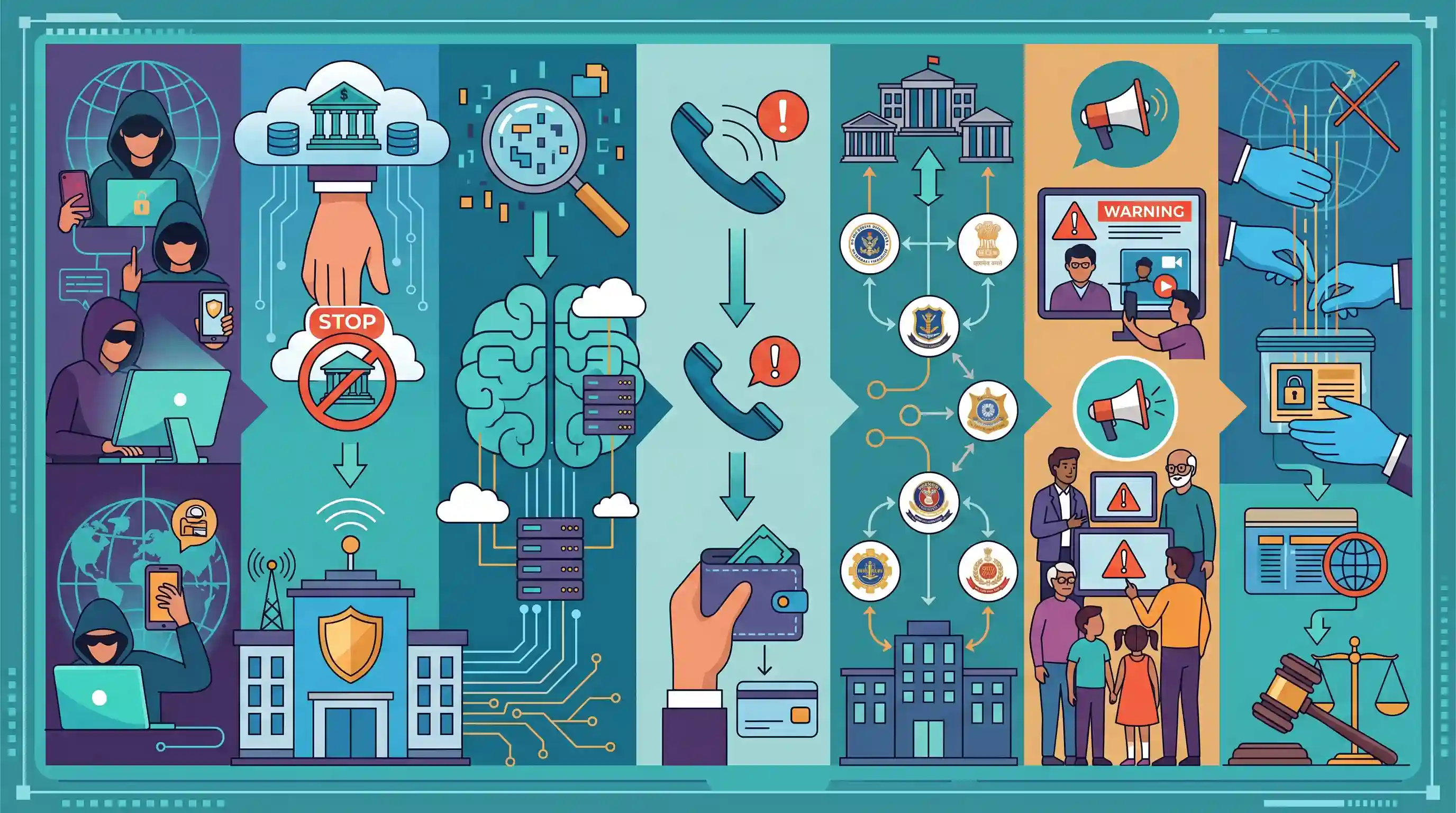
The Uttar Pradesh Police is advocating for a standardized, intelligence-led response model to combat the sharp rise in cyber fraud and digital arrest scams. State police officials highlight the need for a State-level threat intelligence database, swift account freezing via the 1930 helpline, and coordination with the Indian Cyber Crime Coordination Centre (I4C). Additionally, they recommend targeted public awareness campaigns to prevent AI-driven voice and video spoofing, emphasizing the preservation of digital evidence for proper prosecution of transnational syndicates.
Key Points
- Rising threat of hybrid cyber scams and 'digital arrests' operating at transnational syndicate levels.
- Growing technological threat of artificial intelligence (AI) voice and video spoofing, which requires independent verification via official helplines rather than incoming numbers.
- Call for an intelligence-led, standardized response model involving real-time fund-freezing through the national '1930' helpline and coordination with bank and telecom nodal officers.
- Proposed establishment of a State-level threat intelligence database to track repeat phone numbers, mule accounts, phishing domains, and IP clusters.
- Utilization of existing cybersecurity mechanisms such as UP Police Cybercrime Headquarters, District Cyber Units, cybercrime.gov.in, and integration with the Indian Cyber Crime Coordination Centre (I4C).
Important Terms
Indian Cyber Crime Coordination Centre (I4C)

A national-level nodal agency established under the Ministry of Home Affairs to coordinate and comprehensively tackle cybercrime across India, aiding law enforcement agencies and operating the citizen helpline.
UPSC context
GS Paper III (Internal Security); tests understanding of institutional frameworks to combat emerging cyber threats and financial crimes.
Information Technology Act, 2000
India's primary legal framework governing electronic commerce, digital transactions, and cybercrime, providing legal recognition for electronic records and digital signatures while prescribing cyber penalties.
UPSC context
GS Paper III (Cyber Security); tests knowledge of legal frameworks regulating digital transactions and cyber offenses in India.
Digital Arrest Scam
An intimidation-based cyber fraud where criminals impersonate law enforcement officers on video calls to falsely accuse victims of crimes and extort large sums of money.
UPSC context
GS Paper III (Internal Security); tests familiarity with emerging cyber-enabled security threats and public safety challenges in India.
Central Bureau of Investigation (CBI)
India's premier central investigating agency, established in 1963, which derives its power from the Delhi Special Police Establishment Act, 1946 to probe corruption and major economic offenses.
UPSC context
GS Paper II (Polity & Governance); tests understanding of federal law enforcement agencies, their statutory limits, and structural challenges.
Prelims Trap
Digital arrest is a provisional law enforcement measure authorized under the Bharatiya Nagarik Suraksha Sanhita (BNSS) for cyber-suspects.
Digital arrest is purely a cyber-fraud tactic with no legal basis under Indian law; law enforcement agencies cannot arrest or detain anyone online.
Static Concepts Connected
What is the structural and legislative framework of the Indian Cyber Crime Coordination Centre (I4C)?
- MHA Office: Operates as an attached office under the Ministry of Home Affairs (MHA) since its upgrade in July 2024.
- PMLA Integration: Authorized under Section 66 of the PMLA to exchange financial intelligence with the Enforcement Directorate.
- Core Mandate: Acts as India's nodal agency to coordinate cybercrime prevention, detection, and investigation among States and Union Territories.
How does the Seventh Schedule shape India's cybercrime law enforcement architecture?
- State Subjects: 'Police' and 'Public Order' are State subjects, making state police the primary investigators of cyber fraud.
- Union Override: Cyber infrastructure, telecommunications, and information technology fall under List I, giving the Centre exclusive legislative powers.
Cross-Topic Patterns
Cybercrime + PMLA integration
The addition of I4C to PMLA's information-sharing regime bridges domestic cyber threat intelligence directly with federal anti-money laundering mechanisms.
Federalism + Cyber Policing
While local policing remains a State subject, countering transnational digital syndicates increasingly requires central nodes like I4C and federal channels like BHARATPOL.

I4C’s upgraded MHA status, its PMLA information-sharing powers, and BHARATPOL’s CBI linkage will likely feature in Prelims 2026.
Linked PYQs · 1
Linked PYQs · 1
- 2025UPPSC_PRELIMSGS1
BHARATPOL', an online portal for International Police Co-operation has been developed by which of the following?
