Rajasthan high court scrutiny puts Aravalli hill policies in focus
Source:outlook-india ↗
Why It Matters
The Aravalli Range is a crucial geographical feature that prevents desertification and maintains water security in Rajasthan. The High Court's intervention highlights the critical governance challenge of balancing state tourism objectives with the urgent need to protect fragile ecosystems and biodiversity.
Summary
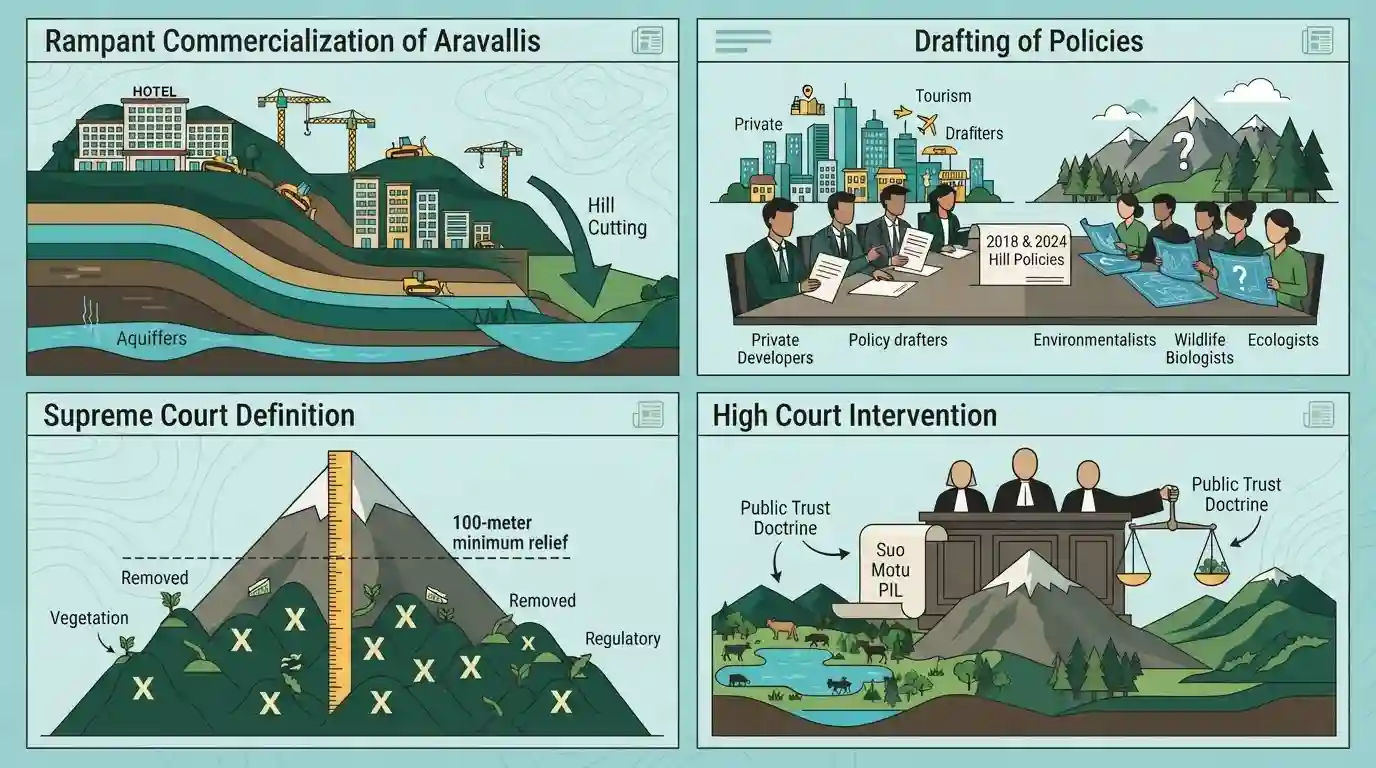
The Rajasthan High Court has intensely scrutinized the state's 2018 and 2024 Hill Policies, criticizing the rampant commercial and hotel construction in the ecologically fragile Aravalli hills surrounding Udaipur. The court expressed concern that these policies were drafted by private agencies without input from environmental and wildlife experts, thereby prioritizing tourism over conservation. Concurrently, environmentalists have opposed the Supreme Court's acceptance of a 100-meter minimum local relief definition for Aravalli hills, fearing it removes regulatory protection for smaller but vital hillocks. Unchecked hill cutting severely threatens groundwater recharge, the survival of Udaipur's famous lakes, and wildlife corridors. To address these threats, the High Court is considering a suo motu public interest litigation invoking the Public Trust Doctrine.
Key Points
- The Rajasthan High Court heavily criticized the state's 2018 and 2024 Hill Policies for facilitating unchecked commercial and hotel construction in the fragile Aravalli landscape around Udaipur.
- The court noted that the policies were seemingly drafted by private agencies without the necessary consultation with wildlife, climate, and environmental experts.
- The Supreme Court recently adopted a definition of an Aravalli hill based on a minimum local relief of 100 meters, which environmentalists argue leaves smaller hillocks vulnerable to mining and construction.
- Unregulated hill cutting threatens natural catchments for Udaipur's lakes, groundwater recharge, and essential ecological corridors for wildlife like leopards and hyenas.
- The High Court indicated it may initiate a suo motu PIL under the Public Trust Doctrine to address the region's ecological survival.
Important Terms
Hill Policy 2018

An earlier Rajasthan regulatory framework for hill development, heavily criticized by the High Court for reportedly being drafted by private agencies without expert environmental consultation, leading to rampant hill cutting.
UPSC context
Important for GS-2 Governance. Illustrates how opaque, non-expert policy drafting can undermine sustainable development and environmental protection.
Hill Policy 2024
A recent Rajasthan state policy regulating hill development. It is currently under High Court scrutiny for allegedly continuing a trend of facilitating private hotel construction and ecological destruction in the Aravallis.
UPSC context
Relevant for GS-3 Environment and GS-2 Policies. Highlights the conflict between tourism-driven infrastructure and ecological conservation.
Public Trust Doctrine
A legal principle dictating that natural resources like lakes and hills are held in trust by the government for public benefit, prohibiting their unchecked privatization or commercial exploitation.
UPSC context
Crucial for GS-2/GS-3 Environmental Law. It is frequently invoked by the judiciary to protect fragile ecosystems from unsustainable development.
Jheel Sanrakshan Samiti
An Udaipur-based environmental NGO pivotal in protecting local lakes. Through public interest litigations, it successfully pushed the judiciary to invoke the Public Trust Doctrine against unchecked commercialization in fragile habitats.
UPSC context
Maps to GS-2 Role of Civil Society. Showcases how grassroots NGOs utilize judicial activism to enforce environmental governance.
Prelims Trap
"The Public Trust Doctrine is explicitly defined under Article 48A of the Directive Principles of State Policy."
The Public Trust Doctrine is a judicial innovation (M.C. Mehta case) derived from Article 21. It is not explicitly written anywhere in the Constitution.
Static Concepts Connected
How does the Aravalli Range act as a continental water divide?
- Westward drainage: It separates westward-flowing rivers like Luni and Sabarmati, which drain into the Arabian Sea.
- Eastward drainage: It acts as a barrier for eastward-flowing rivers like Banas (a tributary of the Chambal) that ultimately drain into the Bay of Bengal.
- Climatic divide: By standing across the wind direction, it acts as a climatic barrier checking the expansion of the Thar desert towards eastern Rajasthan.
What is the Public Trust Doctrine in Indian Environmental Law?
- Judicial Origin: Introduced into Indian jurisprudence through the landmark M.C. Mehta v. Kamal Nath case.
- State as Trustee: The State acts merely as a trustee holding vital natural resources (air, water, forests) for the benefit of the general public.
- Commercial Restriction: It strictly prohibits the State from alienating essential ecological resources to private entities for commercial exploitation.
Cross-Topic Patterns
Aravalli degradation + Desertification
The mining of smaller Aravalli hillocks removes a critical natural windbreak, accelerating the eastward expansion of the Thar Desert, directly undermining India's UNCCD targets.
Urban Hydrology + Catchment Destruction
Udaipur's lake crisis mirrors urban hydrology collapses seen in Bengaluru or Chennai. Destroying hill catchments and natural drainage disrupts surface runoff, leading to dual crises of water scarcity and flooding.

Expect a multi-statement geography question in 2026 linking Aravalli's role as a water divide to the Supreme Court's 100m definition.
Linked PYQs · 4
Linked PYQs · 4
- 2021RPSC_PRELIMSGS1
The following characteristics are of which river? – Its origin is near Kumbhalgarh Fort in the Aravalli hills. – This river passes through the middle of the Mewar plains. – Bedach, Kothari and Morel are its tributaries.
- 2025RPSC_PRELIMSGS1
Consider the following statements: A. Luni Basin and Shekhawati region are sub-regions of Bhangar in Rajasthan. B. The Ghaggar plain is mostly spread in Hanumangarh and Ganganagar districts. C. Nagaur Uplands have saline lakes and internal drainage. D. The Aravalli ranges are rich in all types of minerals. Select the correct answer from the code given below: Code:
- 2025RPSC_PRELIMSGS1
Choose the incorrect statement with respect to the Rajasthan Forestry and Biodiversity Project (Phase-2).
- 2023RPSC_PRELIMSGS1
According to a recently released notification by the Forest, Environment and Climate Change Department of Rajasthan, how many wet-lands are there in the state?
