Democratic Transition and Economic Challenges in South Korea
Source:The Hindu ↗
Why It Matters
South Korea's political stability and foreign policy recalibration significantly affect the broader Indo-Pacific security architecture. For UPSC aspirants, the country's democratic resilience serves as a modern case study in comparative politics, while its maneuvering between the U.S. and China, alongside economic challenges from global protectionism, directly mirrors key themes in international relations and macroeconomics.
Summary
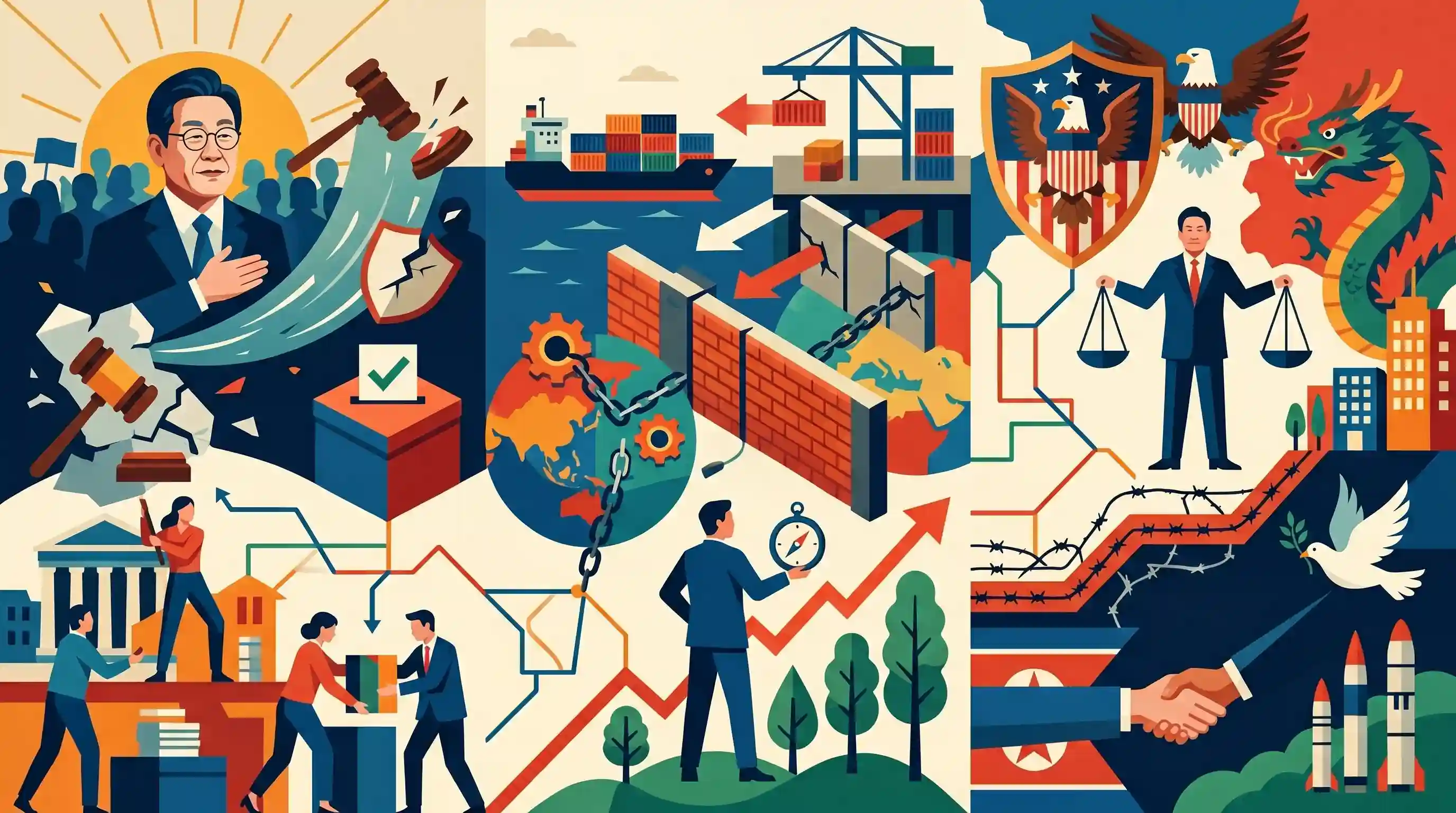
South Korea has navigated a severe political crisis following the martial law debacle of former President Yoon Suk Yeol, demonstrating democratic resilience with the election of Lee Jae-myung. The new President's mandate involves restoring domestic order and accountability while steering the nation through complex economic and geopolitical headwinds. Economically, the export-oriented country faces challenges from global protectionism and tariff threats, prompting calls for stimulus. On foreign policy, Lee is expected to pivot from his predecessor's approach by balancing the crucial U.S. security alliance with vital Chinese commercial relations, and by actively de-escalating tensions with North Korea.
Key Points
- South Korea's democracy demonstrated strong institutional resilience following former President Yoon Suk Yeol's abortive martial law declaration, culminating in the smooth election of Lee Jae-myung.
- President Lee faces the immediate domestic challenge of ensuring legal accountability for the martial law crisis without turning it into a divisive political witch-hunt.
- On the economic front, South Korea's export-driven economy requires stimulus as the central bank downgraded forecasts amid rising global trade and tariff uncertainties.
- Geopolitically, the new administration intends to recalibrate its foreign policy by balancing its U.S. security alliance with crucial commercial ties to China, while also de-escalating tensions with North Korea by halting cross-border propaganda.
Important Terms
Democratic Party of Korea (DPK)

South Korea's primary liberal political party; it advocates for social welfare, economic reform, and diplomatic engagement with North Korea while balancing relations with major global powers.
UPSC context
GS-II (Comparative Politics/International Relations); tests understanding of party systems and foreign policy shifts in major democracies.
Martial Law
Temporary military rule imposed during crises, suspending civil rights and parliamentary functions; its 2024 abuse in South Korea tested the resilience of democratic institutions and constitutional safeguards.
UPSC context
GS-II (Governance/Constitutional Law); relevant for comparing emergency provisions and executive accountability across different democratic frameworks.
Export-Oriented Growth
An economic development strategy prioritizing industrialization through the export of manufactured goods; it transformed South Korea into a global powerhouse but remains vulnerable to global trade shifts.
UPSC context
GS-III (Indian Economy); provides a comparative benchmark for India's 'Make in India' and trade-led development strategies.
Protectionism
Economic policies, such as tariffs and quotas, aimed at restricting imports to protect domestic industries; it currently poses a significant challenge to global trade-dependent economies like South Korea.
UPSC context
GS-III (Global Trade); essential for analyzing threats to multilateralism and the impact of 'trade wars' on global supply chains.
Strategic Balancing
A foreign policy strategy where a nation maintains security ties with one superpower (e.g., the U.S.) while preserving deep economic relations with another (e.g., China).
UPSC context
GS-II (International Relations); critical for understanding 'Strategic Autonomy' and how middle powers navigate the U.S.-China geopolitical rivalry.
Denuclearization
The diplomatic goal of removing nuclear weapons from the Korean Peninsula; President Lee advocates for conditional, step-by-step dialogue with Pyongyang to achieve regional stability.
UPSC context
GS-II (International Relations/Global Security); tests knowledge of regional security dynamics and global non-proliferation regimes.
Prelims Trap
The Constitution of India explicitly defines 'Martial Law' under Article 34 and provides specific grounds for its declaration.
Article 34 restricts fundamental rights during martial law, but the Constitution does not define the term, unlike National Emergency (Article 352) which has explicit grounds.
Static Concepts Connected
How does Martial Law (Art 34) differ from National Emergency (Art 352)?
- Constitutional Definition: Emergency has specific constitutional grounds (war, external aggression, armed rebellion); Martial Law has no explicit constitutional definition.
- Scope of Impact: Martial Law suspends ordinary law. Emergency alters Centre-state relations, legislative terms, and revenue distribution.
- Geographic Application: Martial law applies to specific disturbed areas, while Emergency can cover the entire country.
What is the 'Strategic Hedging' approach adopted by middle powers?
- Core Objective: Avoiding binary alignment to mitigate geopolitical risk, balancing security dependencies against economic imperatives.
- Execution: Maintaining defense treaties with a security guarantor (e.g., US) while deepening economic interdependence with an opposing power (e.g., China).
Cross-Topic Patterns
Middle Power Strategic Hedging
South Korea’s balancing of US security and Chinese commerce mirrors India’s multi-alignment strategy and the broader Global South's resistance to cold-war style binary bloc politics.
Protectionism vs. Export Economies
Surging Western tariffs expose the vulnerabilities of export-heavy Asian growth models, forcing nations to pivot toward domestic macroeconomic stimulus and consumption.

Strategic hedging by Indo-Pacific middle powers balancing US security and China trade is a high-probability GS2 IR question for 2026.
Linked PYQs · 4
Linked PYQs · 4
- 2025MainsGS3
What are the challenges before the Indian economy when the world is moving away from free trade and multilateralism to protectionism and bilateralism? How can these challenges be met?
- 2018MainsGS3
How would the recent phenomena of protectionism and currency manipulations in world trade affect macroeconomic stability of India?
- 2021MainsGS2
“The USA is facing an existential threat in the form of a China, that is much more challenging than the erstwhile Soviet Union.” Explain.
- 2022MainsGS2
Critically examine the procedures through which the Presidents of India and France are elected.
