National Health Accounts Show Decline in Out-of-Pocket Spending
Source:The Hindu ↗
Why It Matters
The National Health Accounts estimates provide empirical data to evaluate India's progress toward Universal Health Coverage (UHC). The reduction in Out-of-Pocket Expenditure is a critical indicator of improving healthcare accessibility and affordability, which is a frequent theme in both Prelims (Ayushman Bharat features) and Mains (evaluating public health infrastructure and welfare state responsibilities).
Summary
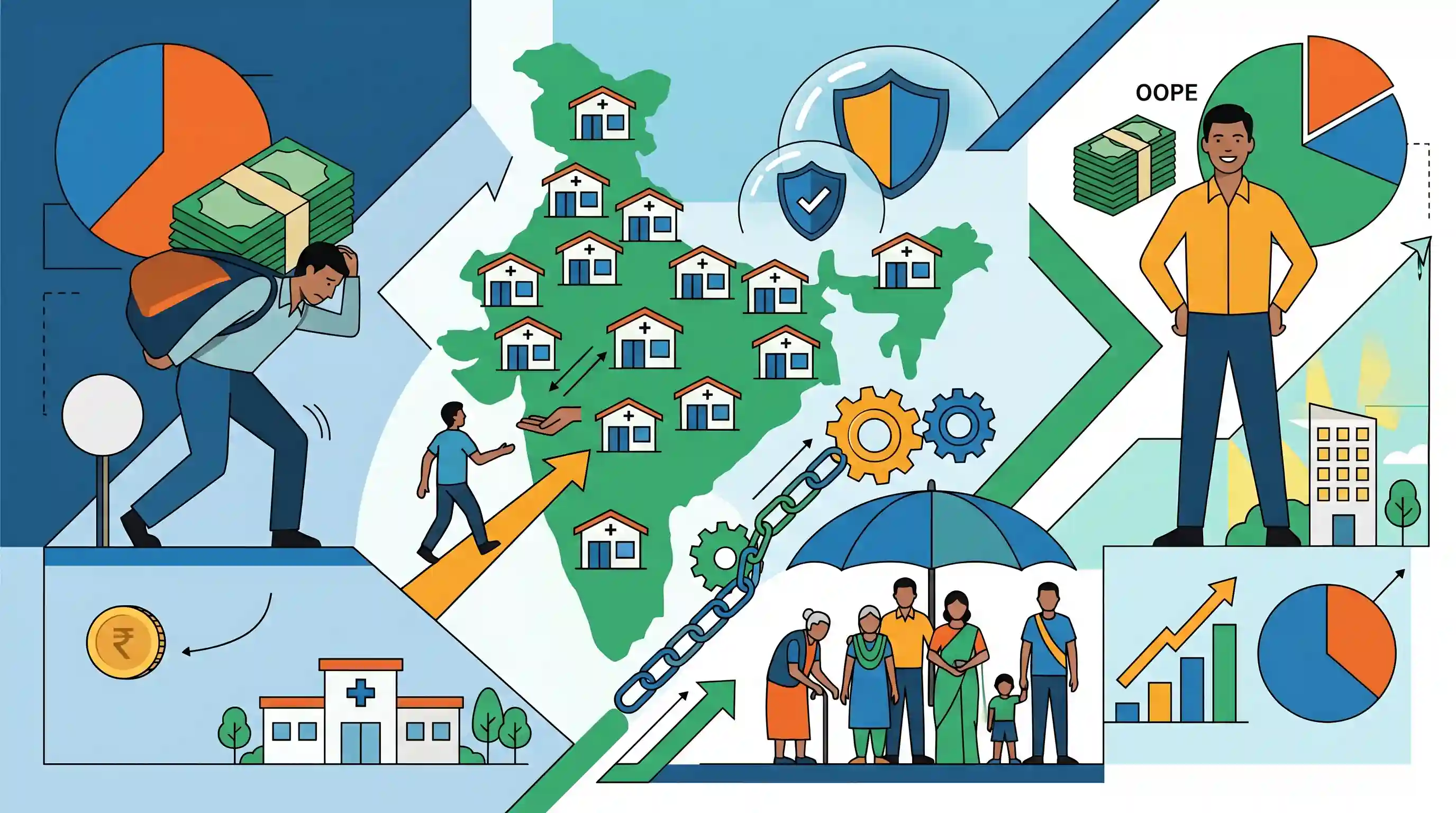
The latest National Health Accounts (NHA) estimates for 2022-23 reveal a positive shift in India's healthcare financing. Out-of-Pocket Expenditure (OOPE) as a share of total health expenditure has witnessed a steep decline, dropping from 64.2% in 2013-14 to 43.4% in 2022-23. Correspondingly, Government Health Expenditure (GHE) has risen, both as a percentage of GDP (from 1.15% to 1.43%) and as a share of the General Government Expenditure (from 3.78% to 4.89%). Initiatives such as the rollout of over 1.8 lakh Ayushman Arogya Mandir wellness centres have significantly contributed to this trend by expanding access to free primary and preventive care. Furthermore, reliance on private health insurance and social security expenditure on health have also increased, thereby reducing the direct financial burden on citizens seeking healthcare.
Key Points
- India's Out-of-Pocket Expenditure (OOPE) on health decreased significantly from 64.2% of Total Health Expenditure (THE) in 2013-14 to 43.4% in 2022-23.
- Government Health Expenditure (GHE) increased from 1.15% to 1.43% of the GDP over the same period.
- Per capita Government Health Expenditure saw a substantial rise from ₹1,042 to ₹2,786.
- The establishment of over 1.8 lakh Ayushman Arogya Mandir wellness centres has played a crucial role in lowering out-of-pocket costs by offering free preventive and curative primary healthcare.
- Private health insurance contribution as a share of total health expenditure grew from 3.4% to 9.2%.
Important Terms
National Health Accounts (NHA)

Annual framework tracking healthcare spending flows from sources to providers. Prepared by the NHSRC, it uses global standards (SHA 2011) to monitor health financing trends and policy effectiveness.
UPSC context
GS Paper II (Social Justice/Health): Crucial for evaluating public health investment and progress toward National Health Policy 2017 targets.
Out-of-Pocket Expenditure (OOPE)
Direct payments made by households at the point of receiving healthcare services, including medicines and consultations. High OOPE indicates low financial protection and a potential poverty trap.
UPSC context
GS Paper II (Social Justice): Key indicator for measuring the financial burden of healthcare on citizens and welfare scheme effectiveness.
Government Health Expenditure (GHE)
Total spending by Central and State governments on health services. The 2022-23 estimates show this rose to 1.43% of GDP, reflecting increased public prioritization of health.
UPSC context
GS Paper III (Economy) & II (Health): Assesses fiscal commitment to social sectors and the target of 2.5% GDP spending.
Ayushman Arogya Mandir
Renamed Health and Wellness Centres (HWCs) under Ayushman Bharat, providing free comprehensive primary care, diagnostics, and essential medicines closer to the community to reduce secondary-care burdens.
UPSC context
GS Paper II (Social Justice/Infrastructure): Tests knowledge of primary healthcare decentralization and preventive health models.
Ayushman Bharat
India’s umbrella health scheme featuring two pillars: Comprehensive Primary Health Care (via Ayushman Arogya Mandirs) and health insurance of ₹5 lakh/family (via PM-JAY) for secondary/tertiary care.
UPSC context
GS Paper II (Welfare Schemes): Central to discussions on healthcare equity, insurance penetration, and social security.
Universal Health Coverage (UHC)
Global goal (SDG 3.8) to ensure all individuals receive quality health services without financial hardship. India’s NHA data tracks the nation’s transition toward this publicly-funded model.
UPSC context
GS Paper II (Social Justice): Links domestic health reforms to international Sustainable Development Goals.
Prelims Trap
"India's Government Health Expenditure has achieved the 2.5% of GDP target set by the National Health Policy 2017."
While GHE has risen steadily from 1.15% to 1.43%, it remains significantly below the ambitious 2.5% target set by the NHP 2017 for 2025.
Static Concepts Connected
What is the National Health Accounts (NHA) framework?
- Global Standard: Prepared by the National Health Systems Resource Centre (NHSRC) using the internationally recognized System of Health Accounts (SHA-2011) designed by the WHO.
- Core Purpose: Systematically tracks total health expenditure (THE), mapping out who pays for healthcare (government, households, corporations) and where the money goes.
What are the key financial targets of the National Health Policy 2017?
- GDP Target: Increase Government Health Expenditure to 2.5% of GDP in a time-bound manner (by 2025).
- State Spending: Increase State sector health spending to more than 8% of their individual state budgets.
- Primary Healthcare: Allocate at least two-thirds or more of healthcare resources toward primary care infrastructure.
Cross-Topic Patterns
Private Insurance & the 'Missing Middle'
Growing private insurance reliance (9.2%) highlights the 'missing middle'—the ~400 million Indians lacking state coverage (PM-JAY) or formal corporate insurance, making them vulnerable to catastrophic health costs.
Fiscal Federalism in Healthcare
Health is a State subject, yet the expansion of primary care (Ayushman Arogya Mandirs) relies heavily on Centrally Sponsored Schemes, shaping Center-State fiscal dynamics and healthcare funding.

Expect a multi-statement Prelims question comparing National Health Policy 2017 targets (2.5% GDP) with actual NHA 2022-23 trends (1.43%).
Linked PYQs · 4
Linked PYQs · 4
- 2021MainsGS2
“Besides being a moral imperative of a Welfare State, primary health structure is a necessary precondition for sustainable development.” Analyze.
- 2018MainsGS2
Appropriate local community-level healthcare intervention is a prerequisite to achieve 'Health for All' in India. Explain.
- 2016MainsGS2
Professor Amartya Sen has advocated important reforms in the realms of primary education and primary health care. What are your suggestions to improve their status and performance?
- 2022PrelimsGS1
With reference to Ayushman Bharat Digital Mission, consider the following statements: 1. Private and public hospitals must adopt it. 2. As it aims to achieve universal health coverage, every citizen of India should be part of it ultimately. 3. It has seamless portability across the country. Which of the statements given above is/are correct?
