Electoral Roll Omissions and Voter Disfranchisement
Source:Indian Express ↗
Why It Matters
The issue underscores the critical importance of accurate electoral rolls in safeguarding the Constitutional right to vote. It highlights the administrative challenges under the Representation of the People Act, 1950, and demonstrates how bureaucratic processes at the grassroots level intersect with larger socio-political anxieties regarding citizenship in border states.
Summary
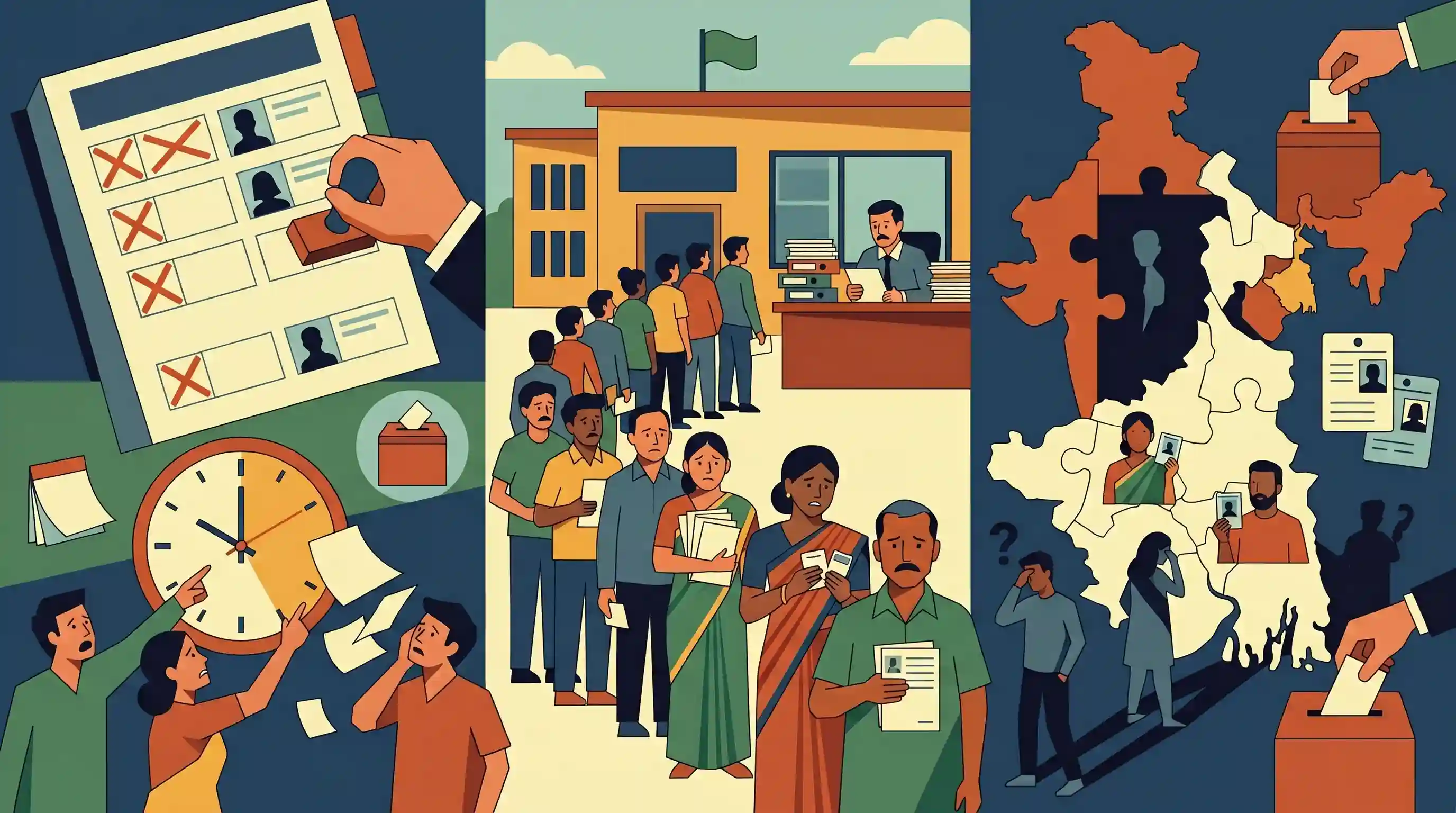
The article highlights the distress of voters in West Bengal who have discovered their names missing from the updated electoral rolls. Facing a race against time ahead of the elections, affected citizens are crowding outside Block Development Officer (BDO) offices to rectify the anomalies. Beyond the immediate loss of the constitutional right to vote, these sudden deletions have amplified deep-seated anxieties among marginalized communities, as being left off the voter list is increasingly viewed through the lens of citizenship fears linked to the CAA and NRC debates.
Key Points
- Numerous voters in West Bengal have found their names suddenly deleted from the electoral rolls, leading to a frantic rush to local BDO offices to restore their voting rights before elections.
- The unexpected disenfranchisement strips citizens of their Constitutional Right to vote (Article 326) and heightens distrust in the electoral roll maintenance process.
- Under the Representation of the People Act, 1950, maintaining accurate voter lists is a core administrative duty, often handled at the grassroots level by local officers like BDOs acting as Electoral Registration authorities.
- In the politically charged atmosphere of Bengal, deletion from the voter list is not just an electoral loss but triggers deep-seated anxieties about citizenship status amidst the broader CAA and NRC narratives.
Important Terms
Representation of the People Act 1950 (RPA)

An act providing for the allocation of seats, delimitation of constituencies, voter qualifications, and the preparation of electoral rolls for national and state elections.
UPSC context
GS II: Elections. Tests the statutory framework for electoral administration and voter eligibility criteria.
Election Commission of India (ECI)
A permanent constitutional body under Article 324 mandated to conduct, superintend, and control elections to the Parliament, State Legislatures, and the offices of President and Vice-President.
UPSC context
GS II: Constitutional Bodies. Tests understanding of independent institutions and "free and fair" election mandates.
Citizenship Amendment Act (CAA) 2019
A law granting fast-tracked citizenship to non-Muslim religious minorities from Afghanistan, Bangladesh, and Pakistan who entered India on or before December 31, 2014.
UPSC context
GS II: Citizenship. Tests constitutional provisions (Articles 5-11), equality (Article 14), and secularism.
National Register of Citizens (NRC)
An official record listing legal Indian citizens, intended to identify illegal immigrants. It was updated in Assam and remains a subject of nationwide debate.
UPSC context
GS II: Governance. Tests internal security, citizenship verification processes, and federal-state relations.
Block Development Office (BDO)
The administrative head at the block level responsible for implementing development schemes and serving as a crucial link for grassroots electoral registration.
UPSC context
GS II: Governance. Tests knowledge of administrative machinery for service delivery and local election management.
Prelims Trap
"The Representation of the People Act, 1951 governs the preparation, revision, and maintenance of electoral rolls."
The preparation and maintenance of electoral rolls fall strictly under the RPA 1950. The RPA 1951 deals with the actual conduct of elections, poll offenses, and disqualifications.
Static Concepts Connected
Is the Right to Vote in India a Constitutional, Statutory, or Fundamental Right?
- Constitutional Right: Article 326 mandates elections to the Lok Sabha and Legislative Assemblies on the basis of adult suffrage, establishing it as a Constitutional Right.
- Statutory backing: It is operationalized by the RPA 1950 and 1951. (Note: UPSC 2017 Prelims officially classified it as a Constitutional Right).
- Not a Fundamental Right: It is not a Part III Fundamental Right and therefore cannot be enforced directly via Article 32 writ petitions to the Supreme Court.
What is the primary division of scope between RPA 1950 and RPA 1951?
- RPA 1950: Focuses strictly on the preparation and revision of electoral rolls, voter qualifications, and delimitation of constituencies.
- RPA 1951: Covers the actual conduct of elections, administrative machinery for polls, corrupt practices, and the disqualification of representatives.
- Form 7 (Deletions): Under the Registration of Electors Rules, 1960 (linked to RPA 1950), Form 7 is used to request the deletion or object to the inclusion of a voter's name.
Cross-Topic Patterns
Electoral Rolls + Foreigners Act 1946
Missing voter names trigger citizenship panic because Section 9 of the Foreigners Act places a 'reverse burden of proof' on the individual to prove Indian citizenship, rather than the State proving otherwise.
Federal Friction + Grassroots ECI machinery
BDOs act as Electoral Registration Officers under ECI deputation. This dual-subordination (State government for daily admin, ECI for poll rolls) frequently causes friction and allegations of bias during highly charged state elections.

Expect a 2026 Prelims statement differentiating RPA 1950 (voter rolls) from RPA 1951 (conduct of polls) alongside Article 326 provisions.
Linked PYQs · 3
Linked PYQs · 3
- 2017PrelimsGS1
Right to vote and to be elected in India is a
- 2017PrelimsGS1
For election to the Lok Sabha, a nomination paper can be filed by
- 2024MainsGS2
Examine the need for electoral reforms as suggested by various committees with particular reference to "one nation one election" principle.
