Oslo Summit Highlights Strategic Need for India Northern Pivot
Source:The Hindu ↗
Why It Matters
This pivot highlights an emerging geographical focus in India's diplomacy. Understanding the Nordic-Arctic region's significance is critical for GS2 (International Relations/Bilateral Ties) and intersects with GS1 (Geography/Arctic resources).
Summary
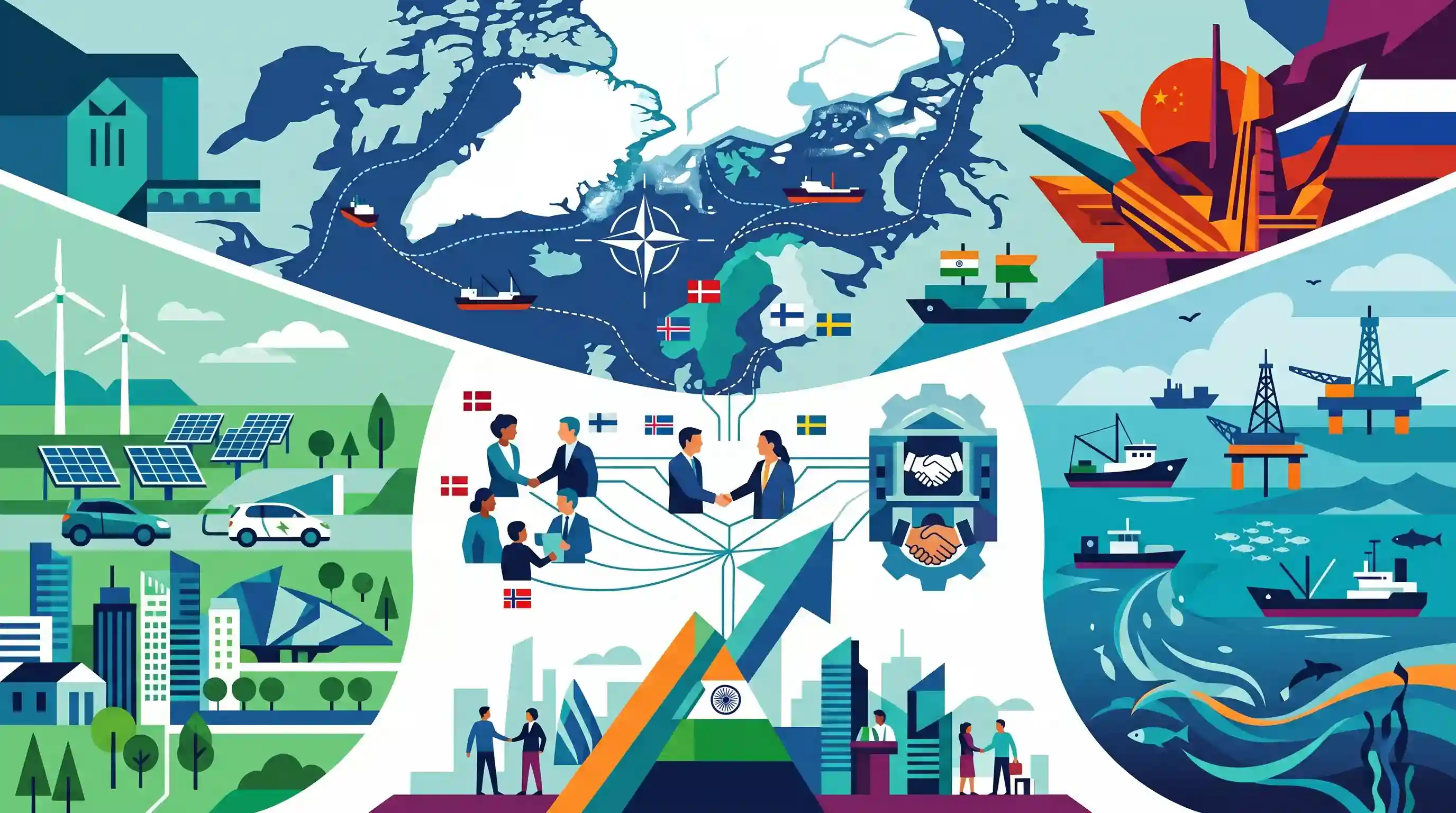
The article advocates for a strategic 'Northward turn' in India's foreign policy, leveraging the India-Nordic Summit in Oslo to deepen ties with Denmark, Finland, Iceland, Norway, and Sweden. This pivot is driven by the need for advanced green technologies, investments in sustainable development, and expertise in the blue economy. Furthermore, the changing geopolitical landscape—marked by the expansion of NATO in the region and the growing strategic significance of the Arctic due to melting ice and newly accessible maritime routes—makes the Nordic partnership crucial. Strengthening these ties allows India to secure its geoeconomic interests in the Arctic while counterbalancing the increasing Sino-Russian influence in the High North.
Key Points
- The Oslo India-Nordic Summit presents an opportunity for India to execute a strategic 'Northward turn' in its foreign policy, complementing its established Act East and Look West strategies.
- The Nordic nations are vital partners for India's sustainable growth, offering advanced capital, innovation, and expertise in green transitions, renewable energy, and the blue economy.
- Changing geopolitical dynamics, particularly the recent inclusion of Finland and Sweden into NATO, have elevated the strategic importance of Northern Europe.
- The rapid melting of Arctic ice is opening new maritime transit routes and providing access to untapped natural resources, making the region geoeconomically critical.
- Deeper diplomatic and strategic collaboration with Nordic countries will help India secure its interests in the High North and counterbalance the growing Sino-Russian footprint in the Arctic.
Important Terms
India's Arctic Policy

Launched in 2022, this whole-of-government framework focuses on scientific research, climate protection, and sustainable economic cooperation to enhance India's engagement in the Arctic region.
UPSC context
GS Paper 2 (International Relations); critical for assessing India's strategic interests in climate research, energy security, and polar governance.
India-Nordic Summit
A high-level diplomatic platform between India and the five Nordic nations—Denmark, Finland, Iceland, Norway, and Sweden—collaborating on green transition, blue economy, and innovation.
UPSC context
GS Paper 2 (Bilateral/Regional Groupings); evaluates India’s outreach to technology-rich partners for sustainable development and environmental cooperation.
Arctic Council
The primary intergovernmental forum for Arctic cooperation, environmental protection, and sustainable development. India has held permanent 'Observer' status in this council since 2013.
UPSC context
GS Paper 2 (International Institutions); tests knowledge of India's role in polar diplomacy and its scientific footprint in the High North.
NATO (North Atlantic Treaty Organization)
A transatlantic political and military alliance; its recent expansion to include Finland (2023) and Sweden (2024) has significantly reshaped the security architecture of the Arctic region.
UPSC context
GS Paper 2 (Global Groupings); important for understanding geopolitical realignments and the impact of Western security architecture on India's interests.
Blue Economy
An economic model promoting the sustainable use of ocean resources for economic growth and improved livelihoods while preserving the health of the marine ecosystem.
UPSC context
GS Paper 3 (Economy/Environment); tests India’s maritime strategy, including the Deep Ocean Mission and coastal resource management.
Northern Sea Route (NSR)
A maritime passage along Russia's Arctic coast that could reduce shipping times between Europe and Asia by up to 40% compared to the Suez Canal route.
UPSC context
GS Paper 1 (Geography) and Paper 2 (IR); concerns global trade shifts and India's strategic partnership with Russia in the Arctic.
Prelims Trap
"The Arctic Council acts as a regulatory body to resolve military and boundary disputes in the High North."
The 1996 Ottawa Declaration that established the Arctic Council explicitly excludes matters related to military security and boundary disputes from its mandate.
Static Concepts Connected
What is the mandate and composition of the Arctic Council?
- Mandate: Established by the 1996 Ottawa Declaration to promote cooperation on sustainable development and environmental protection.
- Members: Comprises 8 member states (Canada, Denmark, Finland, Iceland, Norway, Russia, Sweden, US).
- India's Role: India has been an Observer since 2013 and actively conducts research via its Himadri station.
What is the geographic and economic significance of the Northern Sea Route (NSR)?
- Location: A shipping lane spanning the Russian Arctic coast from the Barents Sea to the Bering Strait.
- Economic Edge: Drastically cuts transit time between Europe and Asia by 30-40% compared to the traditional Suez Canal route.
- Limitations: Requires icebreaker assistance, but rapid Arctic warming is increasing the number of navigable days annually.
Cross-Topic Patterns
Arctic warming & Indian monsoon
The teleconnection between melting Arctic sea ice and shifts in the Indian summer monsoon rainfall links global geopolitical forums directly to India's domestic agricultural security and climate modeling.
Green tech & India's climate targets
Nordic expertise in offshore wind, green shipping, and carbon capture (CCS) fits perfectly into India's Panchamrit climate targets, blending diplomatic outreach with deep-tech climate financing.

A multi-statement Prelims question merging the geographic scope of the Northern Sea Route, Arctic Council's mandate, and Nordic NATO expansion is highly probable in 2026.
Linked PYQs · 4
Linked PYQs · 4
- 2018MainsGS1
Why is India taking keen interest in resources of Arctic Region?
- 2023MainsGS2
‘The expansion and strengthening of NATO and a stronger US-Europe strategic partnership works well for India.’ What is your opinion about this statement ? Give reasons and examples to support your answer.
- 2015MainsGS1
What are the economic significances of discovery of oil in Arctic Sea and its possible environmental consequences?
- 2021MainsGS1
How do the melting of the Arctic ice and glaciers of the Antarctic differently affect the weather patterns and human activities on the Earth? Explain.
