Amartya Sen highlights concerns over weakening secularism in India
Source:Indian Express ↗
Why It Matters
Secularism and the spirit of tolerance are core themes in the UPSC syllabus across GS1 (Indian Society), GS2 (Polity and Constitution), and GS4 (Ethics). Amartya Sen's critique highlights the contemporary challenges to India's unique model of secularism, making it highly relevant for essay topics and mains questions evaluating the changing nature of pluralism, assimilation, and constitutional morality in modern India.
Summary
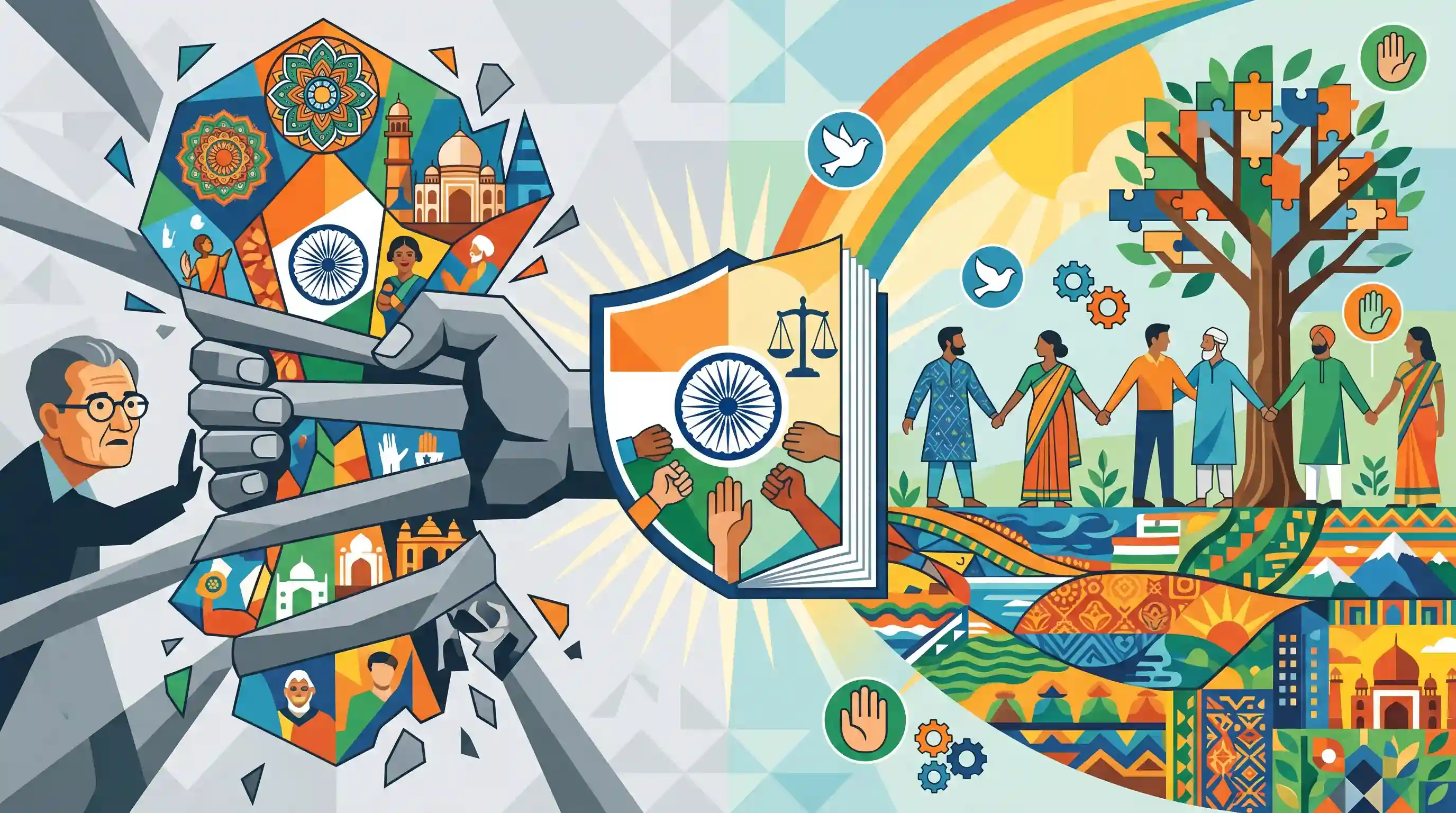
Nobel laureate Amartya Sen has expressed deep concern over the weakening of secularism in India, characterizing this trend as an "organised thrusting of smallness." He emphasizes the foundational importance of pluralism, tolerance, and broad-mindedness in Indian society, arguing that narrowing the focus of national identity runs counter to India's long-standing constitutional and cultural values. This discourse underscores the significance of secularism not merely as a legal or constitutional mandate, but as an essential societal element required for maintaining social harmony, promoting constitutional morality, and preserving India's diverse socio-cultural fabric.
Key Points
- Nobel laureate Amartya Sen has warned about the gradual weakening of secularism in India, terming it an "organised thrusting of smallness."
- Sen emphasizes that undermining secularism poses a threat to India's historically rich, diverse cultural fabric and its pluralistic heritage.
- The remarks underscore the importance of reaffirming constitutional values, tolerance, and social harmony against narrow, exclusionary identity markers.
- Indian secularism is highlighted as an inclusive framework that relies inherently on broad-mindedness, assimilation, and mutual respect rather than merely state neutrality.
Important Terms
Secularism (Indian Context)

The Indian 'positive' secular model where the state maintains a 'principled distance' from all religions, ensuring equal treatment (Sarva Dharma Sambhava) and the right to social reform.
UPSC context
GS II (Polity); tests the distinction between Indian 'principled distance' and Western 'strict separation' models.
Constitutional Morality
Adherence to core constitutional values like justice, liberty, and equality, prioritizing the spirit of the document over literal text or prevailing social prejudices.
UPSC context
GS II (Judiciary) and GS IV (Ethics); tests the application of democratic values in resolving socio-legal conflicts.
Pluralism
A socio-political philosophy recognizing and validating the coexistence of diverse ethnic, religious, and linguistic groups, summarized by the motto 'Unity in Diversity.'
UPSC context
GS I (Diversity of India); tests understanding of India’s composite culture and the protection of minority identities.
Communalism
An ideology that constructs identity based on religious affiliation, often leading to social antagonism, political polarization, and threats to national integration.
UPSC context
GS I (Indian Society); a frequent topic concerning challenges to secularism and social harmony.
Basic Structure Doctrine
A judicial principle (Kesavananda Bharati case) holding that Parliament cannot amend fundamental features of the Constitution, such as secularism, democracy, or judicial review.
UPSC context
GS II (Polity); critical for understanding the limits of parliamentary power and judicial independence.
Constitution of India
The supreme law of India, establishing the political framework and fundamental rights, enshrining the nation as a sovereign, socialist, secular, and democratic republic.
UPSC context
GS II (Polity); the primary source for most questions on Indian governance, laws, and rights.
Sarva Dharma Sambhava
A Sanskrit phrase meaning 'equal respect for all religions,' representing the moral and philosophical foundation of Indian secularism and communal harmony.
UPSC context
GS I (Indian Society) and GS II (Preamble); tests the cultural roots of India's democratic framework.
Prelims Trap
"The Indian Constitution mandates a strict and absolute separation between religion and the State."
Indian secularism follows 'principled distance', allowing state intervention in religious affairs for social reform (e.g., abolishing untouchability), unlike Western mutual exclusion.
Static Concepts Connected
How does the Indian concept of secularism differ from the Western model?
- Western Model: Relies on strict mutual exclusion and non-interference between religion and the State (e.g., USA, France).
- Principled Distance: India allows state intervention in religious affairs to enact progressive social reforms, such as abolishing untouchability or discriminatory practices.
- Positive Secularism: Embraces 'Sarva Dharma Sambhava' (equal respect to all religions), providing state support to minority institutions, whereas Western secularism is strictly negative.
What constitutes 'Constitutional Morality' in the Indian context?
- Beyond Literal Text: Refers to adherence to core democratic ideals—liberty, equality, and fraternity—rather than merely abiding by the written legal text.
- Anti-Majoritarianism: Serves as a vital safeguard against the tyranny of the majority, actively protecting pluralism and minority rights (reaffirmed in the Navtej Singh Johar case).
- Ambedkar's Warning: Dr. B.R. Ambedkar famously noted that it is not a natural sentiment in Indian society and must be actively cultivated to prevent democratic collapse.
Cross-Topic Patterns
Capability Approach & Fundamental Rights
Amartya Sen's 'capability approach' connects individual freedoms with basic education and health, mirroring the Supreme Court's expansive reading of Article 21 (Right to Life with dignity).
Medieval Travelers & Social Pluralism
The reference to Ibn Battuta documenting 14th-century Kerala's matrilineal society links modern secularism/diversity debates to medieval historical accounts heavily favored in Prelims.

Expect a Prelims conceptual question differentiating Indian secularism (principled distance) from the French model (laïcité) in 2026.
Linked PYQs · 5
Linked PYQs · 5
- 2024MainsGS2
Discuss India as a secular state and compare with the secular principles of the US constitution.
- 2019MainsGS2
What can France learn from the Indian Constitution's approach to secularism?
- 2022MainsGS1
Are tolerance, assimilation and pluralism the key elements in the making of an Indian form of secularism? Justify your answer.
- 2018MainsGS1
How the Indian concept of secularism is different from the western model of secularism? Discuss.
- 2017MainsGS1
The spirit of tolerance and love is not only an interesting feature of Indian society from very early times, but it is also playing an important part at the present. Elaborate.
