Phalguni River Industrial Pollution and Regulatory Board Failures
Source:The Hindu ↗
Why It Matters
This article provides an excellent case study for Mains GS3 answers on industrial river pollution and the enforcement failures of State Pollution Control Boards. It also directly ties into Mains GS2 topics regarding the role of environmental pressure groups holding government agencies accountable.
Summary
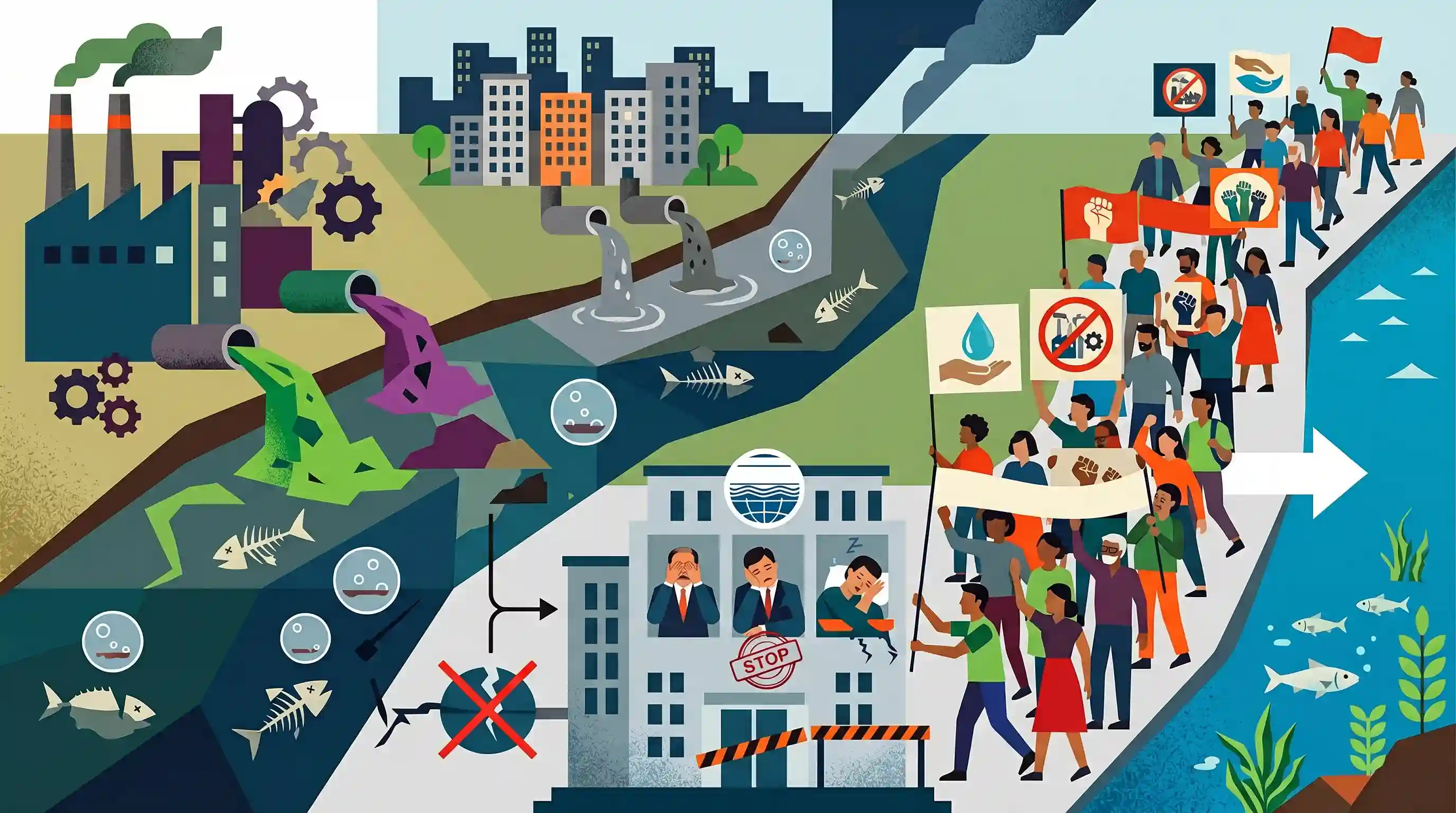
Civic organizations and the Phalguni Nadi Ulisi Horata Samithi organized a 'KSPCB Chalo' march in Mangaluru, demanding immediate action against the severe pollution of the Phalguni river. The protesters highlighted that untreated industrial effluents from the Baikampady Industrial Area and raw domestic sewage from the Mangaluru City Corporation are choking the river, causing dissolved oxygen levels to plummet and resulting in mass aquatic mortality. They criticized the Karnataka State Pollution Control Board (KSPCB) for its regulatory failures and the Karnataka Industrial Area Development Board (KIADB) for not setting up a Common Effluent Treatment Plant (CETP). The movement underscores the growing role of civil society in environmental governance.
Key Points
- Civic organisations staged a protest march against the Karnataka State Pollution Control Board (KSPCB) over the severe pollution of the Phalguni (Gurupura) river in Mangaluru.
- The river is being contaminated by untreated industrial effluents from the Baikampady Industrial Area and domestic sewage discharged by the Mangaluru City Corporation.
- Pollution has caused dissolved oxygen levels to drop to zero, resulting in mass deaths of aquatic life and rendering nearby well water unfit for human consumption.
- Protesters highlighted the failure of the Karnataka Industrial Area Development Board (KIADB) to establish a functional Common Effluent Treatment Plant (CETP) for local industries.
- The agitation exemplifies the role of local environmental pressure groups in demanding accountability from statutory environmental bodies.
Important Terms
Common Effluent Treatment Plant (CETP)

A centralized facility established to treat wastewater from multiple industrial units in a cluster, enabling small-scale industries to achieve regulatory compliance and economies of scale.
UPSC context
GS-III (Environment & Pollution); tests understanding of industrial waste management, sustainable development, and the 'Polluter Pays Principle'.
Karnataka State Pollution Control Board (KSPCB)
A statutory body established under the Water Act (1974) responsible for monitoring pollution, enforcing environmental laws, and granting industrial consents in Karnataka.
UPSC context
GS-II (Statutory/Regulatory Bodies); tests the role and effectiveness of state agencies in environmental governance and law enforcement.
Karnataka Industrial Area Development Board (KIADB)
A statutory organization tasked with promoting industrial development in Karnataka through land acquisition and infrastructure provision, including the obligation to mitigate environmental impacts.
UPSC context
GS-III (Industrial Growth/Infrastructure); tests knowledge of state-led industrialization and its friction with environmental conservation.
Phalguni Nadi Ulisi Horata Samithi
A Mangaluru-based civil society organization and environmental pressure group dedicated to the protection and rejuvenation of the Phalguni (Gurupura) river.
UPSC context
GS-II (Role of NGOs and Pressure Groups); an example of public participation in governance to demand accountability for environmental degradation.
Mangaluru City Corporation (MCC)
The local urban governing body responsible for providing civic infrastructure, including sewage treatment and solid waste management, under the 74th Constitutional Amendment Act.
UPSC context
GS-II (Local Governance); tests the functions and failures of Urban Local Bodies (ULBs) in managing public health and environment.
Prelims Trap
"State Pollution Control Boards derive their statutory origin from the Environment (Protection) Act, 1986."
SPCBs and the CPCB were originally constituted under the Water (Prevention and Control of Pollution) Act, 1974, not the Environment (Protection) Act, 1986.
Static Concepts Connected
How do untreated effluents alter biological oxygen demand (BOD) and dissolved oxygen (DO)?
- High BOD: Influx of organic waste triggers rapid microbial decomposition, dramatically increasing oxygen consumption in the water body.
- DO Depletion: As bacteria consume oxygen, Dissolved Oxygen levels plummet, creating hypoxic conditions.
- Aquatic Mortality: When DO drops below critical thresholds (typically below 4 mg/L), fish and other aquatic flora suffocate, leading to mass mortality events.
What is the statutory framework governing State Pollution Control Boards (SPCBs)?
- Water Act 1974: SPCBs were originally established as statutory bodies under the Water (Prevention and Control of Pollution) Act, 1974.
- Air Act 1981: They were subsequently entrusted with additional functions and powers under the Air (Prevention and Control of Pollution) Act, 1981.
- EPA 1986: SPCBs act as key enforcement agencies for various hazardous waste and pollution rules framed under the broader EPA 1986.
Cross-Topic Patterns
Minor West-Flowing Rivers & Estuaries
UPSC frequently targets minor peninsular rivers. The Phalguni (Gurupura) and Netravati share a sensitive estuarine ecosystem at Mangaluru before joining the Arabian Sea.
SMEs & Industrial Infrastructure (CETP)
MSMEs often lack the capital for individual treatment units. GS3 links the lack of centralized Common Effluent Treatment Plant (CETP) infrastructure directly to ecological degradation.

Expect Prelims questions pairing minor west-flowing rivers (Phalguni, Netravati) with estuarine ecosystems and water chemistry parameters.
Linked PYQs · 3
Linked PYQs · 3
- 2024MainsGS3
Industrial pollution of river water is a significant environmental issue in India. Discuss the various mitigation measures to deal with this problem and also the government's initiatives in this regard.
- 2017PrelimsGS1
Biological Oxygen Demand (BOD) is a standard criterion for
- 2025MainsGS2
What are environmental pressure groups? Discuss their role in raising awareness, influencing policies and advocating for environmental protection in India.
