Supreme Court Petition Seeks Mandatory Surprise Flight Audits
Source:The Hindu ↗
Why It Matters
Highlights the critical issue of aviation safety regulation in India, the accountability of statutory bodies like the DGCA, and expands the constitutional interpretation of Article 21 to include public safety in commercial transportation.
Summary
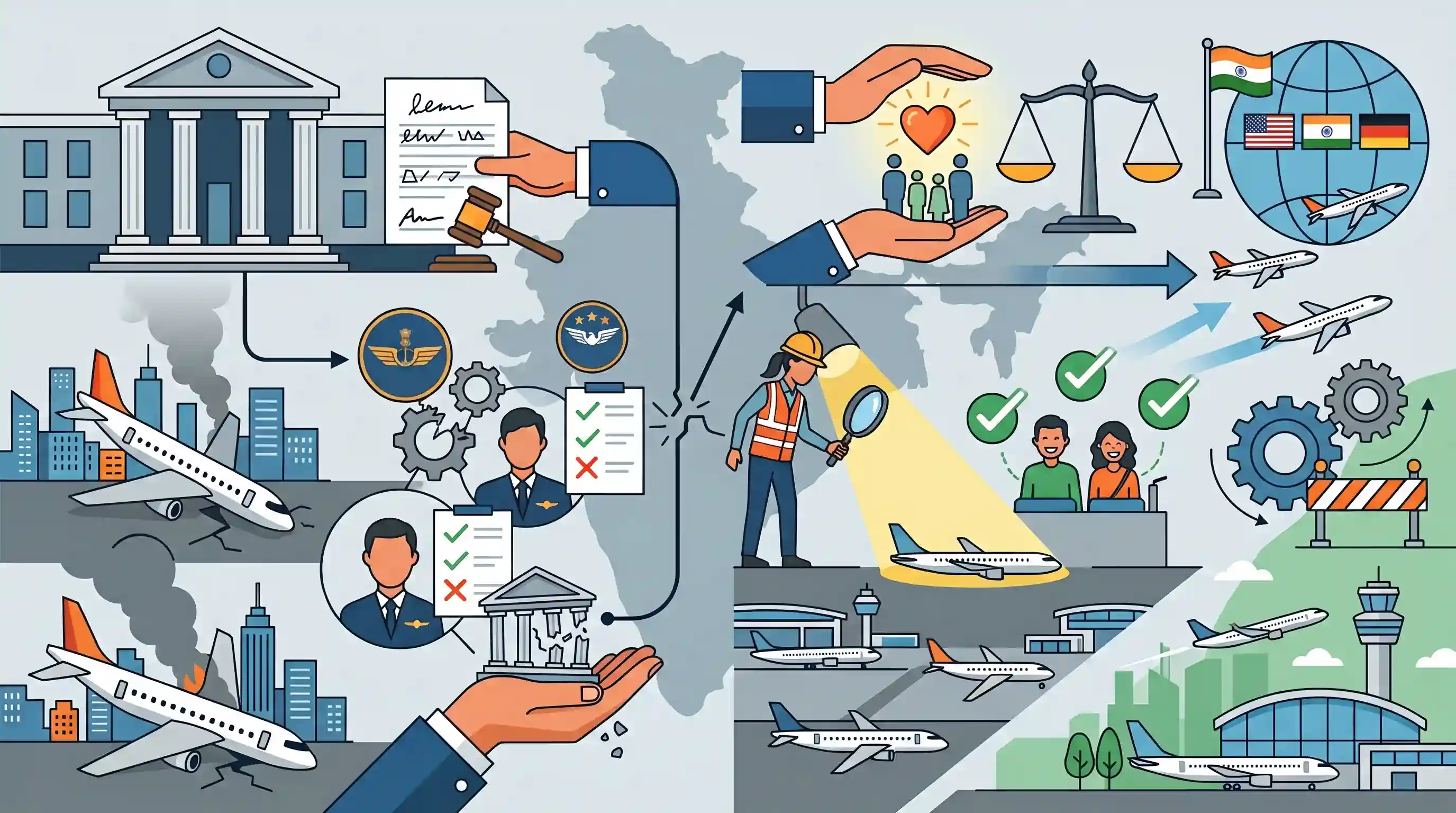
A petition filed in the Supreme Court seeks surprise safety audits of all flights operating in India, prompted by a recent Air India crash in Ahmedabad. The plea blames systemic failures on lax enforcement by the Directorate General of Civil Aviation (DGCA) and the Bureau of Civil Aviation Security (BCAS). The petitioner alleges that these safety lapses violate passengers' fundamental right to life under Article 21 and demands adherence to international aviation safety standards.
Key Points
- A petition in the Supreme Court demands surprise audits of all flights following the tragic Air India flight AI171 crash in Ahmedabad.
- The petitioner asserts that systemic failures and lax safety enforcement violate the fundamental right to life of passengers under Article 21.
- Civil aviation regulators like the DGCA and BCAS are accused of failing to properly enforce the Aircraft Act, 1934 and Aircraft Rules, 1937.
- The plea seeks the suspension of Air India's Boeing fleet for an immediate safety audit and adherence to international safety standards (FAA FAR 25, EASA CS-25).
Important Terms
Directorate General of Civil Aviation (DGCA)

A statutory body under the Ministry of Civil Aviation that regulates civil aviation safety, airworthiness standards, and licensing of personnel in India.
UPSC context
GS Paper 2 (Statutory Bodies) and GS Paper 3 (Infrastructure). Tests knowledge of regulatory frameworks and safety oversight.
Bureau of Civil Aviation Security (BCAS)
The national regulator responsible for safeguarding civil aviation operations against unlawful interference, such as hijackings, and setting aviation security standards.
UPSC context
GS Paper 3 (Internal Security/Infrastructure). Crucial for understanding specialized agencies managing transport security and international protocol compliance.
Article 21
A fundamental right guaranteeing that no person shall be deprived of their life or personal liberty except according to procedure established by law.
UPSC context
GS Paper 2 (Polity/Fundamental Rights). Tests the evolving judicial interpretation of safety and dignity as components of the 'Right to Life'.
Aircraft Act, 1934
The primary legislation governing the manufacture, possession, use, and operation of aircraft in India; currently being replaced by the Bharatiya Vayuyan Adhiniyam, 2024.
UPSC context
GS Paper 3 (Infrastructure/Legal reforms). Tests awareness of colonial-era laws being modernized to align with international safety standards.
International Civil Aviation Organization (ICAO)
A specialized UN agency established by the Chicago Convention (1944) that sets global standards and recommended practices for international civil aviation safety and security.
UPSC context
GS Paper 2 (International Institutions). Tests understanding of how global bodies influence domestic regulatory policies and safety audits.
Aircraft Rules, 1937
Subordinate legislation issued under the Aircraft Act that provides detailed technical requirements for flight operations, airworthiness, and the licensing of aviation personnel.
UPSC context
GS Paper 3 (Infrastructure). Understanding the specific executive rules that translate broad legislative powers into daily aviation safety protocols.
Prelims Trap
"DGCA is responsible for civil aviation security, while BCAS is responsible for aviation safety."
UPSC frequently swaps these mandates in statements. DGCA regulates aviation safety and airworthiness, whereas BCAS exclusively handles aviation security (anti-hijacking, passenger screening).
Static Concepts Connected
What are the core mandates of India's primary aviation regulators?
- DGCA (Safety): Regulates civil aviation safety, airworthiness, and crew licensing. It was granted statutory status under the Aircraft (Amendment) Act, 2020.
- BCAS (Security): Ensures aviation security, including anti-hijacking measures and airport security protocols. It was established following the Pande Committee (1978) recommendations.
- AAIB (Investigation): The Aircraft Accident Investigation Bureau conducts independent investigations into aviation accidents and serious incidents, separating this function from DGCA's purview.
How does the Chicago Convention (1944) govern global civil aviation?
- ICAO Creation: It established the International Civil Aviation Organization (ICAO), a specialized UN agency that coordinates principles and techniques of global air navigation.
- Airspace Sovereignty: It established the foundational principle that every state possesses complete and exclusive sovereignty over the airspace directly above its territory.
- Accident Protocols: Under Annex 13, it dictates international protocols for aircraft crash investigations, permitting participation from the aircraft's 'State of Design' and 'State of Manufacture'.
Cross-Topic Patterns
Article 21 Expansion: Infrastructure Safety
The Supreme Court continuously expands Article 21 to encompass a safe public environment, allowing PILs to frame regulatory negligence in infrastructure or aviation as a direct violation of fundamental rights.
Judicial Review vs. Technical Governance
Petitions demanding courts order complex, technical safety audits or fleet groundings highlight the tension between judicial activism and the executive domain, often bordering on judicial overreach.

Expect a prelims pair-matching question mapping aviation bodies (DGCA, BCAS, AAIB) to their exact safety/security mandates.
Linked PYQs · 3
Linked PYQs · 3
- 2014MainsGS3
International civil aviation laws provide all countries complete and exclusive sovereignty over the airspace above their territory. What do you understand by 'airspace'? What are the implications of these laws on the space above this airspace? Discuss the challenges which this poses and suggest ways to contain the threat.
- 2016MainsGS2
What is a quasi-judicial body? Explain with the help of concrete examples.
- 2024MainsGS2
Right to privacy is intrinsic to life and personal liberty and is inherently protected under Article 21 of the constitution. Explain. In this reference discuss the law relating to D.N.A. testing of child in the womb to establish its paternity.
