Orangutan Discovery in Odisha and Exotic Wildlife Trade Regulation
Source:Indian Express ↗
ఇది ఎందుకు ముఖ్యం
The illegal trade of exotic non-native wildlife poses severe biosecurity, animal welfare, and conservation concerns in India. Understanding the interplay between CITES, domestic wildlife laws (Wildlife Protection Act), and enforcement mechanisms is crucial for GS3 Environment and Biodiversity.
సారాంశం
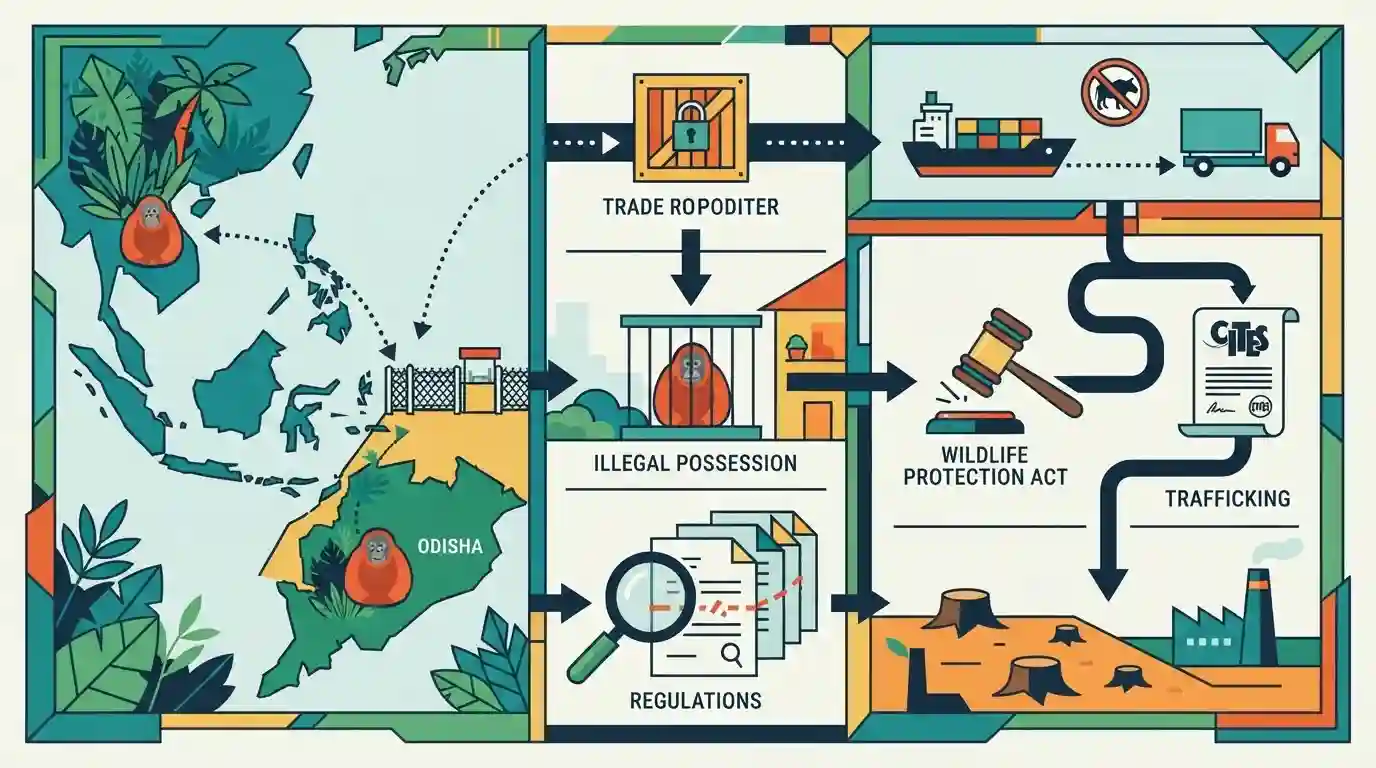
The discovery or presence of an orangutan—an exotic great ape native to Southeast Asia—in Odisha has brought attention to the illegal exotic pet trade in India. The case highlights how international wildlife trafficking networks bypass domestic and international regulations like CITES and India's Wildlife Protection Act, pointing to regulatory gaps regarding exotic animal possession and the challenges faced by enforcement agencies.
ముఖ్య అంశాలు
- An orangutan, a non-native great ape native to Southeast Asia (Sumatra and Borneo), was found/rescued or tracked in Odisha, highlighting the illegal exotic pet trade in India.
- Orangutans are protected under CITES Appendix I, which bans international commercial trade, and are critically endangered globally.
- India's Wildlife (Protection) Act, 1972 (and its recent amendments) and advisory norms by the Ministry of Environment, Forest and Climate Change (MoEFCC) regulate the voluntary disclosure and possession of exotic live species, but illegal smuggling remains a major conservation and security challenge.
- The incident underscores systemic loopholes in domestic enforcement, border checks, and the growing demand for exotic animals as status symbols among private collectors.
ముఖ్యమైన పదాలు
Wildlife (Protection) Act 1972

India's primary legislation for animal and plant conservation, which sets up protected schedules and incorporates CITES-listed species to penalize unauthorized wildlife trade and exotic animal possession.
UPSC context
UPSC Mains Paper III (Environment & Biodiversity). Tests knowledge of conservation laws, anti-poaching measures, and legal frameworks governing wildlife in India.
CITES Appendix I
The highest category under CITES covering species threatened with extinction, for which international commercial trade is strictly prohibited except under exceptional research or conservation circumstances.
UPSC context
UPSC Prelims/Mains. Tests understanding of international environmental conventions, endangered species protection, and global trade regulations on wildlife.
Wildlife Crime Control Bureau
A statutory multidisciplinary body under India's Ministry of Environment, Forest and Climate Change tasked with combating organized wildlife crime and enforcing CITES provisions.
UPSC context
UPSC Prelims. Tests familiarity with specialized environmental governance bodies, enforcement agencies, and their roles in tackling cross-border trafficking.
అనుసంధానమైన స్థిర భావనలు
What are the three appendices of CITES and their respective trade regulations?
- Appendix I:: Species threatened with extinction; international commercial trade is generally prohibited.
- Appendix II:: Species not necessarily threatened with extinction, but whose trade must be controlled to avoid utilization incompatible with their survival.
- Appendix III:: Species protected in at least one country, which has asked other CITES Parties for assistance in controlling trade.
అంతర-అంశ నమూనాలు
Wildlife Trafficking Meets CITES Treaty Obligations
The Wildlife Protection Amendment Act 2022 aligns domestic law with CITES Appendix obligations, bridging national borders and international environmental treaty compliance.

Exotic pet registration under WPA Amendment Act 2022 + CITES Appendices is a high-yield prelims matching area.
అనుసంధాన PYQలు · 3
అనుసంధాన PYQలు · 3
- 2017PrelimsGS1
In India, if a species of tortoise is declared protected under Schedule I of the Wildlife (Protection) Act, 1972, what does it imply?
- 2022PrelimsGS1
With reference to Indian laws about wildlife protection, consider the following statements : 1. Wild animals are the sole property of the government. 2. When a wild animal is declared protected, such animal is entitled for equal protection whether it is found in protected areas or outside. 3. Apprehension of a protected wild animal becoming a danger to human life is sufficient ground for its capture or killing. Which of the statements given above is/are correct?
- 2026PrelimsGS1
With respect to the Western Hoolock Gibbons, which of the following statements is/are correct? 1. A Sanctuary in North-east India is home to this ape species listed as Endangered in the International Union for Conservation of Nature (IUCN) Red List. 2. They have specialized brachiation and can easily swing between trees. 3. They possess a strong and heavy build like gorillas, yet are remarkably agile tree climbers. Select the answer using the code given below :
