Opposition walks out of Rajya Sabha over parliamentary rules dispute
Source:The Hindu ↗
Why It Matters
Highlights critical procedural aspects of the Indian Parliament, including the rules governing the Motion of Thanks, the convention against discussing one House's proceedings in the other, the suspension of MPs, and the role of Presiding Officers in managing House disruptions.
Summary
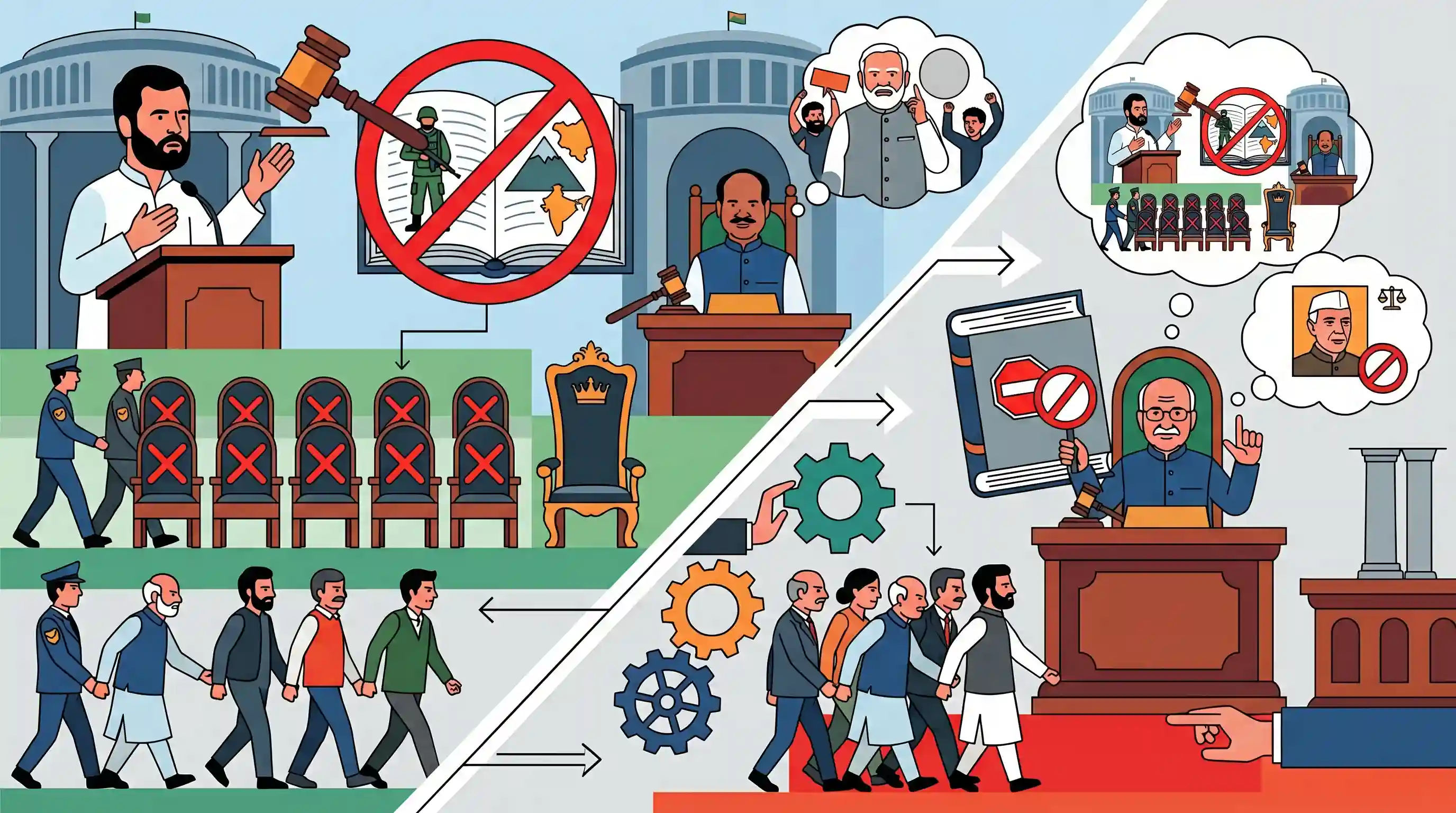
The Opposition staged a walkout in the Rajya Sabha to protest developments in the Lok Sabha, where Leader of the Opposition Rahul Gandhi was prevented from completing his speech on the Motion of Thanks to the President's address. Rajya Sabha Chairman C.P. Radhakrishnan disallowed the issue from being raised, invoking parliamentary rules and Jawaharlal Nehru's precedent against discussing one House's proceedings in another. The initial Lok Sabha disruption occurred after Gandhi was barred from quoting an article on former Army chief M.M. Naravane's unpublished memoir regarding the 2020 India-China conflict, which subsequently led to the suspension of eight Opposition MPs. Furthermore, Speaker Om Birla advised PM Narendra Modi not to attend proceedings to avoid potential aggressive protests by Congress members.
Key Points
- The Opposition walked out of the Rajya Sabha to protest the Lok Sabha Speaker preventing Rahul Gandhi from finishing his speech on the Motion of Thanks to the President's address.
- Rajya Sabha Chairman C.P. Radhakrishnan disallowed discussing Lok Sabha proceedings, citing parliamentary rules and a precedent established by Jawaharlal Nehru.
- Lok Sabha disruptions were triggered when Gandhi was blocked from quoting an article referencing former Army chief M.M. Naravane's unpublished memoir on the 2020 India-China conflict.
- Eight Opposition MPs were suspended from the Lok Sabha for causing disruptions following the incident.
- Speaker Om Birla advised Prime Minister Narendra Modi to stay away from the House citing 'concrete information' about potential aggressive actions by Congress members.
Important Terms
Rajya Sabha

The Upper House of India's Parliament, representing States and Union Territories. It is a permanent body with members serving six-year terms, where one-third retire every two years.
UPSC context
GS Paper II: Parliament structure, functioning, and federal representation of states in the legislative process.
Lok Sabha
The Lower House of Parliament, composed of directly elected representatives. It holds primary power over money bills and can dissolve the government via a no-confidence motion.
UPSC context
GS Paper II: Composition, powers, and role in ensuring executive accountability to the people.
Motion of Thanks
A parliamentary motion moved to discuss and thank the President for their special address (Article 87). Its defeat signifies a loss of confidence in the government.
UPSC context
GS Paper II: Parliamentary devices and procedures for scrutinizing government policies and executive accountability.
Leader of the Opposition
A statutory position held by the leader of the largest opposition party with at least 10% of seats. The role provides constructive criticism and an alternative government perspective.
UPSC context
GS Paper II: Role of parliamentary officials and the institutional framework for opposition in a democracy.
Article 87
Mandates the President to address both Houses of Parliament at the start of the first session after a general election and the first session of each year.
UPSC context
GS Paper II: Constitutional provisions regarding the President's role in Parliament and the legislative process.
Chairman of the Rajya Sabha
The Vice-President of India serves as the ex-officio Chairman, presiding over sessions, maintaining order, and interpreting rules. C.P. Radhakrishnan assumed this role in late 2025.
UPSC context
GS Paper II: Role and powers of the presiding officer in the Upper House.
INDIA bloc
The Indian National Developmental Inclusive Alliance (INDIA) is a big-tent political alliance of opposition parties formed to contest the 2024 general elections against the NDA.
UPSC context
GS Paper II: Political parties and pressure groups' impact on parliamentary functioning and election dynamics.
Prelims Trap
The Rajya Sabha Chairman has the identical power as the Lok Sabha Speaker to automatically suspend disruptive MPs.
Unlike the Lok Sabha Speaker (Rule 374A), the Rajya Sabha Chairman cannot automatically suspend an MP; the House must adopt a motion.
Static Concepts Connected
What are the constitutional mechanics of the Motion of Thanks?
- Constitutional mandate: Under Article 87, the President addresses both Houses assembled together at the start of the first session each year and after every general election.
- Test of majority: If the motion is defeated in the Lok Sabha, it amounts to the defeat of the government and forces its resignation. Defeat in the Rajya Sabha does not.
- Scope for amendments: Members can move amendments to the Motion. If passed by the House, these amendments are added to the final adopted text of the address.
What are the limits on an MP's freedom of speech in Parliament?
- Article 105 immunity: Article 105 grants MPs absolute immunity from court proceedings for anything said or any vote given inside Parliament or its committees.
- Procedural constraints: This freedom is not absolute; it is subject to the provisions of the Constitution and the internal rules and procedures of the House.
- Article 121 restriction: Article 121 strictly prohibits any discussion in Parliament regarding the conduct of any Supreme Court or High Court judge in the discharge of their duties.
Cross-Topic Patterns
Freedom of speech vs Presiding Officer powers
The recurring conflict between an MP's absolute immunity from courts under Article 105 and the Speaker's expansive internal disciplinary powers to expunge remarks or suspend members highlights shifting parliamentary accountability.
Military memoirs and official secrets classification
Referencing an unpublished military memoir in Parliament triggers secondary debates linking parliamentary privilege to the Official Secrets Act, national security classification, and civil-military information sharing protocols.

Expect a tricky Prelims statement comparing the RS Chairman and LS Speaker's suspension powers, paired with Motion of Thanks voting rules.
Linked PYQs · 2
Linked PYQs · 2
- 2023MainsGS2
Discuss the role of Presiding Officers of state legislatures in maintaining order and impartiality in conducting legislative work and in facilitating best democratic practices.
- 2021MainsGS2
To what extent, in your view, the Parliament is able to ensure accountability of the executive in India?
