Chief Election Commissioner Impeachment Provisions and Context
Source:Indian Express ↗
Why It Matters
It touches directly upon the institutional integrity, independence of constitutional bodies like the Election Commission of India, and the constitutional checks and balances involving Parliament's power of removal.
Summary
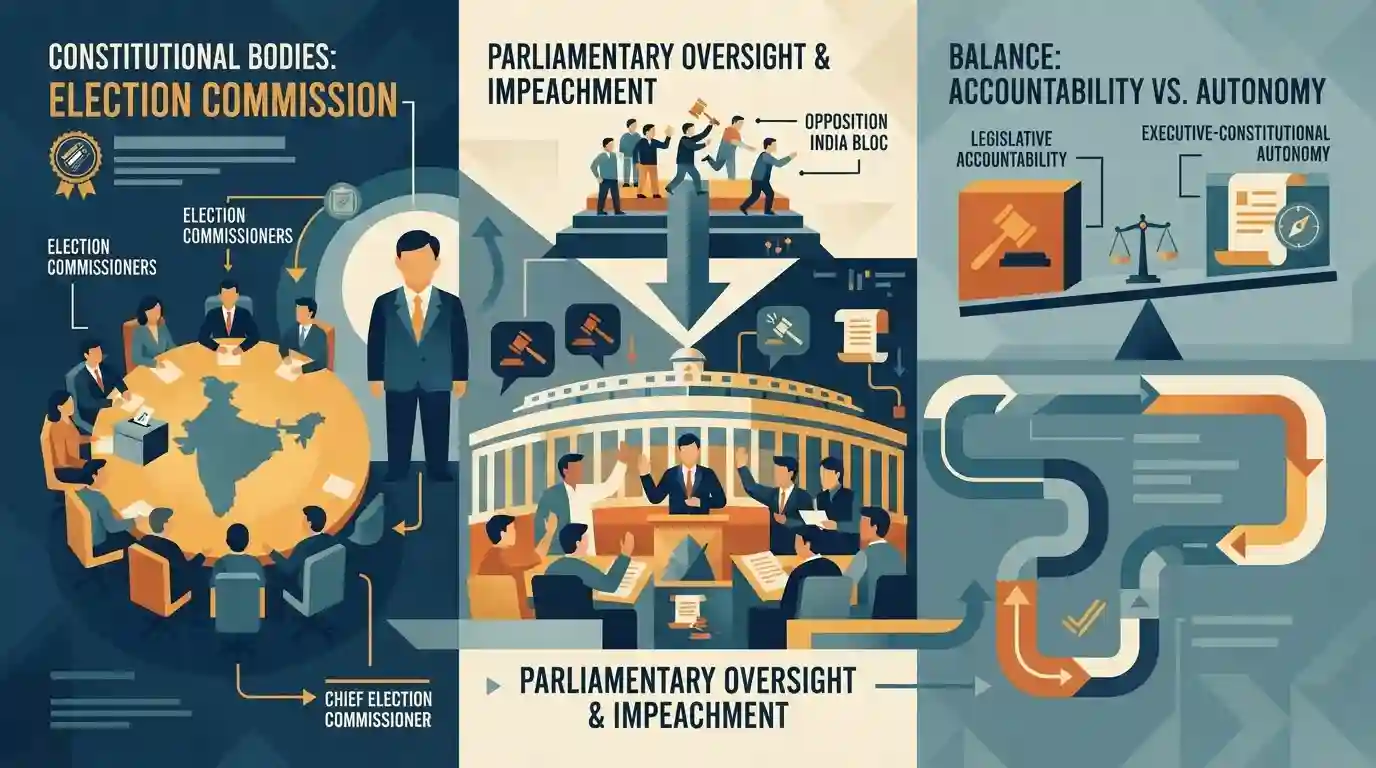
The opposition INDIA bloc is preparing to move an impeachment motion against Chief Election Commissioner Gyanesh Kumar, triggering discussions surrounding the constitutional provisions for removing high-status constitutional authorities, the independence of the Election Commission, and the delicate balance between legislative accountability and executive-constitutional autonomy.
Key Points
- The opposition INDIA bloc has announced plans to move an impeachment motion against Chief Election Commissioner (CEC) Gyanesh Kumar.
- The removal process of a Chief Election Commissioner is tied to the same constitutional mechanism as that of a Supreme Court judge, requiring special majorities in both Houses of Parliament.
- This development highlights intense political friction over the functioning, autonomy, and perception of neutrality of India's premier electoral oversight body.
Important Terms
Election Commission of India

A permanent, independent constitutional body established under Article 324 of the Constitution to ensure free and fair elections to Parliament, State Legislatures, and the offices of President and Vice-President.
UPSC context
GS Paper II (Indian Polity): Tests knowledge of constitutional bodies, appointment, security of tenure, and powers for ensuring democratic integrity.
Parliament
The supreme legislative organ of the Union, consisting of the President and two Houses (Lok Sabha and Rajya Sabha), vested with lawmaking authority and constitutional oversight powers.
UPSC context
GS Paper II (Indian Polity): Tests functions, legislative accountability, parliamentary oversight, and impeachment mechanisms for constitutional functionaries.
INDIA bloc
An opposition coalition of various political parties in India formed to challenge the ruling government in national elections.
UPSC context
GS Paper II (Indian Polity/Governance): Relevant for understanding contemporary party systems, coalition politics, and legislative opposition strategies.
Static Concepts Connected
What are the constitutional provisions for the appointment and removal of the Chief Election Commissioner of India?
- Article 324: Constitutional basis: Article 324 of the Constitution vests superintendence, direction, and control of elections in the Election Commission.
- Special Majority: Removal procedure: The CEC can be removed only through an address by both Houses of Parliament supported by a special majority on grounds of proved misbehaviour or incapacity.
- Asymmetric Protection: Asymmetry: Other Election Commissioners can be removed by the President only upon the recommendation of the Chief Election Commissioner.
Cross-Topic Patterns
CEC Impeachment and Judicial Accountability Standards
Discussions on CEC removal directly mirror debates on judicial accountability, emphasizing the complex constitutional checks required to safeguard independent pillars of democracy.
Parliamentary Oversight vs Constitutional Autonomy
Efforts to alter Election Commission appointments and removal mechanisms intersect with legislative oversight, highlighting tensions between parliamentary democracy and independent constitutional bodies.

Expect statement-based prelims questions on Article 324(5) distinguishing CEC removal grounds from other Election Commissioners.
Linked PYQs · 2
Linked PYQs · 2
- 2024MainsGS2
Examine the need for electoral reforms as suggested by various committees with particular reference to "one nation one election" principle.
- 2019PrelimsGS1
Consider the following statements: 1. The motion to impeach a Judge of the Supreme Court of India cannot be rejected by the Speaker of the Lok Sabha as per the Judges (Inquiry) Act, 1968. 2. The Constitution of India defines and gives details of what constitutes 'incapacity and proved misbehaviour' of the Judges of the Supreme Court of India. 3. The details of the process of impeachment of the Judges of the Supreme Court of India are given in the Judges (Inquiry) Act, 1968. 4. If the motion for the impeachment of a Judge is taken up for voting, the law requires the motion to be backed by each House of the Parliament and supported by a majority of total membership of that House and by not less than two-thirds of total members of that House present and voting. Which of the statements given above is/are correct?
