Rajya Sabha Debate Focuses on Inflation and Economic Inequality
Source:The Hindu ↗
Why It Matters
The article captures the fundamental dichotomy in the Indian economy—rapid aggregate GDP growth and digital transformation versus structural challenges like youth unemployment, inflation, and widening wealth inequality. These contrasting viewpoints form the basis for critically analyzing inclusive growth, a key theme in GS Paper 3.
Summary
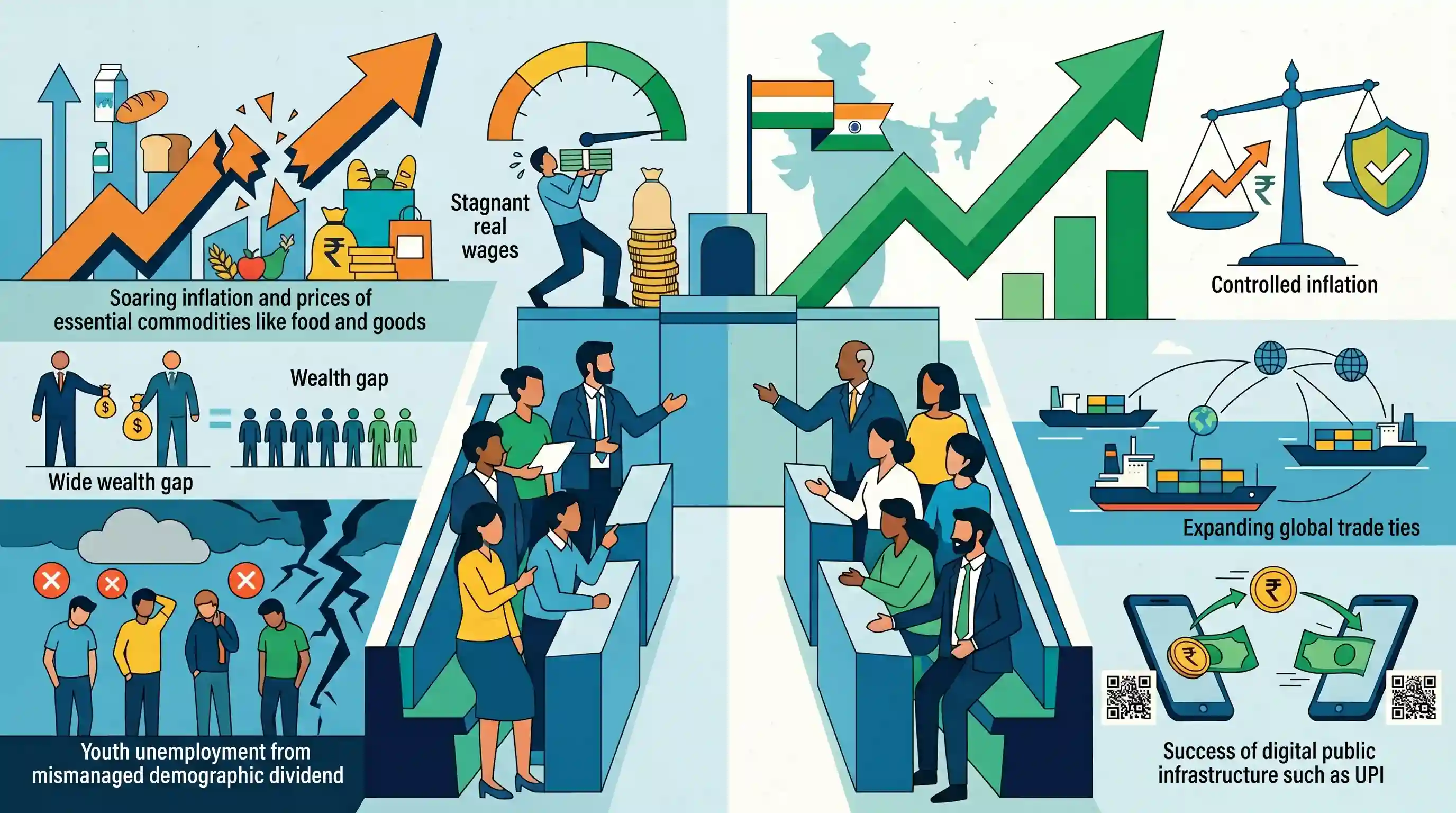
During a Rajya Sabha debate on the Union Budget, Opposition and Treasury benches clashed over the state of the Indian economy. Opposition MPs highlighted issues such as rising inflation, soaring prices of essential commodities, and stagnant real wages. Concerns were raised over widening wealth inequality and rising youth unemployment, with warnings that the demographic dividend could become a liability and lead to social upheaval. The ruling BJP defended its economic performance by citing controlled inflation, robust GDP growth making India the fastest-growing major economy, expanding global trade ties, and the success of digital public infrastructure like UPI.
Key Points
- Opposition members in the Rajya Sabha criticized the government over rising prices of essential commodities, stagnant real wages, and rising youth unemployment during the Union Budget debate.
- Trinamool Congress MP Sukhendu Sekhar Roy warned of potential social upheaval due to skyrocketing income inequality between the rich and the poor.
- RJD MP Manoj Jha cautioned that without addressing unemployment, India's demographic dividend could turn into a demographic liability.
- BJP members defended the government's economic record, highlighting controlled inflation compared to the UPA era, India's status as the fastest-growing major economy, and massive adoption of digital payments (UPI).
- The debate also touched upon the failure to create domestic demand, alleged anti-labour policies, and the farmers' demand for a legal minimum support price (MSP).
Important Terms
Union Budget

The Annual Financial Statement presented under Article 112 of the Constitution, detailing the estimated receipts and expenditures of the Indian government for a specific financial year.
UPSC context
GS Papers II & III: Tests understanding of constitutional budgeting processes and economic resource mobilization.
Demographic Dividend
Economic growth potential resulting from shifts in a population's age structure, specifically when the working-age population (15–64) is larger than the non-working-age share.
UPSC context
GS Papers I & III: Relevant for population dynamics, human capital development, and employment challenges.
Minimum Support Price (MSP)
The guaranteed minimum price set by the government, based on CACP recommendations, to purchase crops from farmers, ensuring price stability and food security.
UPSC context
GS Paper III: Crucial for agriculture, food security, and government intervention in market pricing.
Unified Payments Interface (UPI)
A real-time payment system developed by the National Payments Corporation of India (NPCI) allowing instant inter-bank money transfers via mobile platforms.
UPSC context
GS Paper III: Tests knowledge of digital public infrastructure and financial inclusion technologies.
Rajya Sabha
The permanent Upper House of India's Parliament (Council of States) representing States and Union Territories, providing a federal check on the Lok Sabha.
UPSC context
GS Paper II: Essential for understanding federalism, legislative scrutiny, and parliamentary functions.
Inclusive Growth
Economic growth that creates opportunities for all segments of society while reducing wealth inequality and ensuring equitable distribution of gains.
UPSC context
GS Paper III: Core concept for topics on development, poverty alleviation, and social justice.
Prelims Trap
A rising proportion of working-age population automatically guarantees an increase in India's GDP growth rate.
A demographic dividend requires enablers like skilling and job creation. Without productive employment, the youth bulge causes unemployment, becoming a demographic liability.
Static Concepts Connected
How is economic inequality quantified through economic curves and coefficients?
- Lorenz Curve: A graphical representation showing the proportion of overall income or wealth held by a specific percentage of the population.
- Gini Coefficient: A mathematical ratio derived from the Lorenz curve. A value of 0 indicates perfect equality, while 1 signifies maximum inequality.
What is the economic distinction between nominal wages and real wages?
- Nominal Wages: The exact monetary amount a worker is paid, without any adjustments for inflation or the prevailing cost of living.
- Real Wages: Nominal wages adjusted for inflation. Stagnant real wages mean a worker's purchasing power remains unchanged even if nominal pay rises.
Cross-Topic Patterns
Jobless Growth vs Demographic Dividend
High GDP growth coupled with low employment elasticity reflects 'jobless growth', shifting the demographic dividend from a guaranteed asset to a potential social liability.
K-Shaped Recovery and Inequality
The stark contrast between robust corporate digital growth (UPI) and stagnant rural real wages echoes the structural challenges of a K-shaped economic recovery.

Expect a Prelims question in 2026 contrasting headline GDP growth figures with qualitative development metrics like real wages and Gini.
Linked PYQs · 4
Linked PYQs · 4
- 2022MainsGS3
Is inclusive growth possible under market economy ? State the significance of financial inclusion in achieving economic growth in India.
- 2014MainsGS3
While we flaunt India's demographic dividend, we ignore the dropping rates of employability. What are we missing while doing so? Where will the jobs that India desperately needs come from? Explain.
- 2022MainsGS3
Economic growth in the recent past has been led by increase in labour productivity." Explain this statement. Suggest the growth pattern that will lead to creation of more jobs without compromising labour productivity.
- 2024MainsGS3
What are the causes of persistent high food inflation in India? Comment on the effectiveness of the monetary policy of the RBI to control this type of inflation.
