Rajya Sabha adjourned over absence of Union ministers
Source:The Hindu ↗
Why It Matters
It demonstrates the practical application of parliamentary conventions and the friction between the Opposition and the Executive over ministerial presence, relevant for studying the functioning of Indian Parliament and the mechanisms of holding the executive accountable.
Summary
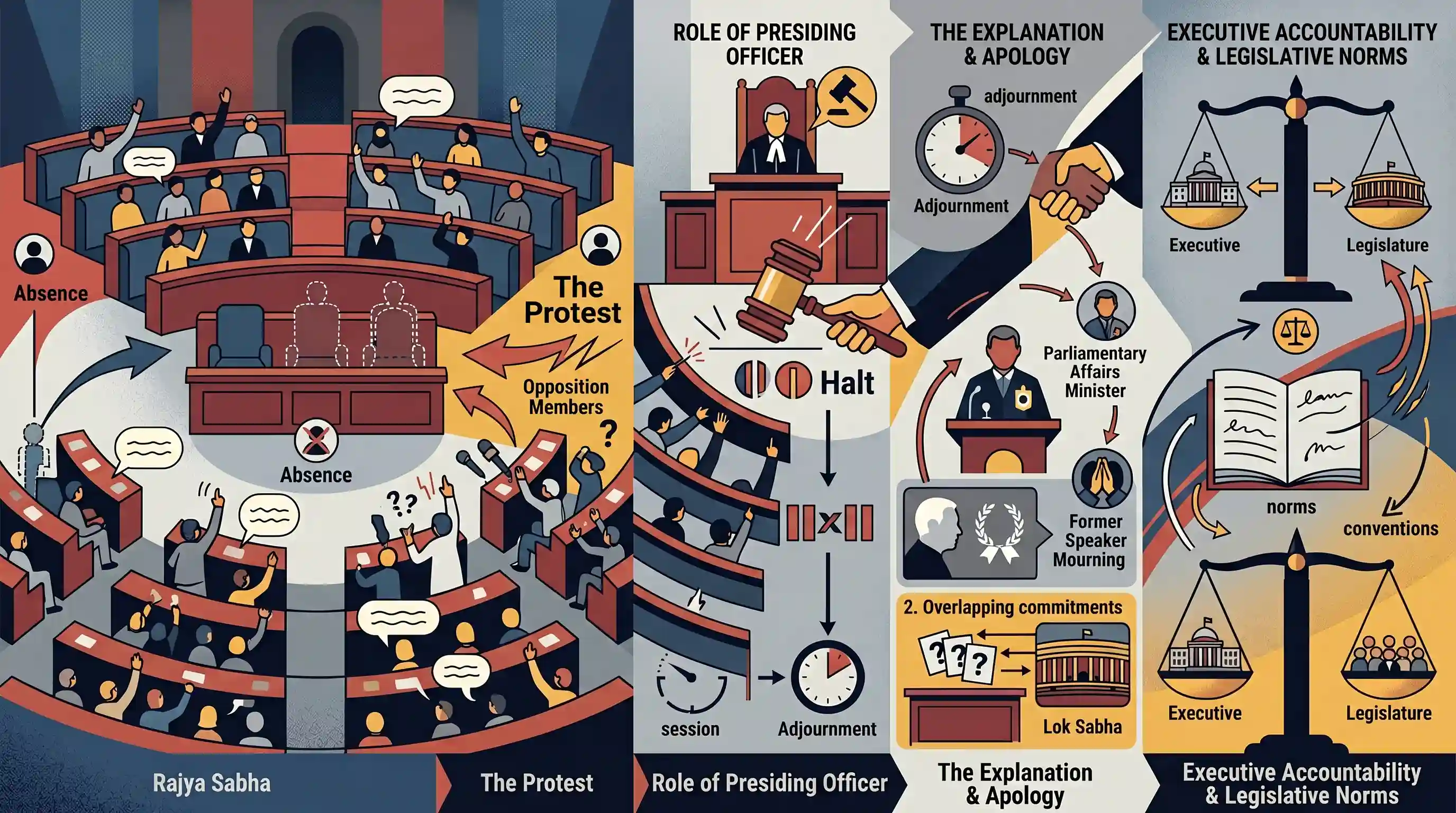
Proceedings in the Rajya Sabha were temporarily halted after Opposition members protested the complete absence of Cabinet Ministers in the House. Chairman C.P. Radhakrishnan adjourned the session briefly. Parliamentary Affairs Minister Kiren Rijiju later apologized, citing overlapping commitments in the Lok Sabha, including mourning the demise of former Speaker Shivraj Patil and attending to listed questions. The event highlights parliamentary norms regarding the executive's physical presence and accountability during legislative sessions.
Key Points
- Rajya Sabha proceedings were briefly adjourned following Opposition protests over the absence of Cabinet Ministers in the House.
- Chairman C.P. Radhakrishnan adjourned the House for 10 minutes to restore order.
- Parliamentary Affairs Minister Kiren Rijiju expressed regret, explaining that he and other ministers were either mourning former Speaker Shivraj Patil in the Lok Sabha or answering listed questions.
- The incident underscores the unwritten parliamentary convention and procedural expectation that the executive maintains a presence in the House out of respect and accountability to the legislature.
Important Terms
Executive Accountability

The principle that the executive branch is answerable to the legislature for its actions, ensuring democratic oversight and the prevention of the concentration of power.
UPSC context
GS Paper II: Essential for understanding the relationship between the Executive and Legislature and mechanisms of parliamentary oversight.
Presiding Officer
The authority (Chairman in Rajya Sabha, Speaker in Lok Sabha) responsible for conducting business, maintaining order, and interpreting rules during legislative sessions.
UPSC context
GS Paper II: Tests knowledge of the powers, functions, and constitutional status of legislative heads.
Adjournment
A procedural tool used by the Presiding Officer to suspend a House sitting for a specified period (hours or days) without terminating the session.
UPSC context
GS Paper II: Key term for Parliamentary Business; distinguishes between temporary suspension, prorogation, and dissolution.
Parliamentary Convention
Unwritten rules and long-standing practices (e.g., presence of a Cabinet Minister) that ensure smooth legislative functioning and uphold the dignity of Parliament.
UPSC context
GS Paper II: Highlights the role of constitutional morality and traditional norms in supplementing codified law.
Rajya Sabha
The Upper House of India's Parliament, representing States and UTs, acting as a permanent body to provide legislative continuity and second-chamber scrutiny.
UPSC context
GS Paper II: Parliament and State Legislatures—Structure, functioning, and the specific role of the House of States.
Collective Responsibility
A fundamental principle (Article 75) where the Council of Ministers is jointly responsible to the Lok Sabha for all governmental decisions and actions.
UPSC context
GS Paper II: Corner-stone of the Parliamentary form of government in India.
Prelims Trap
"The Constitution mandates the physical presence of at least one Cabinet Minister during proceedings."
The presence of a Cabinet Minister is an unwritten parliamentary convention to ensure executive accountability and uphold the dignity of the House, not a constitutional rule.
Static Concepts Connected
What rights does Article 88 grant Ministers regarding Parliament?
- Participation: Every Minister has the right to speak and take part in the proceedings of either House, joint sittings, and parliamentary committees.
- Voting restriction: A Minister is not entitled to vote in a House where they are not a designated member.
- Attorney General: The exact same privileges of parliamentary participation without voting rights are extended to the Attorney General of India.
What are the core functions of the Ministry of Parliamentary Affairs?
- Coordination: Acts as the nodal coordinating agency between the Government (Executive) and the two Houses of Parliament.
- Roster duties: Prepares the roster of Ministers to ensure their presence in both Houses during legislative business and discussions.
- Legislative planning: Determines the dates for summoning and prorogation of Parliament and plans government business time allocation.
Cross-Topic Patterns
Written rules vs Unwritten conventions
UPSC frequently tests the distinction between explicit Constitutional provisions, Rules of Procedure, and unwritten parliamentary conventions (like Minister attendance or Pro-tem speaker selection).
Executive Accountability mechanisms
Connects this physical presence convention to broader day-to-day accountability tools like Question Hour, Zero Hour, and motions against the Council of Ministers.

Expect a Prelims statement confusing unwritten parliamentary conventions (like Ministerial attendance) with explicit Constitutional mandates.
Linked PYQs · 3
Linked PYQs · 3
- 2023MainsGS2
Discuss the role of Presiding Officers of state legislatures in maintaining order and impartiality in conducting legislative work and in facilitating best democratic practices.
- 2021MainsGS2
To what extent, in your view, the Parliament is able to ensure accountability of the executive in India?
- 2017PrelimsGS1
The Parliament of India exercises control over the functions of the Council of Ministers through 1. Adjournment motion 2. Question hour 3. Supplementary questions Select the correct answer using the code given below:
