West Bengal opposition raises concerns over voter roll revision
Source:The Hindu ↗
Why It Matters
This issue highlights the critical balance the Election Commission must strike between maintaining accurate electoral rolls (weeding out fake voters) and ensuring that legitimate, often vulnerable, citizens are not stripped of their constitutional right to vote due to bureaucratic or documentation hurdles. It also touches on federal friction and citizenship anxieties in border states.
Summary
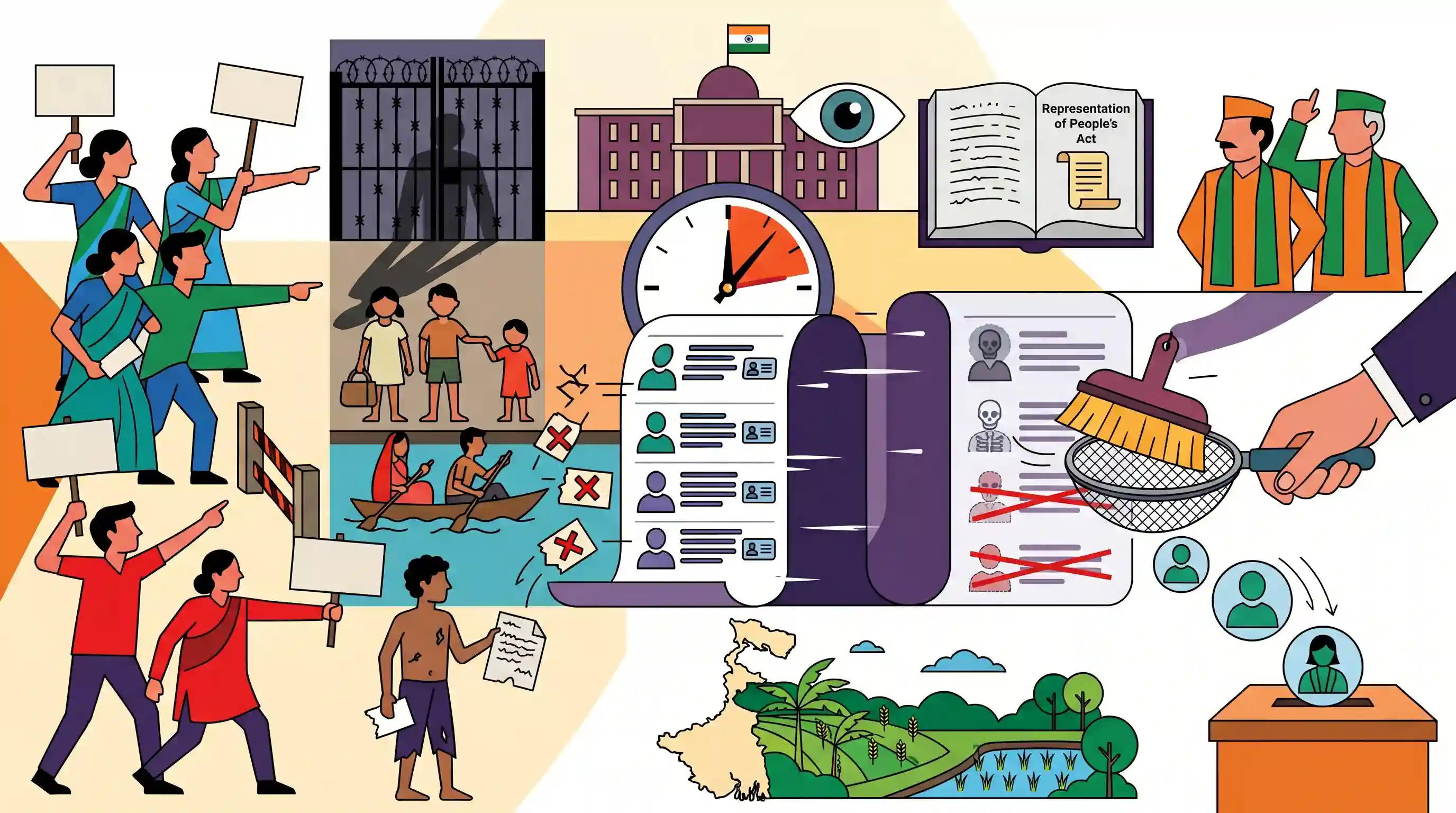
Opposition parties in West Bengal, including the TMC and CPI(M), have raised strong objections to the Election Commission of India's (ECI) 'hurried' Special Intensive Revision (SIR) of electoral rolls. They contend that the truncated two-month timeframe—compared to a two-year process in 2002—will disenfranchise marginalized communities, orphans, and flood victims lacking proper documentation. The exercise has also reignited fears of it being a precursor to the National Register of Citizens (NRC). Meanwhile, the BJP asserts that the revision is essential to sanitize the electoral rolls by removing fake and deceased voters.
Key Points
- The Election Commission of India's (ECI) Special Intensive Revision (SIR) of electoral rolls in West Bengal is facing opposition over its condensed two-month timeline.
- Opposition parties argue the rushed process risks disenfranchising marginalized groups, orphans, and citizens who lost documents in recent floods.
- There is significant political anxiety linking the intensive voter verification process to the National Register of Citizens (NRC).
- The ruling TMC government in West Bengal has instructed ASHA workers not to participate in the ECI survey unless officially mandated.
- The BJP defends the SIR process, arguing it is a necessary electoral reform to eliminate fake and deceased voters from the rolls.
Important Terms
Election Commission of India (ECI)

An autonomous constitutional authority (Article 324) responsible for administering election processes in India. It ensures the 'purity' of electoral rolls to maintain democratic integrity.
UPSC context
GS Paper II: Constitutional Bodies. Crucial for understanding the mandate of Article 324 and election management.
Representation of the People Act, 1950
The primary legislative framework governing the allocation of seats, delimitation of constituencies, and the preparation, revision, and correction of electoral rolls in India.
UPSC context
GS Paper II: Salient features of the Representation of People’s Act. Vital for questions on electoral roll integrity.
Special Intensive Revision (SIR)
A comprehensive, door-to-door verification drive by the ECI under Section 21(3) of RPA 1950 to refresh electoral rolls by removing duplicate, deceased, or ineligible entries.
UPSC context
GS Paper II: Electoral Reforms. Tests knowledge of administrative procedures for maintaining free and fair elections.
National Register of Citizens (NRC)
An official record of legal Indian citizens, mandated by the Citizenship Act, 1955. Its potential nationwide implementation is a significant point of administrative and political debate.
UPSC context
GS Paper II/III: Citizenship and Internal Security. Tests understanding of legal identity, migration, and constitutional rights.
Vulnerable Sections
Disadvantaged groups (e.g., marginalized communities, orphans, disaster victims) who face systemic documentation barriers, hindering their access to welfare and constitutional rights like voting.
UPSC context
GS Paper II: Social Justice. Focuses on obstacles to inclusive governance and the protection of marginalized rights.
Prelims Trap
"The preparation, revision, and updating of electoral rolls are governed by the Representation of the People Act, 1951."
The RPA 1950 covers voter qualifications and the preparation of electoral rolls. The RPA 1951 deals exclusively with the actual conduct of elections and dispute resolution.
Static Concepts Connected
What distinguishes the RPA 1950 from the RPA 1951?
- RPA 1950: Focuses on election groundwork, including the allocation of seats, delimitation of constituencies, voter qualifications, and the preparation/revision of electoral rolls.
- RPA 1951: Governs the actual conduct of elections, outlining qualifications and disqualifications of candidates, corrupt practices, and post-election dispute resolution.
Is the Right to Vote a Constitutional or Statutory right in India?
- Constitutional Origin: The Supreme Court has clarified it is a Constitutional Right flowing directly from Article 326, which establishes universal adult suffrage for citizens over 18.
- Statutory Regulation: While its origin is constitutional, the actual enforcement, mechanics, and reasonable restrictions (like imprisonment) on voting are statutorily regulated by the RPA 1951.
Cross-Topic Patterns
Electoral Rolls vs. NRC Legal Frameworks
While electoral rolls are prepared by the ECI under the RPA 1950, the National Register of Citizens (NRC) is a distinct legal mechanism managed under the Citizenship Act, 1955.
Article 324(6) and State Administrative Machinery
The state directive to ASHA workers tests Article 324(6), which mandates Governors to provide the ECI with requisite state staff, effectively overriding local administrative commands during electoral exercises.

Expect a Prelims question contrasting RPA 1950 (Electoral Rolls), Citizenship Act (NRC), and the legality of Aadhaar-Voter ID linking.
Linked PYQs · 4
Linked PYQs · 4
- 2017PrelimsGS1
Right to vote and to be elected in India is a
- 2017PrelimsGS1
For election to the Lok Sabha, a nomination paper can be filed by
- 2022MainsGS2
Discuss the procedures to decide the disputes arising out of the election of a Member of the Parliament or State Legislature under The Representation of the People Act, 1951. What are the grounds on which the election of any returned candidate may be declared void ? What remedy is available to the aggrieved party against the decision ? Refer to the case laws.
- 2024MainsGS2
Examine the need for electoral reforms as suggested by various committees with particular reference to "one nation one election" principle.
