Agrarian distress and human wildlife conflict issues in Parliament
Source:The Hindu ↗
Why It Matters
This article perfectly captures three distinct and recurring UPSC themes using real-world examples: the ground realities of agricultural procurement and MSP failure in Odisha, the federal tensions over managing human-wildlife conflict (Concurrent List vs State rights) in Kerala, and the sociological/economic impact of the Indian diaspora and brain drain.
Summary
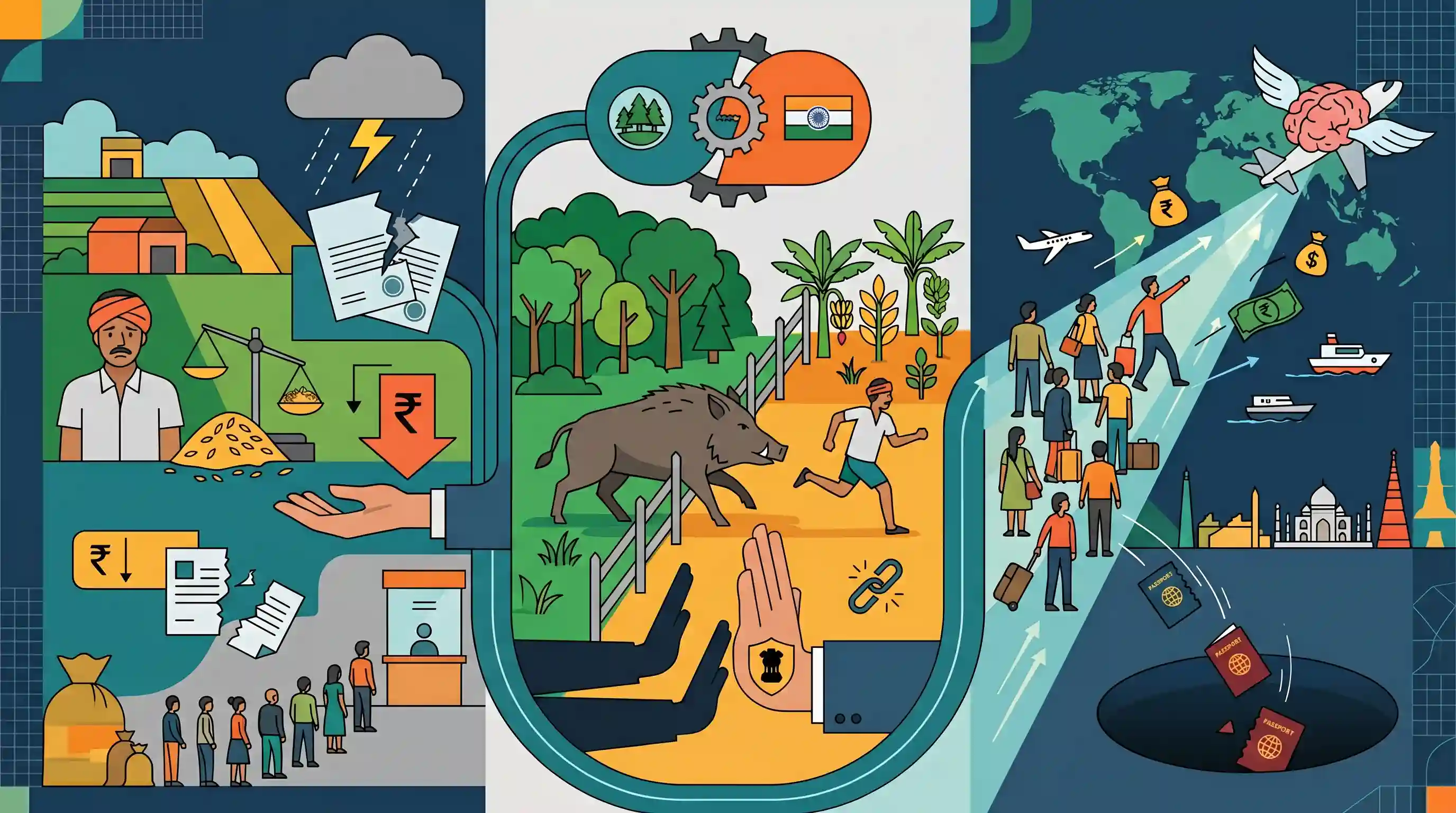
Opposition MPs in the Rajya Sabha raised alarms over multiple national crises, primarily focusing on agrarian distress, human-wildlife conflict, and surging outward migration. In Odisha, a collapse in paddy procurement and crop insurance failures have forced farmers into distress sales below the MSP. In Kerala, escalating human-animal conflicts have led to 555 deaths, driving demands to classify wild boars as vermin—a request denied by the Centre, sparking criticism of the inclusion of forests in the Concurrent List. Concurrently, an alarming 'brain drain' was highlighted, with 25 lakh Indians migrating annually and 2 lakh renouncing their citizenship each year.
Key Points
- Odisha faces severe agrarian distress due to dysfunctional mandis, arbitrary procurement caps, unfair deductions (katni-chatni), and distress sales of paddy below the Minimum Support Price (MSP).
- Crop insurance has failed to provide timely compensation to farmers in Odisha, pushing many into a debt trap.
- Kerala reported 555 deaths from human-wildlife conflict since 2019-20, prompting demands to declare wild boars as vermin to allow culling.
- The Centre rejected Kerala's request to classify wild boars as vermin, despite having previously granted similar status in Bihar and Uttarakhand.
- MPs criticized the historical shift of 'forest and environment' to the Concurrent List, arguing it restricts states from managing wildlife conflicts effectively.
- Outward migration is surging, with 25 lakh Indians leaving annually for education or employment, and roughly 2 lakh citizens renouncing their citizenship each year between 2022 and 2024.
- India currently has an 18-million-strong diaspora, making it the largest source of international migrants globally, which has raised concerns over an ongoing 'brain drain'.
Important Terms
Minimum Support Price (MSP)

A government-assured minimum price for agricultural produce, acting as a safety net against market price volatility and preventing distress sales by farmers.
UPSC context
GS Paper 3: Agriculture. Key for topics on farm subsidies, procurement, and agricultural price policy.
Concurrent List
List III of the Seventh Schedule containing 52 subjects (e.g., forests, education) on which both the Union and State governments can legislate.
UPSC context
GS Paper 2: Polity and Federalism. Essential for understanding legislative powers and the division of subjects.
Wild Life (Protection) Act, 1972
The primary legal framework for the protection of wild animals, birds, and plants, and for managing their habitats through a system of graded protection schedules.
UPSC context
GS Paper 3: Environment. Crucial for conservation, human-wildlife conflict, and species-specific protection laws.
Vermin
Wild animals or birds identified as harmful to crops, life, or property; the Centre can declare a species as vermin under Section 62 of the WPA to permit hunting.
UPSC context
GS Paper 3: Environment/Ecology. Relevant for discussions on human-wildlife conflict management and legal amendments.
Rajya Sabha
The 'Council of States' or Upper House of the Indian Parliament; a permanent body representing the federal interests of States and Union Territories.
UPSC context
GS Paper 2: Polity. Fundamental to the Indian parliamentary system and federal checks and balances.
Pradhan Mantri Fasal Bima Yojana (PMFBY)
India's flagship yield-based crop insurance scheme providing comprehensive coverage against natural calamities, pests, and diseases to stabilize farmers' income.
UPSC context
GS Paper 3: Agriculture. Tests knowledge of risk management in farming and government welfare interventions.
Prelims Trap
"State governments hold the statutory power to notify problematic wild animals as 'vermin' under the Wildlife Protection Act."
Only the Central Government can notify animals as vermin under Section 62 of the WPA, 1972, though State governments send the proposals/requests.
Static Concepts Connected
How did 'Forests' and 'Wildlife' shift to the Concurrent List?
- 42nd Amendment (1976): Shifted five subjects, including 'Forests' and 'Protection of Wild Animals and Birds', from the State List to the Concurrent List.
- Central Supremacy: Under Article 254, Central legislation (like the WPA 1972) prevails over State laws, giving the Centre final authority on issues like declaring species as vermin.
What structural bottlenecks limit the effectiveness of MSP procurement?
- Mandi Inefficiencies: Administrative delays, procurement caps, and infrastructural gaps at APMC mandis frequently deny farmers timely access, forcing distress sales.
- Arbitrary Deductions: Informal 'Katni-Chatni' (arbitrary deductions by millers for perceived moisture or quality drops) artificially depresses the actual price realized by farmers below the official MSP.
Cross-Topic Patterns
Wildlife management & Federal friction
The Centre's exclusive power to declare vermin under WPA 1972 frequently clashes with State governments facing localized human-animal conflict, highlighting stress points in environmental federalism.
Brain drain vs. Demographic dividend
The rising trend of citizenship renunciation among skilled professionals (roughly 2 lakh annually) directly challenges India's ability to capitalize on its much-touted demographic dividend.

A 2026 Prelims question mapping the 42nd Amendment's shift of wildlife to the Concurrent List against the Centre's power to declare vermin.
Linked PYQs · 4
Linked PYQs · 4
- 2018MainsGS3
What do you mean by Minimum Support Price (MSP)? How will MSP rescue the farmers from the low income trap?
- 2017MainsGS3
How do subsidies affect the cropping pattern, crop diversity and economy of farmers? What is the significance of crop insurance, minimum support price and food processing for small and marginal farmers?
- 2024PrelimsGS1
Consider the following statements : Statement-I: The Indian Flying Fox is placed under the "vermin" category in the Wild Life (Protection) Act, 1972. Statement-II : The Indian Flying Fox feeds on the blood of other animals. Which one of the following is correct in respect of the above statements ?
- 2023MainsGS2
Indian diaspora has scaled new heights in the West. Describe its economic and political benefits for India.
