Sonam Wangchuk Protest Eviction and Fundamental Rights
Source:Indian Express ↗
কেন এটি গুরুত্বপূর্ণ
The incident serves as a contemporary case study on the limits and state regulation of the Fundamental Right to assemble peacefully. It is relevant for GS Paper 2 discussions analyzing the relationship between civil society organizations and state actors, as well as the balance between democratic dissent and public order.
সারসংক্ষেপ
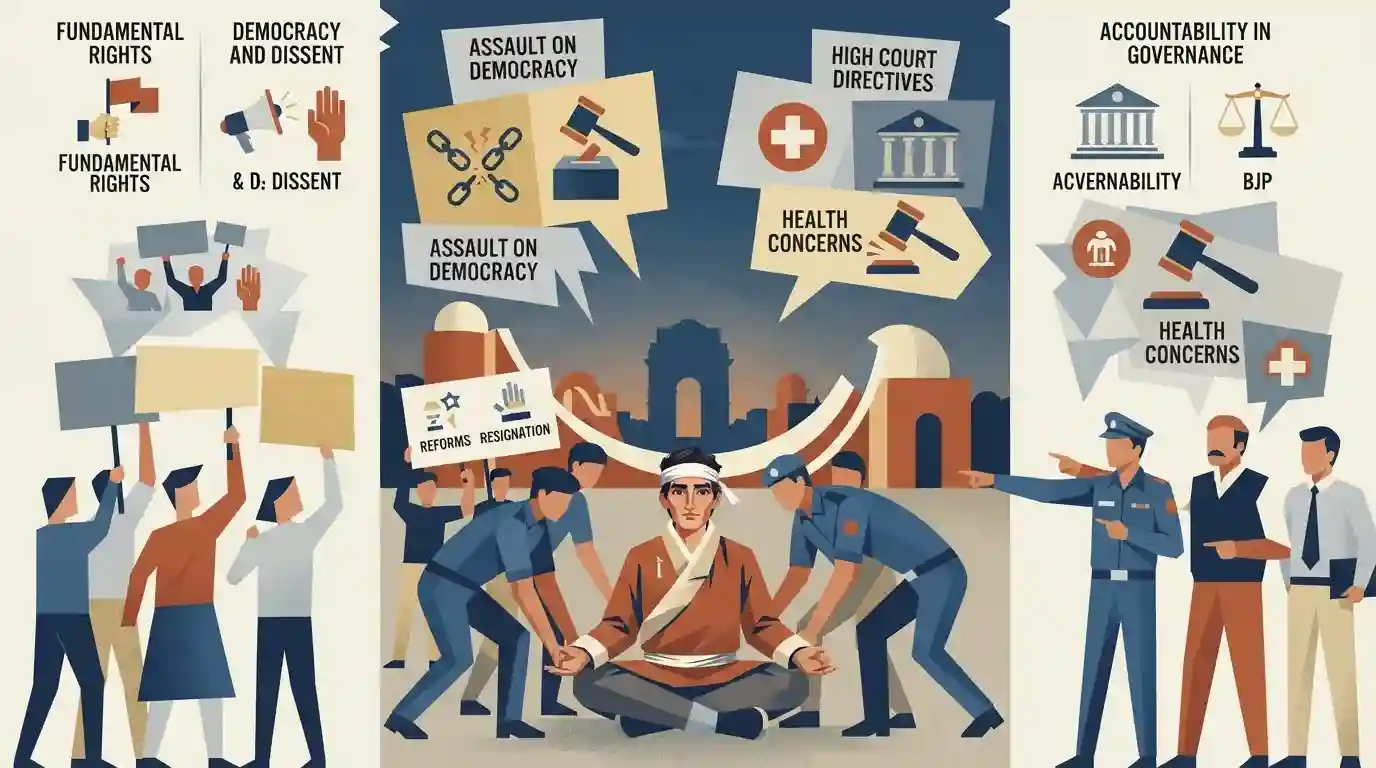
The forceful eviction of activist Sonam Wangchuk and other protesters from Jantar Mantar by Delhi Police has triggered a political row. Wangchuk was on an indefinite hunger strike demanding broader reforms to the examination system and the resignation of Union Education Minister Dharmendra Pradhan. Opposition leaders condemned the move as an assault on democracy and the constitutional right to peaceful protest. Conversely, the BJP defended the police action, citing Delhi High Court directives concerning Wangchuk's failing health, and dismissed the opposition's reaction as opportunistic posturing.
মূল বিষয়
- Activist Sonam Wangchuk was forcibly removed from his indefinite hunger strike at Jantar Mantar by the Delhi Police while demanding educational reforms and the resignation of the Union Education Minister.
- Opposition parties aggressively criticized the central government, asserting that the eviction violates constitutional rights to peaceful protest and freedom of expression.
- The BJP justified the removal by citing Delhi High Court observations regarding Wangchuk's deteriorating health, while accusing the opposition of political opportunism for not physically supporting him earlier.
- The incident highlights the ongoing tension between citizens' fundamental rights to dissent (Article 19) and the state's intervention on grounds of public order and health.
গুরুত্বপূর্ণ শব্দ
Delhi High Court

The principal judicial organ of the National Capital Territory of Delhi, established in 1966, exercising extensive civil, criminal, and constitutional writ jurisdiction under Article 226 of the Constitution.
UPSC context
GS Paper II: Judiciary structure, powers, and functioning, particularly relating to fundamental rights enforcement and judicial review.
Delhi Police
The primary law enforcement agency for the National Capital Territory of Delhi, functioning under the direct administrative jurisdiction of the Ministry of Home Affairs, Government of India.
UPSC context
GS Paper II: Federalism, police reforms, and administration of Union Territories under the Ministry of Home Affairs.
Bharatiya Janata Party (BJP)
A prominent national political party in India, founded in 1980. It is currently the leading party of the ruling National Democratic Alliance (NDA) government at the Union level, representing center-right to right-wing ideologies.
UPSC context
GS Paper II: Political parties, coalition governance, and ideological representation in the Indian democratic system.
Indian National Congress
India's oldest political party, founded in 1885. It spearheaded the nation's freedom struggle and remains a major national political party, advocating center-left socio-economic policies and secularism.
UPSC context
GS Paper I (Modern History) and GS Paper II: Evolution of party systems, political history, and opposition role.
Aam Aadmi Party (AAP)
A recognized national political party in India, founded in 2012 in the wake of the India Against Corruption movement. It governs Punjab and has a significant presence in Delhi.
UPSC context
GS Paper II: Criteria for national party recognition by the ECI, anti-corruption movements, and grassroots welfare governance.
Samajwadi Party (SP)
A major recognized state political party in India, primarily active in Uttar Pradesh, founded in 1992. It advocates democratic socialism, social justice, and secular welfare policies.
UPSC context
GS Paper II: State political parties, regionalism, and their influence on national-level coalition politics and federal dynamics.
প্রিলিমস ফাঁদ
The Bharatiya Nyaya Sanhita (BNS) has entirely decriminalized the attempt to commit suicide, removing all criminal liability for hunger-striking protesters.
Under BNS Section 226, attempting suicide to compel or restrain a public servant from performing duties is explicitly criminalized, directly targeting political hunger strikes.
সংযুক্ত স্থির ধারণা
How does the Bharatiya Nyaya Sanhita (BNS) treat hunger strikes compared to the IPC?
- Targeted Criminalization: BNS Section 226 specifically penalizes suicide attempts made with the intent to compel or restrain a public servant from discharging official duties.
- IPC Section 309 Comparison: The erstwhile IPC Section 309 broadly criminalized all suicide attempts, which courts often found difficult to apply to political hunger strikes.
- Constitutional Friction: It forces a clash between Article 21 (individual autonomy to refuse medical aid, Common Cause, 2018) and the State's duty to preserve life (Gian Kaur, 1996).
What are the judicial boundary lines drawn on the Right to Protest in India?
- Derivative Right: Derived implicitly from Article 19(1)(a) (speech) and 19(1)(b) (peaceful assembly), as it is not explicitly named in the Constitution.
- Shaheen Bagh Case (2020): The Supreme Court ruled that while peaceful assembly is protected, public spaces and roads cannot be blocked or occupied indefinitely.
- Ramlila Maidan Case (2012): Stated that citizens have a fundamental right to assembly, but the administration can impose reasonable, non-arbitrary regulations on protest venues.
আন্তঃবিষয় প্যাটার্ন
Criminal Code Reforms vs Civil Dissent
The transition from IPC 309 to BNS 226 selectively criminalizes hunger strikes aimed at state authorities, fundamentally reshaping the legal boundaries of non-violent civil dissent.
Sixth Schedule and Asymmetric Federalism
Wangchuk's broader struggle for Ladakh highlights the constitutional limits of Article 244, testing how asymmetric federalism manages governance demands in strategically sensitive Union Territories.

The distinction between IPC 309 and BNS Section 226 concerning hunger strikes to compel public servants is a prime target for Prelims 2026.
সংযুক্ত PYQ · 2
সংযুক্ত PYQ · 2
- 2025MainsGS2
Civil Society Organizations are often perceived as being anti-State actors than non-State actors. Do you agree? Justify.
- 2021MainsGS2
Can Civil Society and Non-Governmental Organizations present an alternative model of public service delivery to benefit the common citizen? Discuss the challenges of this alternative model.
