Model School Renaming Controversy and Secularism Concerns in Bihar
Source:thestatesman ↗
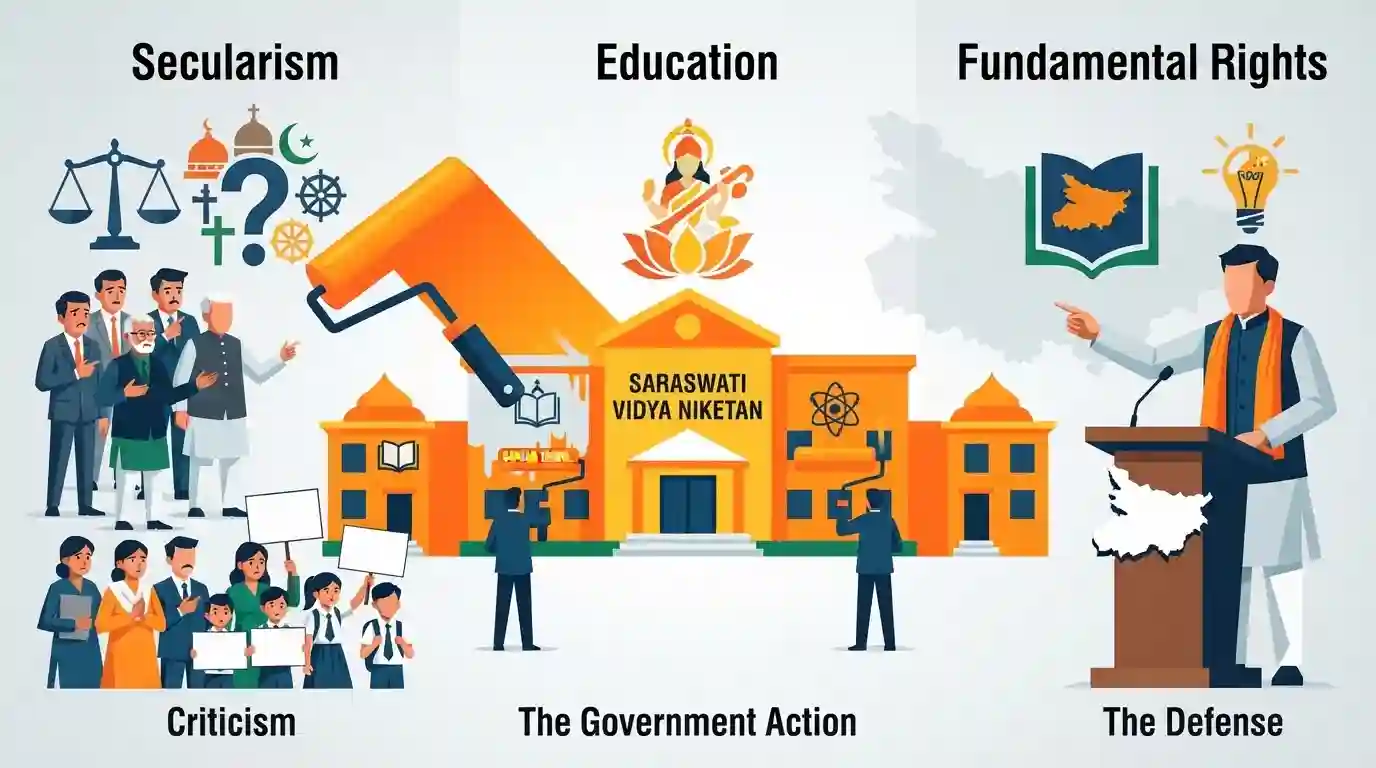
Why It Matters
The controversy highlights the tension between secularism (a basic feature of the Indian Constitution) and state-funded educational initiatives. It touches upon Article 28 of the Constitution, which prohibits religious instruction in state-funded educational institutions, and frequently becomes a subject for Polity questions regarding the separation of religion and state in India.
Summary
The Bihar government has drawn sharp criticism from opposition parties over its decision to rename 551 newly upgraded model schools as 'Saraswati Vidya Niketan' and paint their buildings saffron. Opposition leaders have labelled the move as 'saffronisation' of education, arguing that state-funded educational institutions in a secular country should not promote religious ideologies. The state's Education Minister defended the decision, asserting that Saraswati is universally recognized as the goddess of learning.
Key Points
- The Bihar government recently upgraded and launched 551 Model Schools across the state, equipping them with modern facilities.
- Controversy erupted after the government renamed the schools 'Saraswati Vidya Niketan (Model Schools)' and painted the buildings saffron.
- Opposition parties, including the RJD, Congress, and AIMIM, accused the ruling alliance of 'saffronising' education and violating the secular fabric of the Constitution by using public funds to promote religious symbolism.
- Education Minister Mithilesh Tiwari defended the move, stating that Goddess Saraswati is the symbol of learning and saffron is associated with her, denying any political agenda.
Important Terms
RJD (Rashtriya Janata Dal)

A major regional political party in Bihar, founded by Lalu Prasad Yadav, which traditionally champions the socio-economic and political interests of lower castes, backward classes, and minority communities.
UPSC context
Relevant to GS Paper 2 (Polity) for topics on regional political parties, social justice, and state-level coalition dynamics.
Congress (Indian National Congress)
One of India's two major national political parties, currently acting as a principal opposition force at the national and state levels, advocating for secularism and inclusive social welfare.
UPSC context
Tested in GS Paper 2 (Polity) concerning the evolution of the national party system and the role of the opposition.
AIMIM (All India Majlis-e-Ittehadul Muslimeen)
A political party led by Asaduddin Owaisi, originally based in Hyderabad, focused on safeguarding the socio-economic and political rights of Muslims, Dalits, and other marginalized minorities.
UPSC context
Important for GS Paper 2 (Polity) regarding minority political representation, secularism debates, and identity-based electoral politics.
Bihar Education Department
The state governmental body responsible for managing and regulating educational policies, upgrading infrastructure such as Model Schools, and overseeing administrative reforms across Bihar's educational institutions.
UPSC context
Relevant to GS Paper 2 (Governance) for understanding state-level educational administration, public service delivery, and secularism controversies.
Prelims Trap
The Constitution completely prohibits religious instruction or symbols in all educational institutions that receive any amount of State aid.
Article 28(1) absolute prohibition applies only to institutions wholly maintained by State funds. State-aided or recognized institutions can permit religious instruction on a voluntary consent basis under Article 28(3).
Static Concepts Connected
What are the categories of educational institutions and religious instruction rules under Article 28?
- Wholly State-maintained: Religious instruction is completely prohibited under Article 28(1).
- State-administered, Endowment-established: Religious instruction is permitted if the trust deed requires it, under Article 28(2).
- State-recognized or Aided: Religious instruction is permitted on a strictly voluntary basis under Article 28(3).
How did the Supreme Court define 'Secularism' in the S.R. Bommai case?
- Basic Structure Status: The court explicitly declared secularism to be an essential, non-negotiable component of the basic structure of the Constitution.
- Positive Secularism: Indian secularism is positive, emphasizing equal tolerance and respect for all religions (Sarva Dharma Sama Bhava), rather than complete state-religion exclusion.
- State Neutrality: State governments must remain neutral; introducing religion into politics or state administration violates the constitutional oath.
Cross-Topic Patterns
Secularism vs. State-funded symbolism
Examines how Article 27 (prohibiting public funds for promoting any religion) interacts with Article 28 when state-funded infrastructure adopts majoritarian religious aesthetics or nomenclature.
Concurrent List friction in Education
Analyses how state-level administrative choices in school branding interface with national educational frameworks (NEP 2020) and the constitutional value of scientific temper.

Prelims 2026 is likely to test the precise category-wise restrictions under Article 28 alongside landmark judgments defining secularism.
Linked PYQs · 4
Linked PYQs · 4
- 2024-EBPSC_PRELIMSGS1
Which two words have been incorporated in the Preamble by 42nd Amendment?
- 2025BPSC_PRELIMSGS1
What is the primary objective of Bihar’s Mission Daksh?
- 2023BPSC_PRELIMSGS1
Consider the following statements regarding the 42nd Amendment to the Constitution of India: 1. It added three words to the Preamble—‘Socialist’, ‘Secular’ and ‘Integrity’. 2. It added eight Fundamental Duties to the Constitution. 3. It added new Directive Principles, i.e., Article 39A, Article 43A and Article 47. 4. It granted power to the President, in consultation with the Election Commission, to disqualify members of the State Legislatures. Which of the above statements is/are incorrect?
- 2024-EBPSC_PRELIMSGS1
Which sector received the highest allocation in the Bihar Budget 2024-25?
