NEET Exam Cancellations and Structural Governance Deficits
Source:The Hindu ↗
Why It Matters
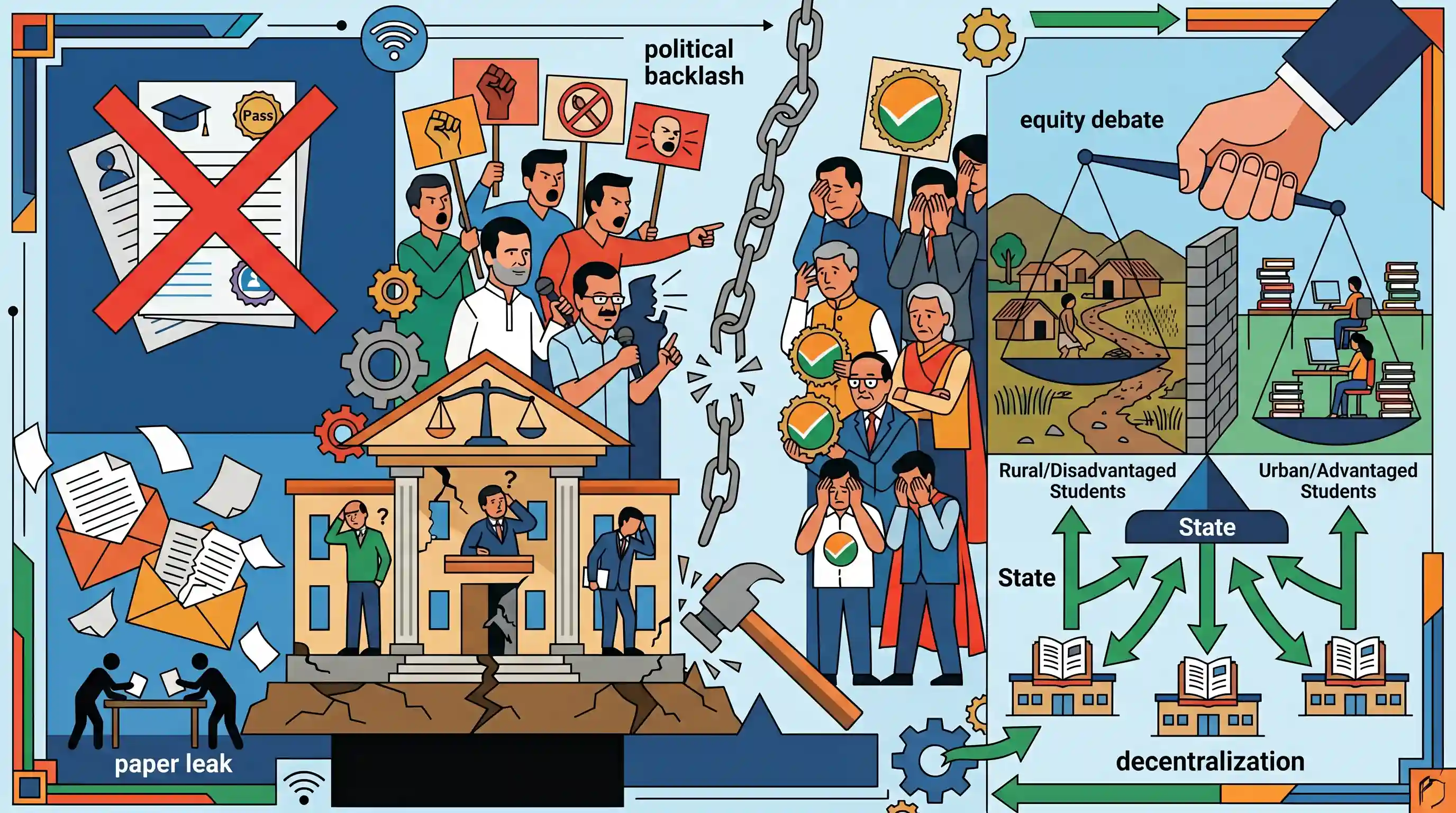
The recurring issue of paper leaks in national examinations raises critical questions about governance, the credibility of central testing agencies like the NTA, and the necessity of structural reforms in India's education system. It also touches upon the federalism debate, questioning the efficacy and equity of centralized exams versus state-level decentralized testing.
Summary
The cancellation of the NEET-UG 2026 examination following allegations of paper leaks has triggered intense political backlash, with Opposition parties accusing the Union government of compromising students' futures. Leaders across the political spectrum, including Rahul Gandhi and Arvind Kejriwal, slammed the administration for institutional failures, zero accountability, and organized corruption in education. Left parties such as the CPI and CPI(M) have called for the disbanding of the National Testing Agency (NTA), advocating instead for the decentralization of examinations. The controversy has reignited debates around the equity of centralized testing, which critics argue is discriminatory and disproportionately disadvantages rural and economically vulnerable students.
Key Points
- NEET-UG 2026 was cancelled amid allegations of paper leaks and irregularities, prompting severe backlash from Opposition parties.
- Congress leader Rahul Gandhi accused the government of shielding a 'paper mafia' and fostering organized corruption within the education system.
- Left parties demanded the immediate disbanding of the National Testing Agency (NTA) and a structural shift towards decentralizing national exams to state government bodies.
- Critics highlighted that centralized examinations like NEET are inherently unjust and discriminatory, disproportionately harming rural and economically disadvantaged students.
- Political leaders highlighted the recurring nature of such leaks over the past decade, demanding strict accountability and comprehensive structural reforms.
Important Terms
National Testing Agency (NTA)

An autonomous testing organization under the Ministry of Education, established in 2017 as a Society to conduct transparent, international-standard entrance exams for higher education.
UPSC context
GS Paper II: Statutory/Regulatory Bodies. Tests knowledge of institutional accountability, autonomy vs. government control, and administrative reforms in testing.
National Eligibility-cum-Entrance Test (NEET)
The mandatory common entrance exam for undergraduate medical and dental courses in India, replacing multiple state-level and private exams to ensure a uniform merit-based admission process.
UPSC context
GS Paper II: Social Sector/Education. Relevant to debates on federalism (Seventh Schedule), rural-urban equity, and centralized vs. decentralized governance.
National Party
A political party recognized by the Election Commission of India based on specific electoral performance across multiple states, entitling it to a reserved national symbol.
UPSC context
GS Paper II: Political Parties and Electoral Reform. Tests criteria for party recognition (e.g., 6% vote share, seat thresholds) and privileges.
Indian National Congress (Congress)
India's principal opposition party in the 18th Lok Sabha; it currently holds the statutory position of Leader of the Opposition (LoP).
UPSC context
GS Paper II: Role of Opposition. Tests the functioning of parliamentary democracy and the LoP's role in constitutional appointments.
Bharatiya Janata Party (BJP)
The ruling political party of India since 2014, leading the National Democratic Alliance (NDA) and advocating for centralized policy frameworks.
UPSC context
GS Paper II: Governance and Executive Accountability. Tests the party's role in policy implementation and administrative transparency.
Communist Party of India (Marxist) (CPI(M))
A recognized National Party and member of the INDIA alliance, advocating for the disbanding of the NTA and decentralization of education.
UPSC context
GS Paper II: Political Ideologies and Federalism. Tests the role of diverse political ideologies in shaping educational policy debates.
Prelims Trap
"The National Testing Agency (NTA) is a statutory body established under a specific Act of Parliament."
NTA is not a statutory body. It is an autonomous testing organization registered under the Indian Societies Registration Act, 1860, approved by the Union Cabinet.
Static Concepts Connected
How is 'Education' classified in the Seventh Schedule of the Constitution?
- Original Status: Initially placed in the State List (Entry 11), giving states primary legislative control over education.
- 42nd Amendment (1976): Moved Education to the Concurrent List (Entry 25), enabling both Parliament and State legislatures to make laws, with Central laws prevailing during conflicts.
- Union List Overlap: Entry 66 of the Union List gives the Centre exclusive power over coordination and determination of standards in higher education and research.
What does the Public Examination (Prevention of Unfair Means) Act, 2024 mandate?
- Jurisdiction: Covers central testing authorities (UPSC, NTA, SSC, RRB) but excludes State Education Boards unless specifically notified by the Central Government.
- Nature of Offences: Makes paper leaks, fake websites, and organized cheating cognizable, non-bailable, and non-compoundable offences.
- Stringent Penalties: Imposes 3 to 10 years of imprisonment and fines up to ₹1 crore for complicit service providers and organized syndicates.
Cross-Topic Patterns
Concurrent List + Federal Friction
The NEET debate directly connects to GS2 themes on Centre-State relations, showcasing how centralized standards (Union List Entry 66) can conflict with regional autonomy.
Centralization vs. Social Equity
Links the Justice A.K. Rajan Committee findings to GS2 Social Justice, highlighting how standardized tests may inadvertently penalize rural, poor, and state-board students.

Expect a GS2 Mains question in 2026 on how centralizing higher education (NTA/NEET) impacts federalism and the equity of access.
Linked PYQs · 3
Linked PYQs · 3
- 2024MainsGS2
What are the aims and objects of recently passed and enforced, The Public Examination (Prevention of Unfair Means) Act, 2024? Whether University/State Education Board examinations, too, are covered under the Act ?
- 2022MainsGS2
“While the national political parties in India favour centralisation, the regional parties are in favour of State autonomy.” Comment.
- 2014MainsGS2
Should the premier institutes like IITs/IIMs. be allowed to retain premier status, allowed more academic independence in designing courses and also decide mode/criteria of selection of students. Discuss in light of the growing challenges.
