Manipur Goods and Services Tax Amendment Bill and Reforms
Source:Indian Express ↗
Why It Matters
The article demonstrates the intersection of GS-2 (parliamentary functioning, walkouts, ordinances, and electoral roll revisions) and GS-3 (indirect tax reforms, resolving the inverted duty structure, and regional economic recovery). It serves as a practical example of legislative challenges and substantive economic policymaking.
Summary
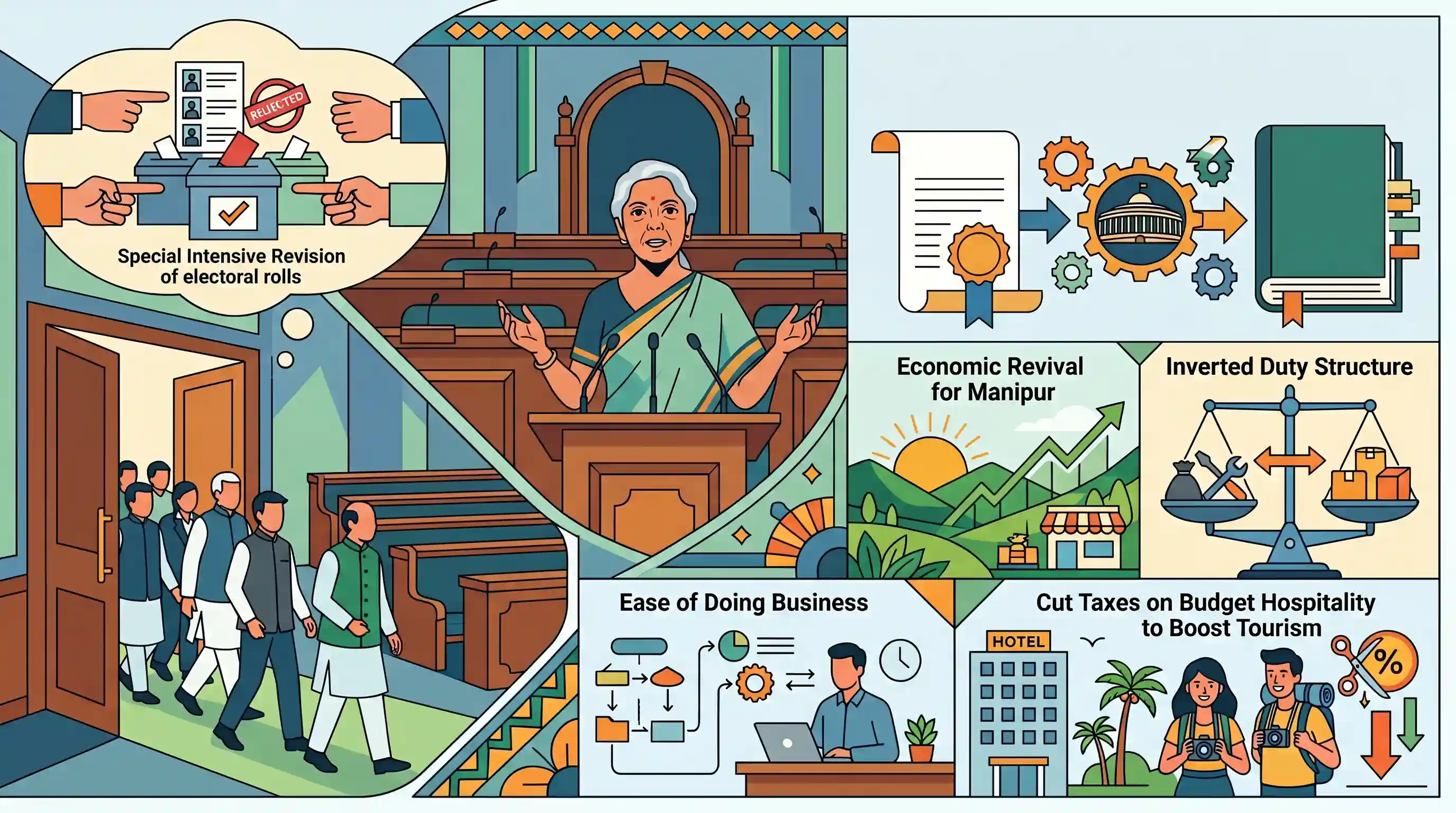
Union Finance Minister Nirmala Sitharaman criticized Opposition parties for walking out of the Rajya Sabha ahead of a debate on the Manipur Goods and Services Tax (Second Amendment) Bill, 2025. The Opposition left the House after their demand for a debate on the Special Intensive Revision of electoral rolls was denied. Sitharaman argued that the Bill, which replaces an Ordinance, is vital for Manipur's economic revival. It implements GST 2.0 reforms, addresses the inverted duty structure, improves ease of doing business, and cuts taxes on budget hospitality to boost tourism.
Key Points
- The Rajya Sabha returned the Manipur Goods and Services Tax (Second Amendment) Bill, 2025, which replaces a prior Ordinance to implement GST 2.0 reforms in the state.
- Finance Minister Nirmala Sitharaman criticized the Opposition for walking out during the debate, stating they abandoned discussions on critical welfare measures for Manipur.
- The Opposition walked out because their demand to debate the Special Intensive Revision (SIR) of electoral rolls was rejected by the Rajya Sabha Chairman.
- The Bill introduces measures to prevent revenue leakages through a track and trace system, removes ambiguities in plant and machinery descriptions, and resolves the inverted duty structure.
- To boost the state's tourism sector, GST on hotel rooms charging ₹7,500 or less per night was reduced from 12% to 5%.
Important Terms
Manipur Goods and Services Tax (Second Amendment) Bill, 2025

A Bill replacing a 2025 Ordinance to align Manipur’s GST laws with Central reforms. It introduces track-and-trace mechanisms and rationalizes pre-deposits for appeals to revive the conflict-affected state’s economy.
UPSC context
GS II/III: Legislative processes under President’s Rule and taxation reforms; tests understanding of federal fiscal relations.
Inverted Duty Structure
A taxation anomaly where GST rates on raw materials (inputs) are higher than on finished products (outputs). This leads to unutilized Input Tax Credit and discourages domestic manufacturing.
UPSC context
GS III: Indian Economy; critical for understanding GST rationalization, trade competitiveness, and 'Make in India' hurdles.
Special Intensive Revision (SIR)
A comprehensive house-to-house verification drive by the Election Commission of India under Section 21(3) of the RPA, 1950. It aims to eliminate ghost voters and ensure electoral roll accuracy.
UPSC context
GS II: Electoral reforms and ECI’s constitutional mandate under Article 324 to ensure fair elections.
Ordinance-making Power
Executive authority under Articles 123 (President) and 213 (Governor) to enact temporary laws when legislatures are not in session. Such laws must be approved within six weeks of reassembly.
UPSC context
GS II: Separation of powers; focuses on executive overreach and the legality of re-promulgating ordinances.
Role of Opposition
Parties not in government that hold the executive accountable through scrutiny, debates, and dissent. They act as a watchdog to protect democratic norms and propose alternative policies.
UPSC context
GS II: Parliamentary functioning; tests knowledge on the balance between constructive dissent and legislative productivity.
Rajya Sabha
The Upper House of India's Parliament, representing States and Union Territories. It acts as a revising chamber to ensure the federal balance and stability of the legislative process.
UPSC context
GS II: Structure and functioning of the Legislature; focuses on its role as a permanent house.
Prelims Trap
"Inverted duty structure arises when finished goods are taxed at a much higher rate than their raw materials."
It is the exact opposite. An inverted duty structure occurs when inputs (raw materials) face a HIGHER tax rate than finished products, leading to accumulated Input Tax Credit.
Static Concepts Connected
What is the Inverted Duty Structure under the GST regime?
- The Anomaly: Occurs when the tax rate on inputs (raw materials) is higher than the tax rate on finished goods.
- Economic Impact: Leads to the accumulation of unutilized Input Tax Credit (ITC), locking up manufacturers' working capital.
- Competitiveness: Harms domestic manufacturing by making imported finished goods comparatively cheaper, prompting the GST Council to actively rationalize these rates.
How does a Special Intensive Revision (SIR) of electoral rolls differ from summary revisions?
- Statutory Basis: Mandated by the Election Commission of India under the Representation of the People Act, 1950.
- Methodology: Involves rigorous door-to-door verification and fresh enumeration to remove duplicates and ineligible voters, unlike routine annual summary revisions.
Cross-Topic Patterns
Internal Security + Economic Interventions
Post-conflict stabilization in regions like Manipur often twins security measures with economic lifelines, such as cutting GST on hospitality to revive local tourism.
Track & Trace + Cooperative Federalism
The GST Council's push for Unique Identification Marking (UIM) in evasion-prone sectors illustrates federal collaboration to safeguard both central and state tax revenues.

Expect a 2026 Prelims MCQ contrasting the ECI's Special Intensive Revision (SIR) of electoral rolls with annual summary revisions.
Linked PYQs · 4
Linked PYQs · 4
- 2019MainsGS3
Enumerate the indirect taxes which have been subsumed in the Goods and Services Tax (GST) in India. Also, comment on the revenue implications of the GST introduced in India since July 2017.
- 2022MainsGS2
Discuss the essential conditions for exercise of the legislative powers by the Governor. Discuss the legality of re-promulgation of ordinances by the Governor without placing them before the Legislature.
- 2023MainsGS2
Discuss the role of Presiding Officers of state legislatures in maintaining order and impartiality in conducting legislative work and in facilitating best democratic practices.
- 2024MainsGS2
Examine the need for electoral reforms as suggested by various committees with particular reference to "one nation one election" principle.
