Raksha Rajya Mantri Reviews Sudarshan Chakra Corps in Bhopal
Source:freepressjournal ↗
Why It Matters
Understanding the locations and roles of major military formations and defense infrastructures in Madhya Pradesh, such as the Sudarshan Chakra Corps in Bhopal, is highly significant for state-level civil service exams (MPPSC). Additionally, progress in indigenous defense technologies under Aatmanirbhar Bharat is a crucial topic for security and technology sections.
Summary
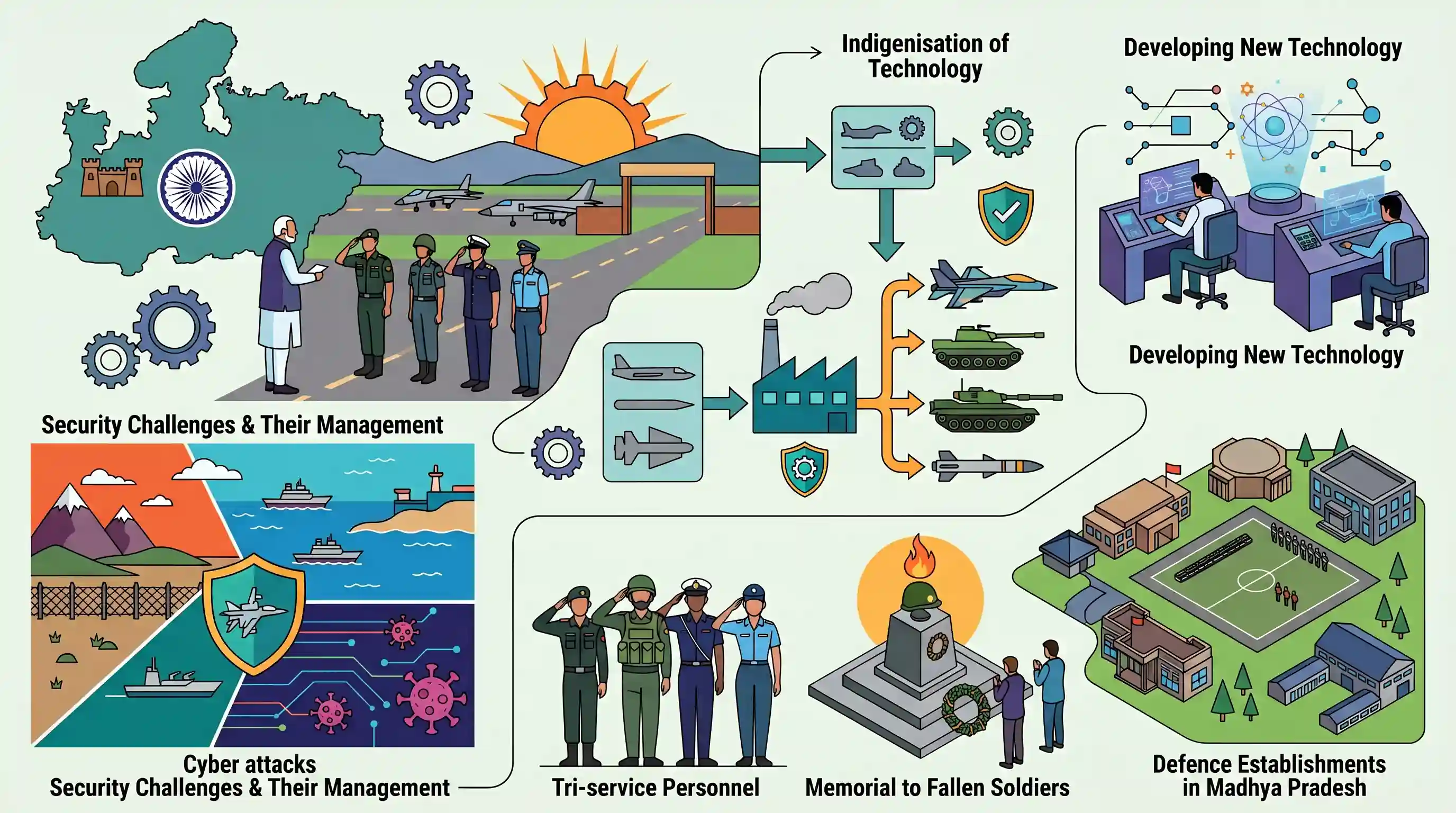
Raksha Rajya Mantri Sanjay Seth visited the Sudarshan Chakra Corps (XXI Corps) at Bhopal Military Station, Madhya Pradesh, to review operational preparedness and examine newly inducted indigenous defence equipment. The visit emphasized India's push for self-reliance (Aatmanirbhar Bharat) in military capabilities, with the minister praising the dedication of the tri-service personnel and honoring fallen soldiers.
Key Points
- Raksha Rajya Mantri Sanjay Seth visited the Sudarshan Chakra Corps at Bhopal Military Station in Madhya Pradesh.
- The visit focused on reviewing the operational preparedness of the corps and checking capability enhancement initiatives amid evolving security scenarios.
- A static demonstration of newly inducted advanced indigenous defence equipment was organized, highlighting the ongoing indigenisation under Aatmanirbhar Bharat.
- The Sudarshan Chakra Corps (XXI Corps) of the Indian Army is headquartered at Bhopal and operates under the Southern Command (headquartered in Pune).
- The minister paid tribute to the fallen soldiers of the corps and interacted with personnel of all three defence services stationed in Bhopal.
Important Terms
Aatmanirbhar Bharat

A national vision launched in 2020 aiming to make India self-reliant by boosting local manufacturing, reducing imports, and strengthening domestic supply chains across key strategic sectors.
UPSC context
GS Paper III (Economy & Indigenisation of Technology); tests strategies for domestic manufacturing and achieving strategic autonomy.
Sudarshan Chakra Corps
Formally designated as the XXI Corps of the Indian Army, this premier strike formation is headquartered in Bhopal, specializing in mechanized offensive warfare under the Southern Command.
UPSC context
GS Paper III (Security); tests awareness of military operational readiness, division structures, and regional defense preparedness.
Southern Command
Headquartered in Pune, it is one of the largest geographical commands of the Indian Army, responsible for safeguarding India's southern and southwestern borders and managing major strike formations.
UPSC context
GS Paper III (Security); tests understanding of the Indian military's geographical command structures and regional defense administration.
Ministry of Defence
The apex government ministry responsible for safeguarding India's national security, managing the armed forces, formulating defense policies, and driving indigenous military manufacturing.
UPSC context
GS Paper II (Government Policies) & GS III (Security); tests understanding of defense governance, procurement, and policy frameworks.
Indian Army
The land-based branch of the Indian Armed Forces, responsible for safeguarding national territorial integrity, managing borders, countering internal security threats, and conducting disaster relief operations.
UPSC context
GS Paper III (Security); tests knowledge of national defense capabilities, security challenges, and border management structures.
Prelims Trap
The Sudarshan Chakra Corps (XXI Corps) is a defensive holding formation tasked primarily with securing central border sectors.
XXI Corps is a dedicated strike (offensive/mechanized) corps, not a defensive holding formation. UPSC frequently tests operational-level classifications.
Static Concepts Connected
How is the Indian Army structured, and how do Strike Corps differ from Holding Corps?
- Command Structure: The Army operates under six geographical commands and one functional training command (ARTRAC based in Shimla).
- Strike Corps: Offensive formations equipped with heavy armor, mechanized infantry, and artillery designed to penetrate deep into enemy territory during conflicts.
- Holding/Pivot Corps: Defensive formations deployed close to the border, tasked with absorbing enemy offensives and maintaining territorial integrity.
What are the primary policy mechanisms driving defense indigenisation in India?
- Positive Indigenisation Lists: Lists issued by the Ministry of Defence that place strict import embargoes on specific military platforms and components to force domestic sourcing.
- SRIJAN Portal: An online platform mapping historically imported military components to allow domestic MSMEs and private firms to design and manufacture them.
- DAP 2020 Framework: Prioritizes 'Buy (Indian-IDDM)' (Indigenously Designed, Developed and Manufactured) as the highest priority category for capital acquisitions.
Cross-Topic Patterns
Defence Indigenisation & MSME Integration
Positive Indigenisation Lists act as demand-side guarantees, transforming domestic MSMEs from sub-tier vendors to key developers of critical subsystems.
IPKF Legacy & Neighborhood Diplomacy
The conversion of the IPKF headquarters into the XXI Corps in 1990 reflects how regional external interventions historically reshaped India's internal military commands.

UPSC may link the operational distinctions of Strike/Holding Corps with defense indigenisation policy tools like PILs and DAP 2020.
