Operation Spider Web and Lessons for India Drone Security
Source:Indian Express ↗
Why It Matters
The tactical innovations in drone warfare seen in the Russia-Ukraine conflict hold critical lessons for India's national security, particularly given the rising threat of cross-border hostile UAV activities (smuggling and surveillance) along its own borders. Understanding modern drone deployment strategies is essential for formulating effective counter-UAV frameworks.
Summary
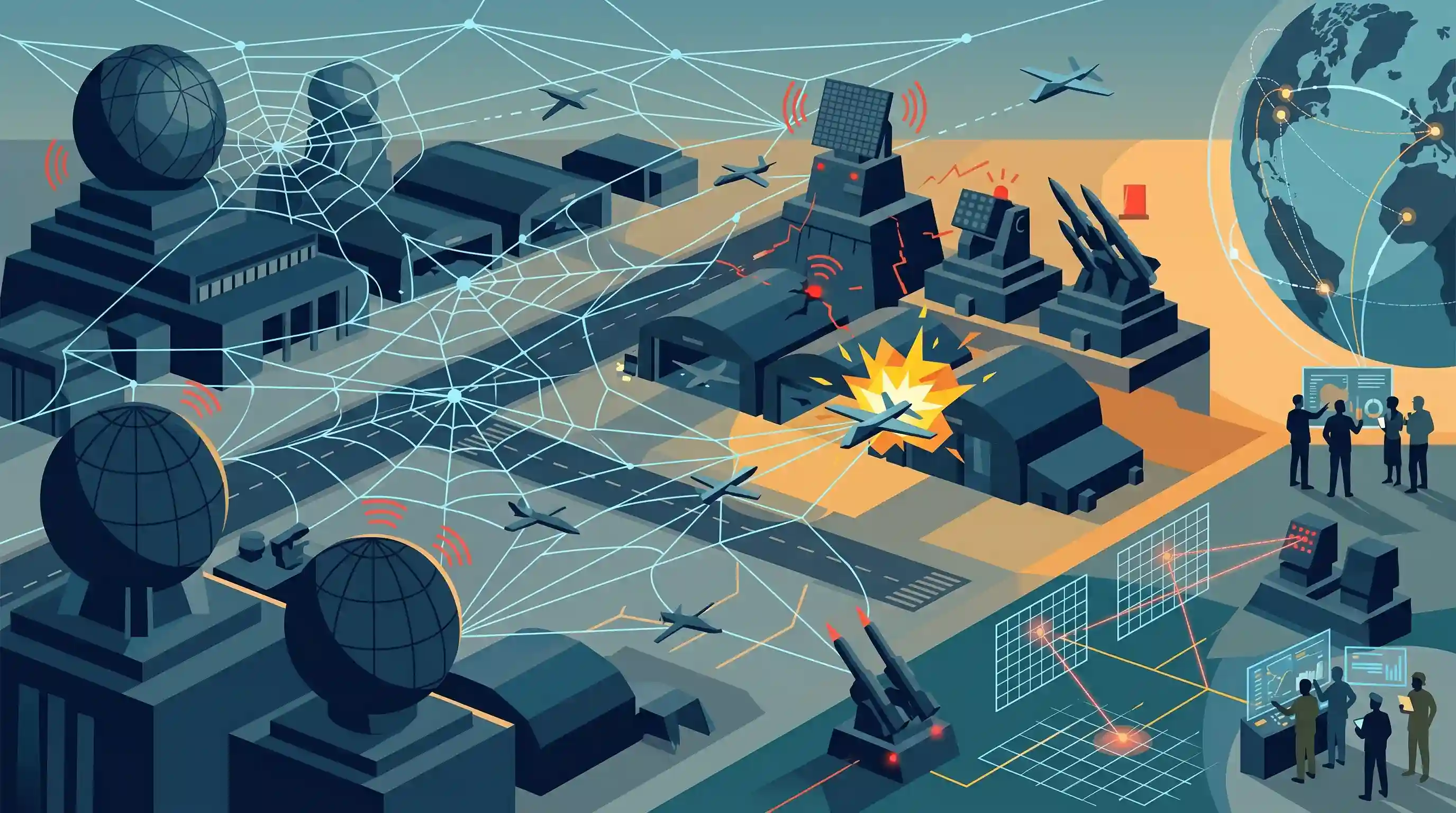
Ukraine's 'Operation Spider's Web' involved a highly tactical drone strike on a Russian airbase, acting as a 'Trojan horse moment' that exposed vulnerabilities in conventional air defense. The operation marks a major paradigm shift in drone warfare, highlighting how Unmanned Aerial Vehicles (UAVs) are being innovatively deployed for asymmetrical advantages, deception, and deep-strike capabilities in the ongoing Russia-Ukraine conflict. For defense and security planners globally, this underscores the urgent need to evolve counter-drone measures against sophisticated, low-cost aerial threats.
Key Points
- Ukraine executed a sophisticated drone strike on a Russian airbase under 'Operation Spider's Web'.
- The event is characterized as a 'Trojan horse moment' for Russia, suggesting the use of deception, stealth, or unconventional infiltration methods in modern warfare.
- This development marks a significant escalation and upends the traditional scope of drone warfare, showcasing the increasing reliance on Unmanned Aerial Vehicles (UAVs) in asymmetrical conflicts.
- The continuous evolution of drone capabilities presents urgent lessons for global defense systems, including India's need to fortify border management and counter-drone technologies.
Important Terms
Operation Spider's Web

A Ukrainian covert operation using smuggled FPV drones to strike Russian airbases deep within its territory, damaging over 40 high-value aircraft including strategic bombers.
UPSC context
GS Paper 3 (Security); tests awareness of evolving asymmetric threats and long-range drone strike capabilities.
Asymmetrical Warfare
Conflict where opposing forces have unequal military power, leading the weaker side to use unconventional tactics and technology to exploit the stronger side’s vulnerabilities.
UPSC context
GS Paper 3 (Security); essential for discussing modern insurgency, proxy wars, and non-traditional security challenges.
Drone Warfare
The deployment of Unmanned Aerial Vehicles (UAVs) for surveillance, reconnaissance, and precision strikes, increasing operational flexibility and cost-effectiveness.
UPSC context
GS Paper 3 (S&T/Security); central to modern military doctrine and India's theater command restructuring.
Cost Asymmetry
A military-economic situation where low-cost weapons destroy high-value assets, forcing the defender to spend disproportionately on countermeasures.
UPSC context
GS Paper 3 (Security/Economics); key for analyzing the viability of traditional air defenses against cheap drone swarms.
Strategic Depth
The distance between a nation's forward battle lines and its critical core infrastructure. Drone technology increasingly negates this advantage by striking deep interior targets.
UPSC context
GS Paper 2/3 (Security/IR); used to evaluate geographic advantages in continental-sized nations like India.
Prelims Trap
Operation Spider's Web used stealth long-range drones to breach and evade Russia's early-warning radar.
The operation bypassed radar entirely by smuggling short-range commercial drones via civilian trucks and launching them internally using domestic mobile networks.
Static Concepts Connected
What is Anti-Access/Area Denial (A2/AD) in military strategy?
- Definition: Military strategies and systems used to prevent an adversary from entering or operating safely within a specific geographic area.
- Conventional Components: Relies heavily on long-range ballistic/cruise missiles, coastal defenses, early warning radars, and integrated air defense systems (e.g., S-400).
- Strategic Vulnerability: Highly susceptible to internal sabotage or locally launched low-altitude threats (like FPV drones) that completely bypass outward-facing perimeter radars.
What are the key drone categories under India's Drone Rules, 2021?
- Nano and Micro: Nano (<= 250g) and Micro (250g to 2kg). Nano drones are generally exempt from strict licensing, making them easily accessible dual-use items.
- Heavier Categories: Small (2-25kg), Medium (25-150kg), and Large (>150kg). These require stricter regulatory compliance, Type Certificates, and Unique Identification Numbers (UIN).
- Security Implications: Commercial drones weaponized for FPV attacks fall into lighter categories, highlighting the difficulty of regulating civilian tech with military applications.
Cross-Topic Patterns
Dual-Use Tech + Internal Security
The weaponization of domestic commercial cellular networks for drone targeting exposes a major internal security vulnerability for India's border states and critical infrastructure.
Asymmetric Warfare + Defense Procurement
$7B of advanced hardware destroyed by cheap FPVs highlights the declining utility of conventional heavy armor, echoing debates around India's defense procurement versus swarm-drone investments.

Expect a GS3 Mains 2026 question linking the smuggling of dual-use commercial drones with the weaponization of civilian telecom networks.
Linked PYQs · 1
Linked PYQs · 1
- 2023MainsGS3
The use of unmanned aerial vehicles (UAVs) by our adversaries across the borders to ferry arms/ammunitions, drugs, etc., is a serious threat to the internal security. Comment on the measures being taken to tackle this threat.
