Chhatrapati Shivaji Maharaj and the Historical Legacy of Swaraj
Source:Indian Express ↗
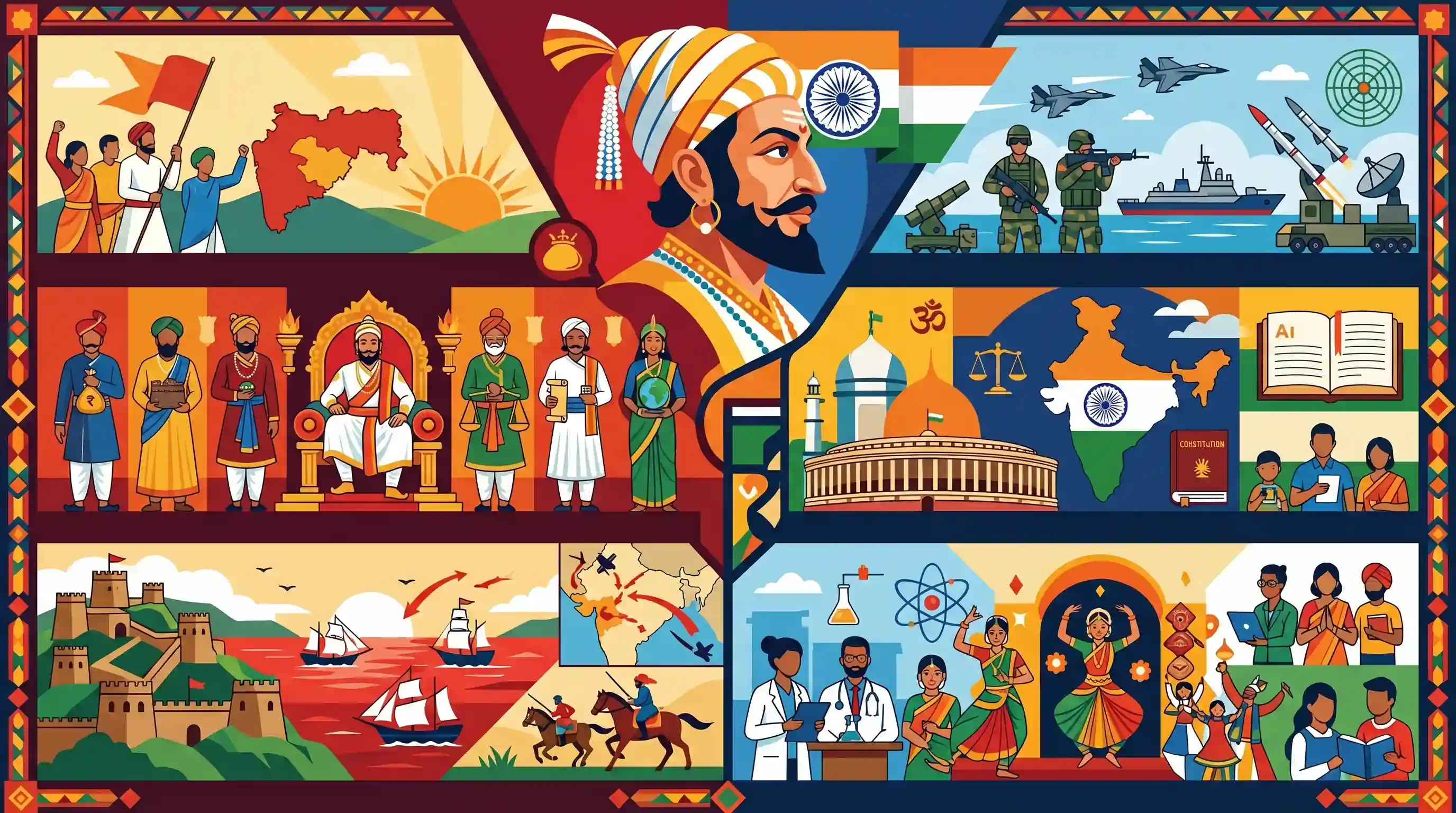
Why It Matters
For UPSC aspirants, understanding the administrative (Ashta Pradhan, Chauth, Sardeshmukhi) and military (Guerrilla warfare, naval forts) contributions of Chhatrapati Shivaji Maharaj is crucial for GS Paper 1. The article also highlights how historical narratives are integrated into modern political and security discourse.
Summary
Union Home Minister Amit Shah lauded Chhatrapati Shivaji Maharaj's vision of 'Swaraj' (self-rule) and his historic military campaigns, referring to his tactical maneuvers as "Operation Sindoor." Speaking in Pune, Shah highlighted that Shivaji Maharaj's strategic defense against invaders and his administrative acumen, particularly through institutions like the Ashta Pradhan, laid the groundwork for indigenous governance and military self-reliance in India. The invocation of Shivaji's legacy serves to connect medieval historical pride with contemporary narratives of national security, sovereignty, and cultural resilience.
Key Points
- Union Home Minister Amit Shah hailed Chhatrapati Shivaji Maharaj's commitment to "Swaraj" (self-rule), citing historical military maneuvers as exemplary models of defending Indian sovereignty.
- The term "Operation Sindoor" was invoked to symbolize the tactical brilliance and unyielding resolve of Maratha forces in protecting their territory from invaders.
- Shivaji Maharaj's governance structures, particularly the Ashta Pradhan (Council of Eight Ministers), and his focus on decentralized administration and indigenous military fortification continue to be lauded as foundational statecraft.
- The article underscores the ongoing cultural significance of Maratha history, illustrating how medieval Indian heroes are celebrated to foster nationalistic pride and inspire modern national security ethos.
Important Terms
Chhatrapati Shivaji Maharaj

The 17th-century founder of the Maratha Empire, known for establishing a sovereign state through administrative innovations, guerrilla warfare (Ganimi Kava), and building a formidable naval presence to protect Indian coastlines.
UPSC context
GS Paper I (History) and Essay. Tests knowledge of medieval Indian leadership, military strategy, and indigenous administrative reforms.
Ashta Pradhan
A council of eight ministers established by Shivaji in 1674 to manage civil and military administration; notable for its non-hereditary appointments and portfolios including the Peshwa (Prime Minister) and Amatya (Finance).
UPSC context
GS Paper I (History). Frequently tested in Prelims/Mains regarding Maratha administration, central governance structures, and historical bureaucracy.
Operation Sindoor
A precision military operation launched by the Indian Armed Forces in May 2025 against terrorist infrastructure in Pakistan/PoJK following the Pahalgam attack; framed by leadership as a commitment to national sovereignty.
UPSC context
GS Paper II (International Relations) and GS Paper III (Internal Security). Relevant for 'India and its neighborhood' and 'surgical strikes' discourse.
Swaraj
A political concept meaning 'self-rule' or 'independence'; championed by Shivaji as 'Hindavi Swarajya' to establish a self-governing indigenous state free from foreign (Mughal/Sultanate) dominance.
UPSC context
GS Paper I (History/Culture) and GS Paper IV (Ethics). Tests philosophical foundations of Indian governance and the evolution of political independence.
Maratha Empire
A powerful confederacy that dominated the Indian subcontinent from the late 17th to early 19th centuries, fundamentally altering the power balance between the Mughals and later European colonialists.
UPSC context
GS Paper I (History). Core topic for the rise of regional powers, Maratha-Mughal conflicts, and the eventual transition to British rule.
Prelims Trap
Operation Sindoor was a 17th-century military campaign launched by Chhatrapati Shivaji Maharaj.
Operation Sindoor was a modern 2025 tri-service strike in PoJK. Amit Shah merely compared its spirit of defending sovereignty to Shivaji's historical commitment to Swaraj.
Static Concepts Connected
What was the administrative structure of Shivaji’s Ashta Pradhan?
- Peshwa (Pantpradhan): Acted as the Prime Minister, responsible for general administration and guiding the affairs of the Maratha state.
- Amatya (Mazumdar): Served as the Finance Minister managing the empire's accounts and revenues.
- Non-hereditary nature: Positions were initially merit-based and non-hereditary under Shivaji, distinguishing it from the later Maratha Confederacy period.
How did the Maratha taxation system of Chauth and Sardeshmukhi function?
- Chauth: A tax comprising 25% of land revenue collected from neighboring (non-Maratha) regions in exchange for protection against Maratha raids.
- Sardeshmukhi: An additional 10% levy claimed on lands where the Marathas asserted historical hereditary rights.
Cross-Topic Patterns
Historical statecraft in modern doctrine
Political framing increasingly merges medieval indigenous defense strategies (Shivaji's forts and guerrilla tactics) with modern military achievements to boost national security narratives.
Tri-service precision strikes & deterrence
Operation Sindoor marks a shift from isolated surgical strikes to joint tri-service integration, representing an evolution in India's proactive cross-border deterrence strategy.

Expect a 2026 GS1 Prelims match-the-following on Ashta Pradhan officials (Amatya, Sumant), specifically testing their non-hereditary nature.
Linked PYQs · 2
Linked PYQs · 2
- 1995PrelimsGS1
Ashtapradhan was a Council of Ministers
- 2019PrelimsGS1
Consider the following statements: 1. In the revenue administration of Delhi Sultanate, the in-charge of revenue collection was known as 'Amil'. 2. The Iqta system of Sultans of Delhi was an ancient indigenous institution. 3. The office of 'Mir Bakshi' came into existence during the reign of Khalji Sultans of Delhi. Which of the statements given above is/are correct?
