Cross Border Terrorism and India Defence Modernisation Strategy
Source:Indian Express ↗
Why It Matters
Provides a comprehensive analysis of India's evolving response to state-sponsored terrorism, highlighting critical capability gaps in intelligence, border security, and defence technology acquisition.
Summary
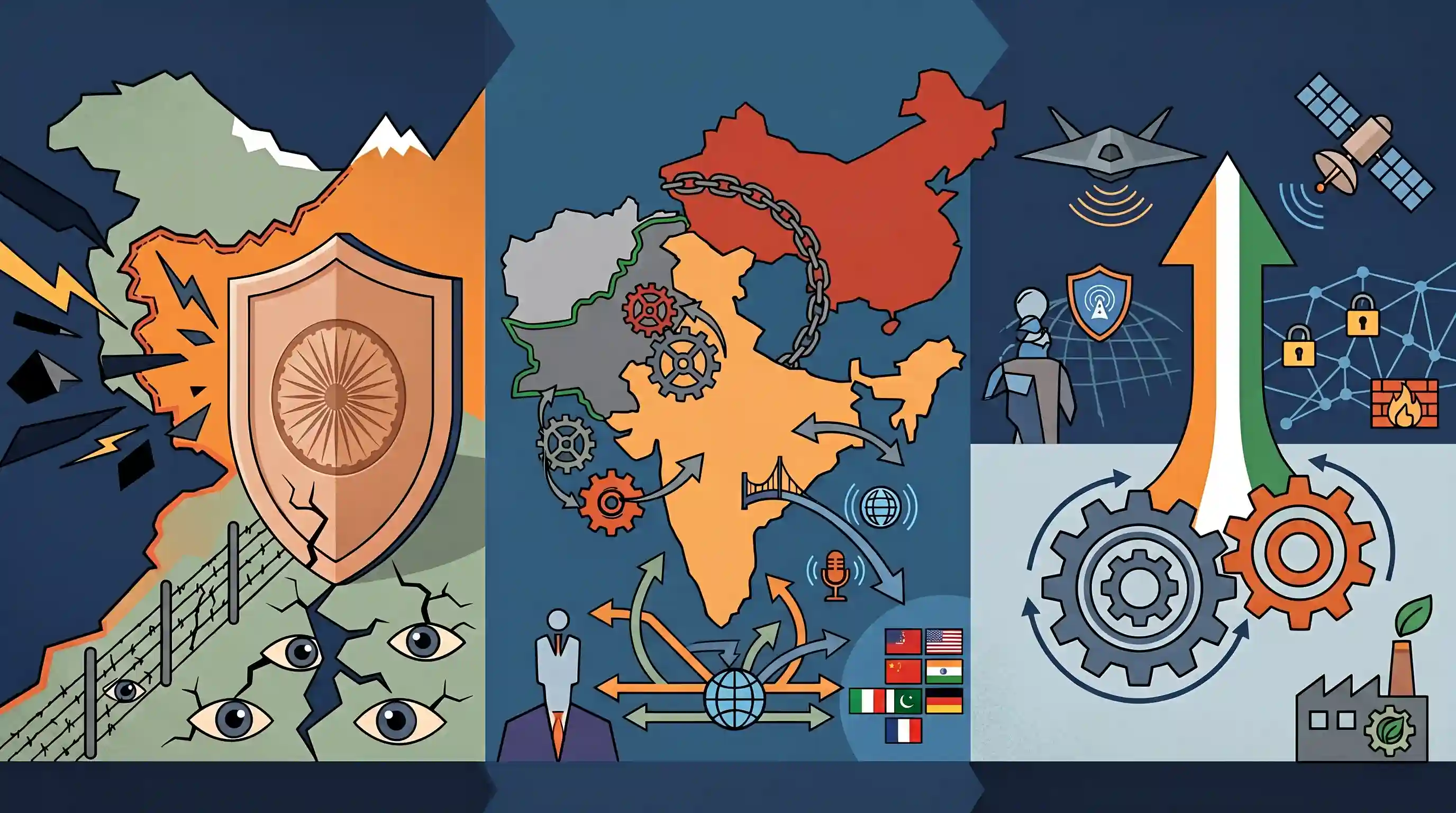
The editorial examines the strategic implications of 'Operation Sindoor', launched in response to a terror attack in Pahalgam. It argues that while the operation restores India’s deterrence against cross-border terrorism—echoing the 2016 surgical strikes and the 2019 Balakot airstrikes—it also exposes persistent intelligence and border management gaps. Looking ahead, India must bolster its global narrative to navigate the China-Pakistan strategic axis and Pakistan's leverage with the US administration. Furthermore, the incident underscores an urgent need for agile defence modernization, advocating self-reliance and enhanced collaboration with the private sector in emerging domains such as drones, cyber warfare, and sub-conventional technology.
Key Points
- Operation Sindoor reinforces India's stance on countering state-sponsored cross-border terrorism, re-establishing deterrence akin to the 2016 surgical strikes and 2019 Balakot airstrikes.
- The successful strike underscores the critical need to revitalize human intelligence networks and address continuing vulnerabilities in border infiltration.
- India faces persistent geopolitical challenges, notably managing the China-Pakistan strategic nexus and Pakistan's diplomatic leverage with the incoming US administration.
- The incident highlights an urgent requirement for defence modernization, emphasizing agility and private sector collaboration in emerging domains like drones, cyber security, and sub-conventional warfare.
Important Terms
Operation Sindoor

A May 2025 Indian multi-domain military offensive involving precision strikes on terror infrastructure in Pakistan and PoJK. It was a retaliatory response to the Pahalgam terror attack, focusing on 'non-contact' warfare.
UPSC context
GS Paper III (Security). Essential for analyzing India's shifting counter-terrorism doctrines and the use of 'deterrence by punishment' in regional conflicts.
Pahalgam Terror Attack (2025)
A 2025 Islamist terror attack on tourists in Jammu & Kashmir that killed 26 civilians. It served as the trigger for Operation Sindoor and a significant escalation in India-Pakistan tensions.
UPSC context
GS Paper III (Internal Security). Tests understanding of internal security challenges, the role of proxies, and triggers for international crises.
Deterrence by Punishment
A military strategy aimed at preventing aggression by promising a swift, costly retaliation that outweighs any gains for the adversary. It marks a shift from India's traditional 'strategic restraint'.
UPSC context
GS Paper III (Internal Security). Explains the evolution of India's strategic posture and military doctrine since the 2016 and 2019 strikes.
Defense Modernization
The systemic upgrade of military hardware and doctrine, emphasizing indigenization (Atmanirbhar Bharat), theaterization, and the integration of emerging technologies like AI, drones, and cyber-defense systems.
UPSC context
GS Paper III (Security). Key for questions on indigenous manufacturing, capital procurement, and adapting to modern, tech-intensive 'gray zone' warfare.
Private Sector (Defense Role)
Non-government commercial entities increasingly integrated into India's defense manufacturing ecosystem to build advanced systems like LCH Prachand and drones, targeting ₹3 lakh crore in production by 2029.
UPSC context
GS Paper III (Economy/Security). Tests knowledge of defense indigenization policies and the role of corporate collaboration in achieving military self-reliance.
Sub-conventional Warfare
Military operations below the level of full-scale war, including proxy warfare, counter-insurgency, and modern 'non-contact' conflicts using drones and cyber-attacks to achieve strategic objectives.
UPSC context
GS Paper III (Security). Vital for discussing asymmetric threats, gray-zone conflict, and the technological evolution of counter-insurgency operations.
China-Pakistan Strategic Axis
The collaborative military, economic, and diplomatic partnership between Beijing and Islamabad, which poses a 'two-front' security challenge and complicates India's strategic deterrence in South Asia.
UPSC context
GS Paper II (International Relations). Crucial for analyzing regional power dynamics, neighborhood challenges, and India’s 'de-hyphenation' strategy in global diplomacy.
Indus Waters Treaty (IWT) Suspension
The 1960 water-sharing agreement between India and Pakistan. During the 2025 crisis, India suspended the treaty as a non-military punitive measure, signaling a hardening of its diplomatic stance.
UPSC context
GS Paper II (International Relations). Examines water diplomacy as a strategic lever and the legal/political ramifications of treaty abrogation in South Asia.
Prelims Trap
The 1960 Indus Waters Treaty contains a unilateral withdrawal clause allowing India to suspend it during hostilities.
The IWT does not contain any provision for unilateral suspension or termination. Any formal modification or termination requires a bilaterally ratified treaty between India and Pakistan.
Static Concepts Connected
How does the Indus Waters Treaty (1960) allocate river waters?
- Eastern Rivers: Ravi, Beas, and Sutlej are allocated to India for unrestricted use.
- Western Rivers: Indus, Jhelum, and Chenab are allocated to Pakistan, but India retains rights for non-consumptive uses like run-of-the-river hydel projects.
- Dispute Mechanism: Employs a graded process: Permanent Indus Commission, followed by a Neutral Expert, and finally a Court of Arbitration.
What are the core components of the Comprehensive Integrated Border Management System (CIBMS)?
- Electronic Surveillance: Utilizes thermal imagers, infrared sensors, radars, and aerostats to create an invisible electronic barrier along porous and difficult terrains.
- Communication Network: Ensures real-time data transmission from border sensors to command and control centers via secure fiber-optic and satellite linkages.
- Quick Response: Enables border guarding forces to swiftly neutralize detected infiltrations through automated alerts and integrated command structures.
Cross-Topic Patterns
Weaponizing transboundary water treaties
Holding the Indus Waters Treaty in abeyance links riparian geography with internal security, marking a shift from India's historical decoupling of hydrology and diplomacy.
Private sector in sub-conventional warfare
The push for agile tech like suicide drones and cyber warfare connects border security needs with the iDEX scheme and Atmanirbhar Bharat defence procurement policies.

Expect a 2026 Mains question linking the evolution of India's kinetic counter-terror doctrine to non-kinetic measures like the IWT.
Linked PYQs · 3
Linked PYQs · 3
- 2016MainsGS3
The terms 'Hot Pursuit' and 'Surgical Strikes' are often used in connection with armed action against terrorist attacks. Discuss the strategic impact of such actions.
- 2024MainsGS3
India has a long and troubled border with China and Pakistan fraught with contentious issues. Examine the conflicting issues and security challenges along the border. Also give out the development being undertaken in these areas under the Border Area Development Programme (BADP) and Border Infrastructure and Management (BIM) Scheme.
- 2025MainsGS3
Terrorism is a global scourge. How has it manifested in India? Elaborate with contemporary examples. What are the counter measures adopted by the State? Explain.
