Political Consensus on Cross Border Military Retaliation
Source:The Hindu ↗
Why It Matters
Operation Sindoor marks a significant shift in India's counter-terrorism posture, highlighting proactive military retaliation to state-sponsored terrorism from Pakistan. It serves as a contemporary example of India's internal security strategy, relevant for GS Paper 3 questions on terrorism and border security, as well as GS Paper 2 topics on neighborhood relations.
Summary
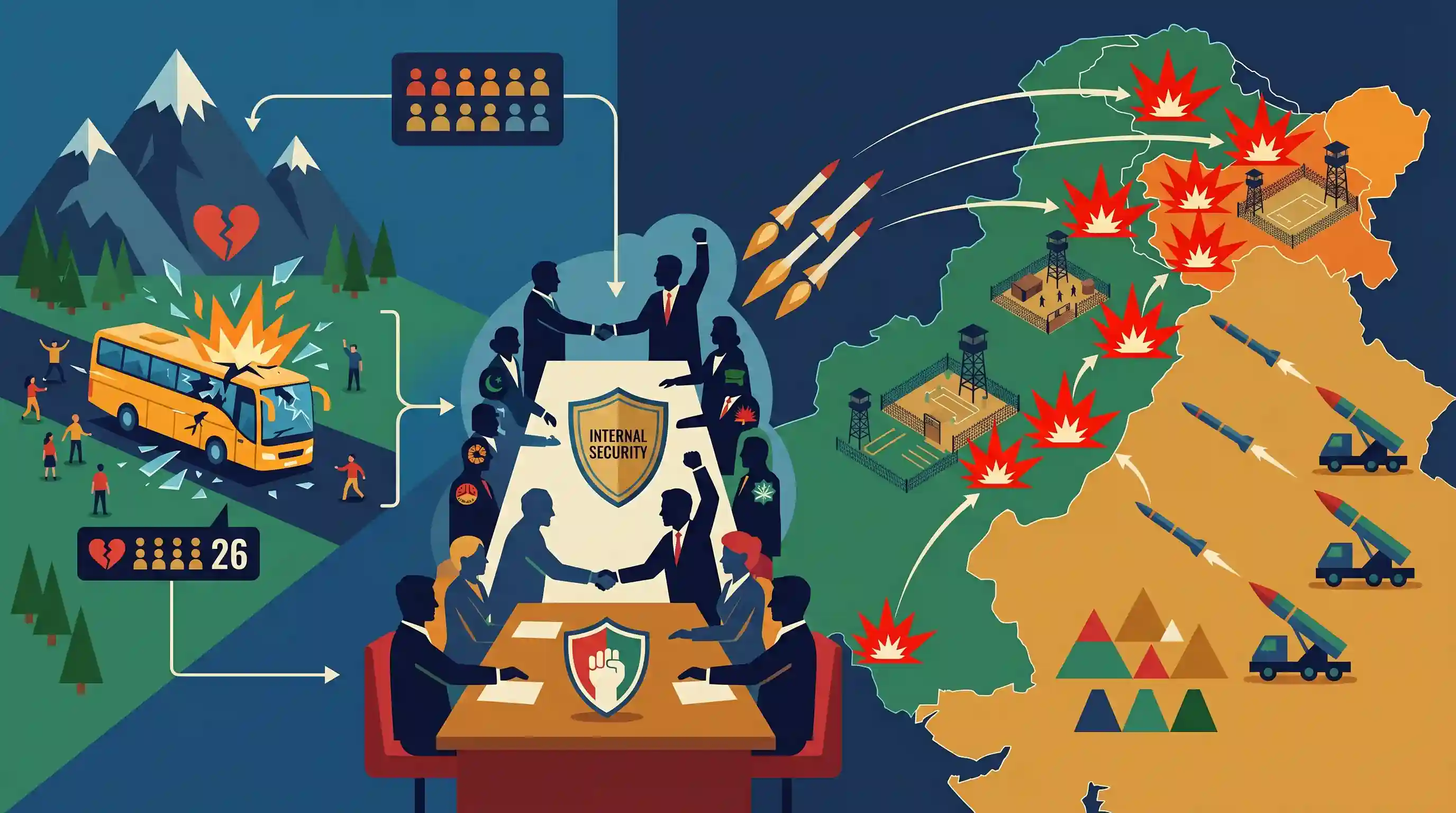
The Indian armed forces executed "Operation Sindoor," carrying out retaliatory missile strikes on nine terror targets across Pakistan and Pakistan-occupied Jammu and Kashmir (PoJK). Major bases of terror groups like Jaish-e-Mohammad in Bahawalpur and Lashkar-e-Taiba in Muridke were targeted in response to the April 22 terrorist attack on tourists in Pahalgam that killed 26 people. The Rashtriya Swayamsevak Sangh (RSS), along with opposition parties like Congress, strongly backed the military response, terming it a necessary strike against cross-border terrorism and the beginning of justice for the Pahalgam victims.
Key Points
- India launched Operation Sindoor, conducting missile strikes on nine terror targets in Pakistan and PoJK.
- The operation targeted major terrorist hubs, including the JeM base in Bahawalpur and LeT headquarters in Muridke.
- The strikes were retaliation for a deadly terrorist attack on tourists in Pahalgam on April 22, which left 26 dead.
- Political and social organizations, including the RSS and Congress, lauded the operation as a decisive counter-measure against state-sponsored terrorism.
Important Terms
Operation Sindoor

A 2025 retaliatory military operation by India using precision missile strikes against terror infrastructure in Pakistan and PoJK following the Pahalgam tourist attack.
UPSC context
GS Paper III (Internal Security). Tests India's evolving deterrence doctrine and response strategies to cross-border terrorism.
Lashkar-e-Taiba (LeT)
A Pakistan-based, UN-designated terrorist organization seeking Kashmir's secession from India; responsible for major attacks including the 2008 Mumbai and 2025 Pahalgam strikes.
UPSC context
GS Paper III (Security). Relates to challenges from non-state actors and external security threats.
Jaish-e-Mohammad (JeM)
A radical Islamist group based in Pakistan, founded by Masood Azhar; known for high-profile attacks on the Indian Parliament (2001) and Pulwama (2019).
UPSC context
GS Paper III (Internal Security). Tests knowledge of terror-group profiles and their impact on regional stability.
Rashtriya Swayamsevak Sangh (RSS)
A right-wing volunteer organization whose ideology of Hindutva and "civilizational security" increasingly shapes India's strategic culture and national security discourse.
UPSC context
GS Paper I/II (Governance/Ideology). Examines the influence of civilizational identity on contemporary national policy.
Cross-border terrorism
Terrorism originating in one country to cause distress in another, often involving state-supported non-state actors as part of a proxy war.
UPSC context
GS Paper III (Security Challenges). A core topic focusing on external state-sponsored threats and border management.
PoJK (Pakistan-occupied Jammu and Kashmir)
Part of the former princely state of Jammu and Kashmir under illegal Pakistani control; traditionally used as a base for anti-India terror infrastructure.
UPSC context
GS Paper II (International Relations). Central to India-Pakistan border disputes and sovereignty issues.
Prelims Trap
Operation Sindoor involved targeted strikes against Pakistani military installations and command centers.
India adheres to a 'non-military retaliatory' doctrine. It targets non-state terror infrastructure (JeM/LeT) to avoid full-scale conventional war, not the adversary's state military forces.
Static Concepts Connected
What governs India's "Non-Military Retaliatory Strike" doctrine?
- Target selection: Strikes exclusively target non-state terrorist infrastructure (like JeM or LeT camps), deliberately avoiding the adversary's official state military assets and civilian populations.
- Legal backing: Such actions invoke the inherent right to individual or collective self-defense under Article 51 of the UN Charter, following armed attacks by state-backed proxies.
How does the Indus Waters Treaty (1960) handle bilateral conflict or suspension?
- No exit clause: The 1960 treaty brokered by the World Bank lacks a unilateral withdrawal or suspension clause. It can only be modified or terminated by a newly drafted mutual treaty.
- Vienna Convention invocation: Suspending the treaty relies on customary international law (Vienna Convention on the Law of Treaties), usually citing a "fundamental change of circumstances" or state-sponsored terror as a material breach.
Cross-Topic Patterns
Internal Security + Human Geography
The shift to targeting tourists in the Lidder Valley (Pahalgam) attempts to cripple J&K's tourism-dependent economy, linking counter-terrorism directly to regional human geography and post-Article 370 integration.
Hard Power + Hydro-Diplomacy
Invoking the suspension of the Indus Waters Treaty signals India's shift to weaponizing riparian geography as a coercive diplomatic tool alongside kinetic military action.
UNSC 1267 + State Proxies
Striking bases of UN-designated entities (LeT/JeM) highlights the limitations of international financial mechanisms (like FATF) in permanently dismantling state-sponsored terror proxies.

Expect a 2026 Mains question on how India's "new normal" of cross-border kinetic strikes integrates with hydro-diplomacy (IWT suspension).
Linked PYQs · 2
Linked PYQs · 2
- 2025MainsGS3
Terrorism is a global scourge. How has it manifested in India? Elaborate with contemporary examples. What are the counter measures adopted by the State? Explain.
- 2015MainsGS2
Terrorist activities and mutual distrust have clouded India-Pakistan relations. To what extent the use of soft power like sports and cultural exchanges could help generate goodwill between the two countries? Discuss with suitable examples.
