Operation Sindoor and India active cross border deterrence
Source:Indian Express ↗
Why It Matters
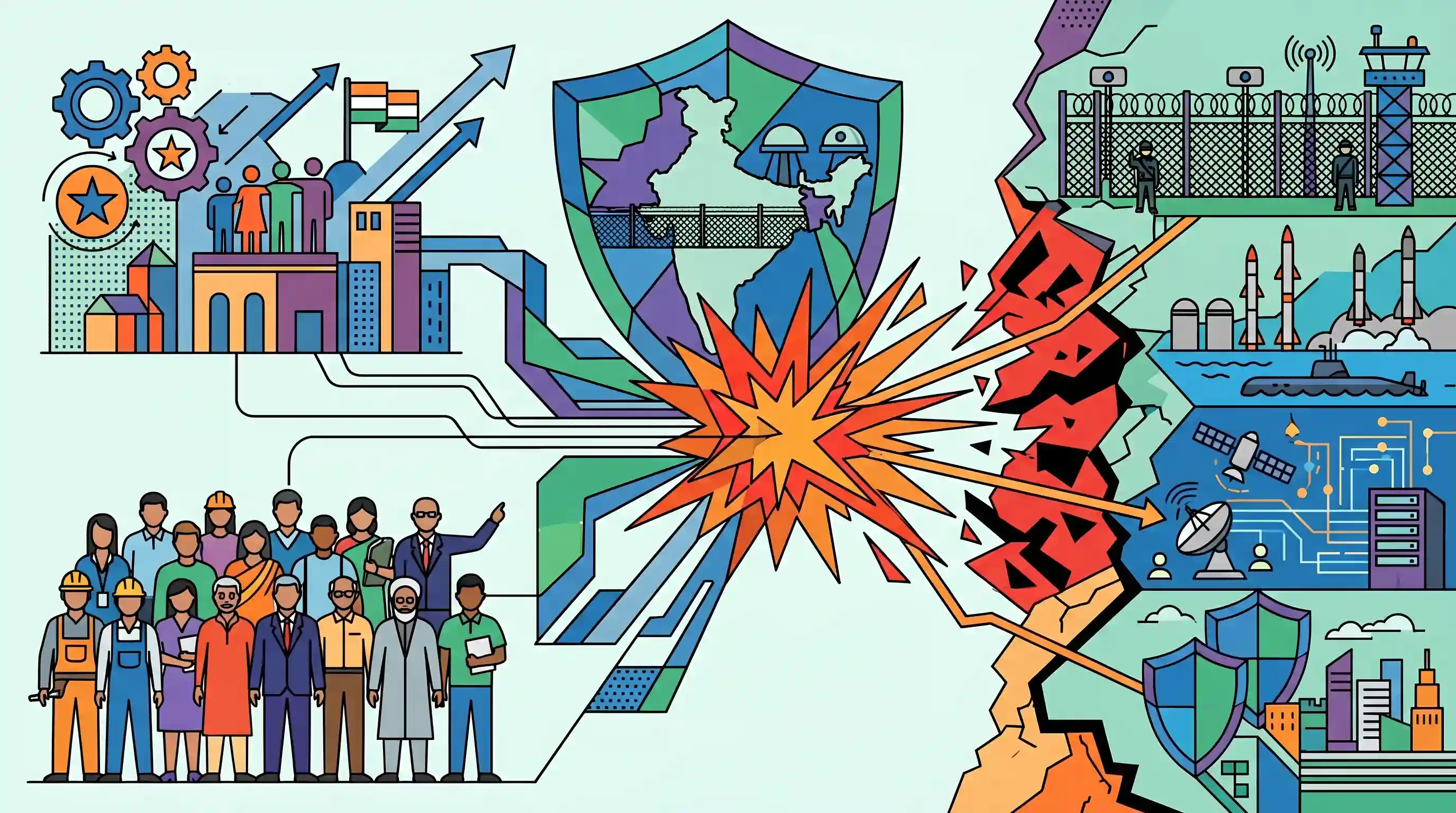
Highlights the shift in India's defense doctrine from strategic restraint to active, demonstrative deterrence in response to cross-border threats. Essential for answering questions on India's evolving military strategies and border security dynamics.
Summary
Defence Minister Rajnath Singh described 'Operation Sindoor' as a significant symbol of India's political, social, and strategic willpower, rather than just a routine military action against Pakistan. The statement underscores India's evolving defense doctrine, emphasizing a robust, multi-dimensional approach to national security and cross-border deterrence.
Key Points
- Defence Minister Rajnath Singh characterized 'Operation Sindoor' as a demonstration of India's political, social, and strategic willpower rather than merely a military maneuver.
- The operation highlights India's proactive defense posture and intent to decisively address security challenges originating from Pakistan.
- The statement reflects a paradigm shift in national security policy toward active deterrence and cross-border strategic assertion.
Important Terms
Operation Sindoor

A military operation launched by India on May 7, 2025, targeting terror infrastructure in Pakistan and PoK following the Pahalgam terror attack.
UPSC context
GS Paper III: Internal Security; demonstrates evolving response mechanisms and military doctrine against cross-border threats.
Indian Armed Forces
The unified military services of India, comprising the Army, Navy, and Air Force, responsible for territorial integrity and national defense.
UPSC context
GS Paper III: Security Forces; focuses on modernization, technological integration, and tri-service synergy.
Cross-Border Terrorism
Terrorist activities originating from one country to target another, often with state-sponsored support to achieve political or strategic goals.
UPSC context
GS Paper III: Internal Security; critical for understanding India-Pakistan relations and sub-conventional warfare challenges.
Strategic Deterrence
A strategy intended to dissuade an adversary from taking an action by the threat of punitive retaliation or cost imposition.
UPSC context
GS Paper III: Defense Policy; involves both conventional and nuclear doctrines to maintain regional stability.
National Security Policy
A comprehensive framework outlining a nation's security concerns and the military, diplomatic, and economic measures to address them.
UPSC context
GS Paper III: Security Strategy; essential for policy formulation and analyzing state responses to complex threats.
Offensive Defence
A security doctrine involving proactive military actions to deter or eliminate threats before they manifest, moving away from purely reactive postures.
UPSC context
GS Paper III: Military Doctrine; represents a paradigm shift in India's border management and counter-terror tactics.
Prelims Trap
"Operation Sindoor involved specialized ground infantry forces crossing the LoC."
It was explicitly characterized as a 'non-contact war'. It relied on standoff weapons (missiles, drones) from tri-services, not physical infantry insertion across the LoC.
Static Concepts Connected
What is 'Active Deterrence' in India's strategic security doctrine?
- Proactive Posture: Moving away from 'strategic restraint' to preemptive or immediate, severe punitive responses against cross-border terror threats.
- Threshold Management: Operating forcefully and punitively in the conventional military space, strictly remaining below the adversary's nuclear threshold.
- Precision Targeting: Targeting terror infrastructure with precision while deliberately avoiding military or civilian collateral to prevent full-scale escalation.
What characterizes a 'Non-Contact War' in modern military operations?
- Standoff Weapons: The extensive use of cruise missiles, guided bombs, and drones to strike targets without physically deploying troops into enemy territory.
- Network-Centric Intelligence: Relying heavily on cyber, space (satellites), and electronic warfare for intelligence gathering and precision strike coordination.
- Tri-Services Synergy: Seamless joint coordination of air, sea, and land-based long-range strike assets rather than single-service operations.
Cross-Topic Patterns
Defense Tech & Standoff Munitions
Prelims frequently tests missile systems. The SCALP cruise missiles, HAMMER bombs, and loitering munitions used in Operation Sindoor directly link GS3 Defense Technology to current strategic operations.
Nuclear Deterrence vs. Conventional Space
Operation Sindoor tests Pakistan's nuclear bluff, proving India can execute high-impact conventional punitive strikes against non-state actors without breaching the regional nuclear threshold.

GS3 2026: Expect a 15-marker evaluating India's doctrinal shift from 'strategic restraint' to 'active deterrence' post-Operation Sindoor.
Linked PYQs · 2
Linked PYQs · 2
- 2016MainsGS3
The terms 'Hot Pursuit' and 'Surgical Strikes' are often used in connection with armed action against terrorist attacks. Discuss the strategic impact of such actions.
- 2024MainsGS3
India has a long and troubled border with China and Pakistan fraught with contentious issues. Examine the conflicting issues and security challenges along the border. Also give out the development being undertaken in these areas under the Border Area Development Programme (BADP) and Border Infrastructure and Management (BIM) Scheme.
