Precision guided long range weapons in Indian military arsenal
Source:Indian Express ↗
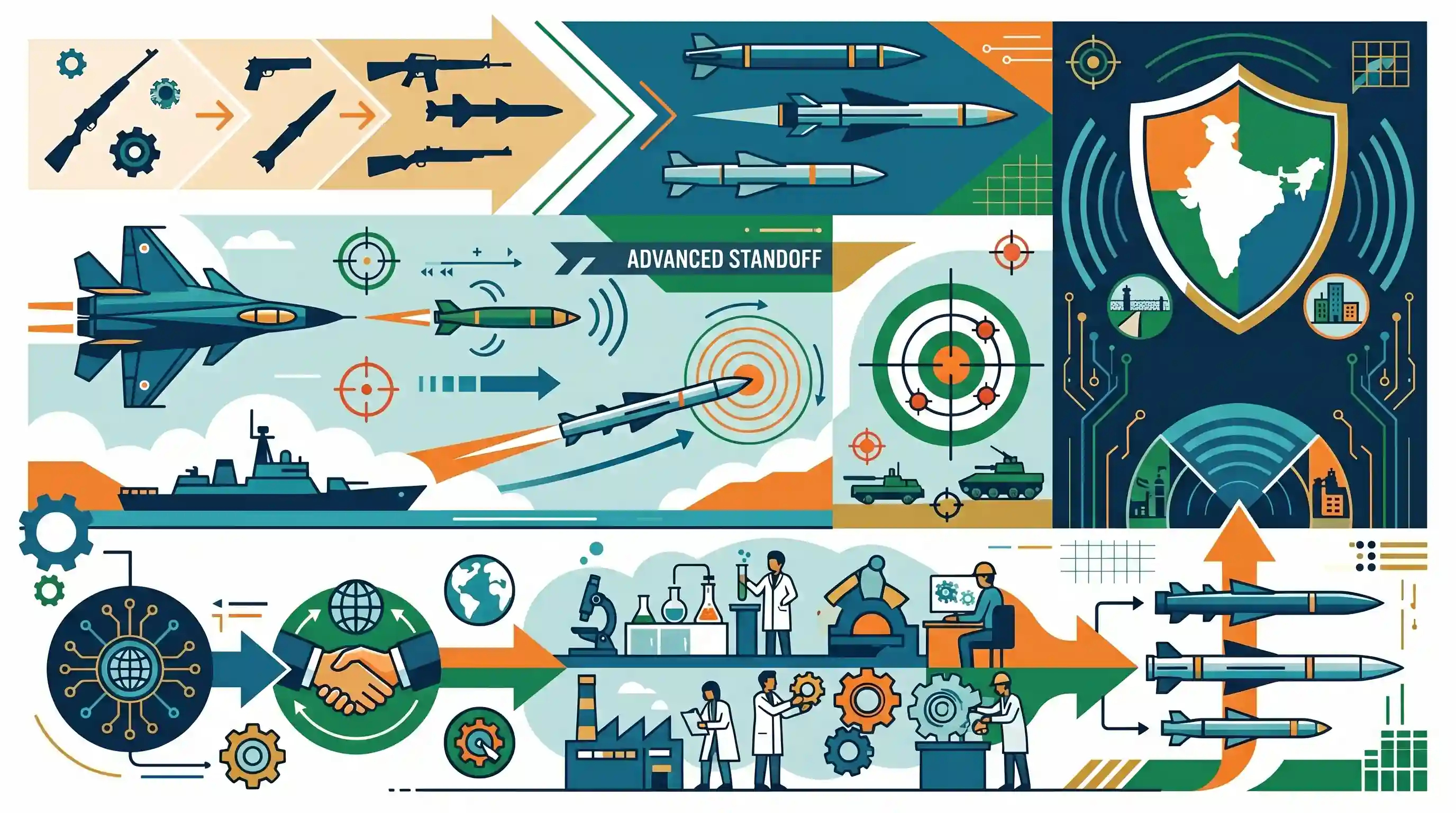
Why It Matters
Knowledge of India's strategic military assets, particularly cruise missiles and precision-guided munitions, is critical for understanding the country's defence preparedness, deterrence capabilities, and progress in indigenisation under GS-3 (Science & Technology and Security).
Summary
The article explores the modernization of the Indian military's arsenal through the acquisition and integration of precision-guided long-range weapons. Highlighted under 'Operation Sindoor', the focus is on advanced standoff capabilities ranging from the French-origin HAMMER to the Indo-Russian BrahMos supersonic cruise missile. This evolution underscores a strategic shift towards precision strikes and highlights the balance between importing critical technologies and fostering indigenous defence manufacturing.
Key Points
- The Indian military is upgrading its arsenal with advanced precision-guided munitions (PGMs) and long-range standoff weapons.
- The integration of both imported systems, such as the French HAMMER missile, and indigenous/joint-venture systems like the BrahMos supersonic cruise missile, highlights India's multi-pronged procurement strategy.
- Operation Sindoor reflects a strategic emphasis on precision strike capabilities, which allow for high lethality while minimizing collateral damage in modern warfare scenarios.
- The transition towards standoff engagement weapons underscores the ongoing modernization efforts and the push for technological self-reliance in India's defence sector.
Important Terms
Operation Sindoor

A 2025 Indian military operation launched after the Pahalgam terror attack, notable for the extensive use of long-range precision-guided munitions like BrahMos and SCALP against terror infrastructure.
UPSC context
GS Paper 3 (Internal Security); tests understanding of modern counter-terror doctrines, precision strike capabilities, and strategic deterrence mechanisms.
BrahMos Joint Venture
A 1998 partnership between India's DRDO and Russia's NPOM (forming BrahMos Aerospace) to develop the world's fastest supersonic cruise missile, representing a milestone in bilateral defense cooperation.
UPSC context
GS Paper 2 (International Relations) & Paper 3 (S&T); tests Indo-Russian strategic ties and success in joint high-tech development.
Defence Research and Development Organisation (DRDO)
The premier R&D wing of the Ministry of Defence, established in 1958 to achieve self-reliance in critical defense technologies through indigenous design and development of weapon systems.
UPSC context
GS Paper 3 (Science & Tech); tests knowledge of institutional frameworks for indigenization and major domestic defense platforms.
Make in India (Defence)
A flagship national initiative launched in 2014 to transform India into a global manufacturing hub, focusing heavily on defense to reduce import dependency and boost exports.
UPSC context
GS Paper 3 (Indian Economy/Security); tests policy analysis regarding Atmanirbhar Bharat and the growth of the domestic defense industrial base.
HAMMER (Highly Agile Modular Munition Extended Range)
A French-origin modular precision-guided bomb (AASM) integrated into IAF's Rafale and Tejas, converting unguided bombs into smart, long-range standoff weapons using GPS or infrared guidance.
UPSC context
GS Paper 3 (Defence Technology); tests familiarity with specific advanced weapon systems and the IAF's modernization through hybrid (imported-indigenous) integration.
Indigenisation of Technology
The process of designing and producing defense equipment within India to achieve strategic autonomy, reduce foreign exchange outflow, and foster a domestic defense-industrial ecosystem.
UPSC context
GS Paper 3 (Science & Tech); a core syllabus theme testing the ability to link policy (Atmanirbhar Bharat) with technological milestones.
Prelims Trap
"BrahMos is a supersonic ballistic missile developed entirely by DRDO under the Make in India initiative."
BrahMos is a cruise missile (not ballistic) and is a joint venture between India and Russia. It is not exclusively indigenous, though its components are increasingly localized.
Static Concepts Connected
What distinguishes Cruise missiles from Ballistic missiles?
- Trajectory: Ballistic missiles follow a parabolic, often exoatmospheric, unguided path after launch. Cruise missiles stay within the atmosphere and can hug the terrain.
- Guidance: Cruise missiles are actively guided throughout their entire flight. Ballistic missiles rely primarily on initial rocket thrust and gravity.
- Propulsion: Cruise missiles typically use air-breathing jet engines (requiring atmospheric oxygen). Ballistic missiles use rocket engines that carry their own oxidizer.
How does a Ramjet engine differ from a Scramjet engine?
- Combustion Airflow: A Ramjet slows incoming supersonic air to subsonic speeds for combustion. A Scramjet (Supersonic Combustion Ramjet) maintains supersonic airflow during combustion.
- Speed Capabilities: Ramjets operate efficiently up to speeds of Mach 3 to 6 (like BrahMos). Scramjets are necessary for hypersonic flight above Mach 6.
Cross-Topic Patterns
Defence FDI and Technology Transfers
The BEL-Safran joint venture for HAMMER kits aligns with India's revised Defence FDI policy, encouraging deep technology transfer rather than mere procurement.
BrahMos exports and Act East Policy
India's shift from importer to exporter is highlighted by BrahMos sales to the Philippines, blending indigenous defence manufacturing with the strategic Act East Policy in the Indo-Pacific.

Expect a 2026 Prelims multi-statement question contrasting Ramjet/Scramjet propulsion mechanics with cruise vs ballistic trajectories.
Linked PYQs · 2
Linked PYQs · 2
- 2023PrelimsGS1
Consider the following statements: 1. Ballistic missiles are jet-propelled at subsonic speeds throughout their flights, while cruise missiles are rocket-powered only in the initial phase of flight. 2. Agni-V is a medium-range supersonic cruise missile, while BrahMos is a solid-fuelled intercontinental ballistic missile. Which of the statements given above is/are correct?
- 2014MainsGS3
Foreign Direct Investment (FDI) in the defence sector is now set to be liberalized. What influence this is expected to have on Indian defence and economy in the short and long run?
