Whole of Government Approach to National Security Preparedness
Source:The Hindu ↗
Why It Matters
Provides a practical example of the 'whole of government' approach to national security crisis management. It links directly to GS3 topics such as cross-border terrorism, securing critical infrastructure, the role of media/fake news in internal security, and institutional synergy during external escalation.
Summary
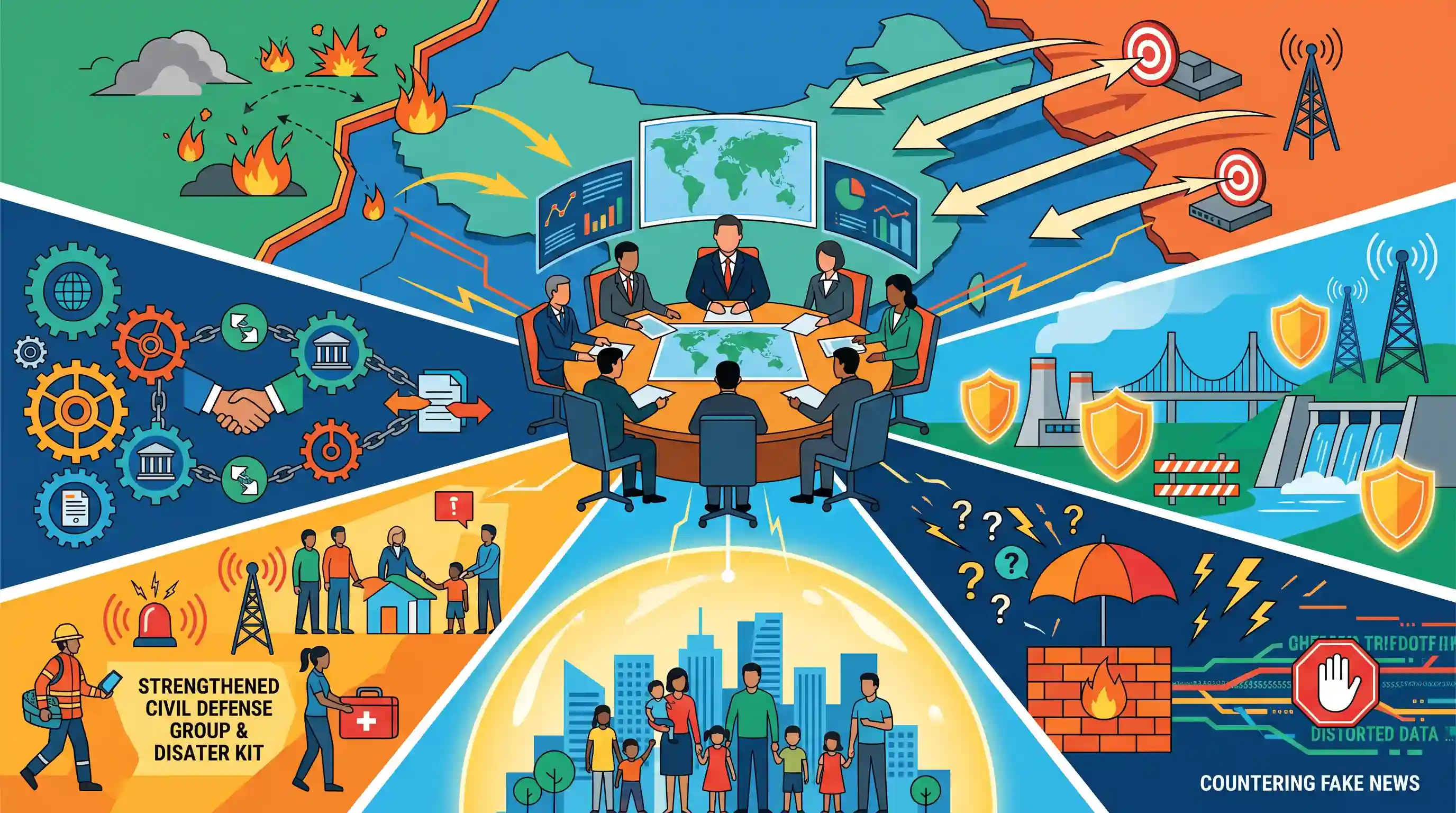
Prime Minister Narendra Modi convened a high-level security review meeting with top Union Secretaries amid heightened Indo-Pak tensions following the April 22 Pahalgam terror attack and India's subsequent retaliatory strikes on May 7 against terror infrastructure in Pakistan and PoK. The government is actively managing the escalation under 'Operation Sindoor', adopting a 'whole of Government' approach to bolster national preparedness. Strategic priorities outlined in the meeting include ensuring seamless inter-ministerial coordination, safeguarding critical infrastructure, countering fake news, and strengthening civil defense mechanisms to maintain operational continuity and citizen safety.
Key Points
- PM Modi chaired a high-level review meeting with Union Secretaries to assess national security preparedness amidst escalating tensions with Pakistan.
- The security review follows the April 22 Pahalgam terror attack that killed 26 civilians, and India's retaliatory strikes on May 7 against terror infrastructure in Pakistan and PoK.
- Ongoing 'Operation Sindoor' involves intensified surveillance, robust civil defense mechanisms, and operational preparedness across ground-level agencies.
- The meeting emphasized a 'whole of Government' approach for safeguarding critical infrastructure, ensuring seamless inter-ministerial coordination, and maintaining essential services.
- Countering misinformation and fake news was highlighted as a vital component of national resilience during the sensitive period.
Important Terms
Operation Sindoor

Precision military strikes launched by India on May 7, 2025, targeting nine terror camps in Pakistan/PoK. It marked a strategic shift from reactive diplomacy to assertive deterrence following the Pahalgam terror attack.
UPSC context
GS Paper III (Internal Security). Tests understanding of India’s response to cross-border terrorism and shifts in national security doctrine.
Whole-of-Government Approach
A strategy integrating all government ministries and agencies to address security threats. It ensures seamless inter-ministerial coordination, resource optimization, and a unified response, breaking traditional institutional silos during national crises.
UPSC context
GS Paper II (Governance). Relevant for questions on effective crisis management, administrative coordination, and executive decision-making frameworks.
Prime Minister's Office (PMO)
The central executive body providing secretarial assistance to the Prime Minister. It serves as the primary hub for strategic decision-making and inter-ministerial oversight during high-stakes military and security operations.
UPSC context
GS Paper II (Executive). Tests the role and functioning of the PMO as a coordinating entity in the parliamentary system.
Ministry of Defence (MoD)
The Union Ministry responsible for external security and the Indian Armed Forces. In this context, it oversees the planning, execution, and logistical support for retaliatory strikes and border defense.
UPSC context
GS Paper III (Security Forces). Tests knowledge of India’s defense organizational structure and military command in conflict scenarios.
Ministry of Home Affairs (MHA)
The ministry tasked with maintaining internal security, border management, and civil defense. It coordinates domestic preparedness, safeguards critical infrastructure, and manages law and order during cross-border escalations.
UPSC context
GS Paper III (Internal Security). Tests the role of central ministries in managing internal stability and border security.
Ministry of External Affairs (MEA)
The ministry responsible for India’s foreign policy. During military operations, it handles diplomatic communication, manages international perceptions, and justifies actions under international law, such as the right to self-defense.
UPSC context
GS Paper II (International Relations). Crucial for questions on India’s diplomacy and neighborhood policy during regional conflicts.
Ministry of Information and Broadcasting (MIB)
The ministry overseeing government communications and media policy. Its role in security crises includes countering misinformation, debunking fake news, and managing the national narrative to maintain public order.
UPSC context
GS Paper III (Internal Security/Cyber). Tests understanding of Information Warfare and the government’s role in mitigating social media-led instability.
Prelims Trap
Operation Sindoor was launched by the Indian government for the evacuation of stranded citizens.
Operation Sindoor is a retaliatory military strike against terror infrastructure, not a civilian evacuation, disaster relief mission, or internal anti-Naxalite operation.
Static Concepts Connected
What constitutes Critical Information Infrastructure (CII) and who protects it?
- Legal Definition: Computer resources whose incapacitation has a debilitating impact on national security, economy, or public health (Section 70 of IT Act 2000).
- Nodal Agency: The National Critical Information Infrastructure Protection Centre (NCIIPC), functioning under the NTRO, is the designated nodal agency.
- Key Sectors: Includes Power & Energy, Banking/Financial Services, Telecom, Transport, Government, and Strategic/Public Enterprises.
What is the 'Whole-of-Government' approach in internal security?
- Institutional Integration: Joint, seamless coordination between military, central intelligence agencies, law enforcement, and civilian ministries to handle crises.
- Unified Action: Ensuring that operational efforts (like military strikes) are simultaneously backed by civil defense, misinformation control, and diplomatic outreach.
Cross-Topic Patterns
Cognitive warfare + cyber-physical sabotage
The weaponization of fake news to trigger civil panic often coincides with cyberattacks on power and telecom grids, representing a multi-domain threat environment beyond conventional border skirmishes.
Evolution of India's counter-terrorism doctrine
Operation Sindoor cements the strategic shift observed since the 2016 surgical strikes and 2019 Balakot strikes, marking "proactive deterrence" as India's established doctrine against cross-border terrorism.

UPSC 2026 GS3 Mains will likely test the 'Whole of Government' approach in hybrid warfare, linking cyber resilience to border security.
Linked PYQs · 5
Linked PYQs · 5
- 2020MainsGS3
Analyze internal security threats and transborder crimes along Myanmar, Bangladesh and Pakistan borders including Line of Control (LoC). Also discuss the role played by various security forces in this regard.
- 2020MainsGS3
For effective border area management, discuss the steps required to be taken to deny local support to militants and also suggest ways to manage favourable perception among locals.
- 2024MainsGS3
India has a long and troubled border with China and Pakistan fraught with contentious issues. Examine the conflicting issues and security challenges along the border. Also give out the development being undertaken in these areas under the Border Area Development Programme (BADP) and Border Infrastructure and Management (BIM) Scheme.
- 2023MainsGS3
What are the internal security challenges being faced by India? Give out the role of Central Intelligence and Investigative Agencies tasked to counter such threats.
- 2016MainsGS3
Use of Internet and social media by non-state actors for subversive activities is a major security concern. How have these been misused in the recent past? Suggest effective guidelines to curb the above threat.
