South Asian Non Alignment Policy Amid Regional Security Challenges
Source:Indian Express ↗
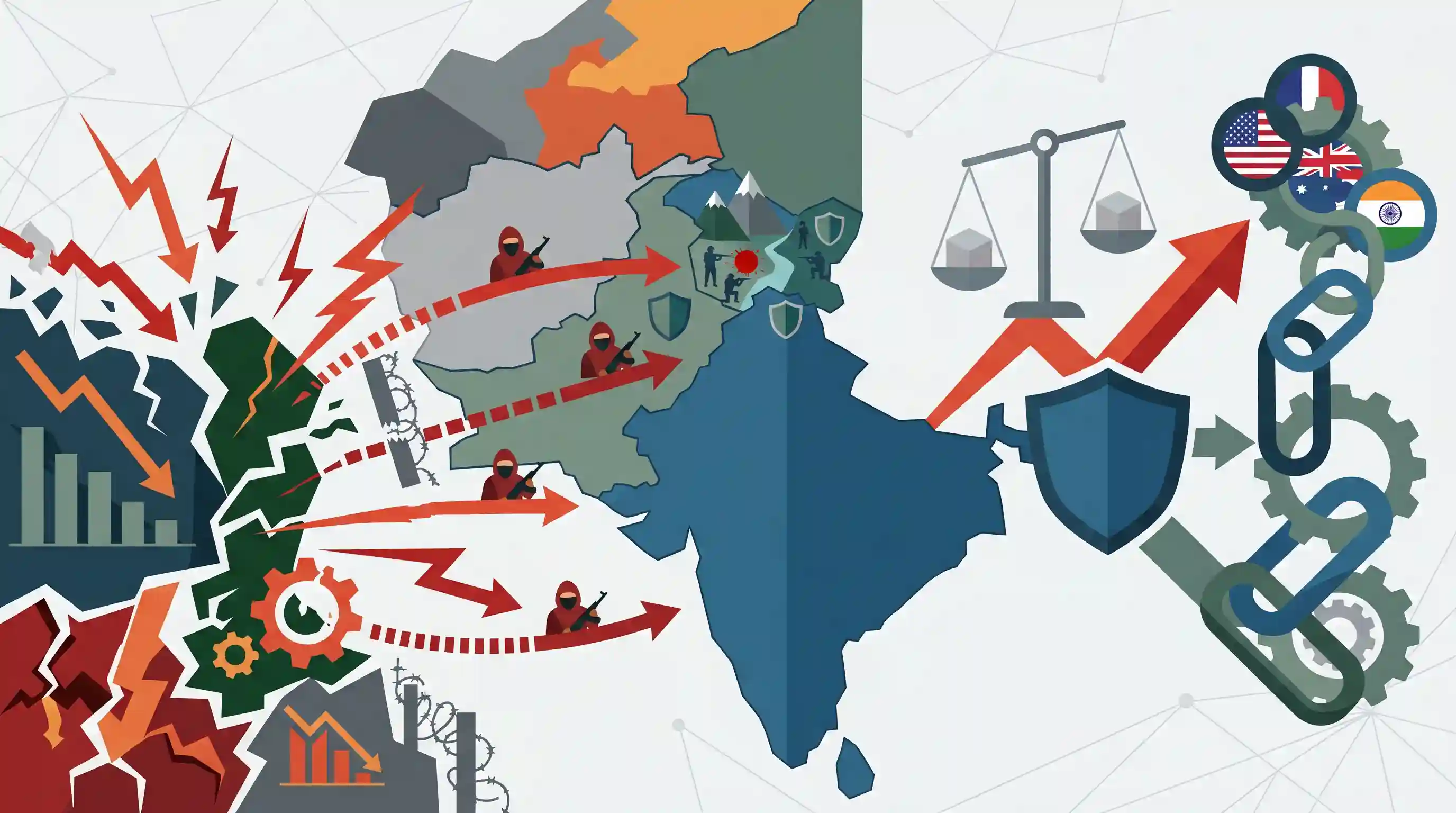
Why It Matters
This article provides a critical perspective on India's foreign policy doctrines (specifically non-alignment/strategic autonomy) in the context of persistent neighborhood instability. It bridges IR (GS2) with internal security (GS3) by linking Pakistan's domestic collapse and border terrorism to a need for shifting diplomatic paradigms.
Summary
The article examines the strategic fallout of Pakistan's deepening internal instability on South Asia, focusing on how its domestic crises fuel regional unpredictability and cross-border terrorism. Referencing recent security engagements like 'Operation Sindoor' in Pahalgam, it argues that Pakistan's actions continue to threaten regional peace. In light of these persistent security challenges, the author suggests that South Asian countries must critically evaluate their traditional adherence to 'non-alignment' policies, potentially shifting toward stronger strategic alignments to better secure their national interests against regional volatility.
Key Points
- Pakistan's domestic turmoil, encompassing political and economic crises, is increasingly spilling over and destabilizing the broader South Asian region.
- Recent security incidents, such as 'Operation Sindoor' in Pahalgam, underscore the continuing reality of cross-border terrorism emanating from Pakistan.
- The persistent regional unpredictability caused by Pakistan's state-sponsored terrorism and internal collapse challenges the effectiveness of traditional non-alignment postures.
- The article suggests that South Asian nations may need to rethink strict non-alignment in favor of more robust strategic partnerships and proactive security architectures.
Important Terms
Non-Aligned Movement (NAM)

An international forum of 120 developing nations not formally aligned with any major power bloc, founded in 1961 to promote sovereignty and independence.
UPSC context
GS Paper II: International Relations. Tests understanding of India's foundational foreign policy and its current relevance in a multipolar world.
Operation Sindoor
A 2025 Indian military campaign involving precision strikes against terrorist camps in Pakistan, launched after a deadly terror attack on tourists in Pahalgam.
UPSC context
GS Paper III: Internal Security. Represents a shift in India's counter-terrorism doctrine and assertive response to state-sponsored militancy.
Strategic Autonomy
The ability of a nation to pursue its national interests and adopt foreign policy positions independently, without being constrained by other states or alliances.
UPSC context
GS Paper II: International Relations. A key concept for analyzing India's modern diplomacy and its refusal to join formal military alliances.
Neighborhood First Policy
India's foreign policy priority that focuses on establishing ties and promoting regional stability, connectivity, and prosperity with its immediate South Asian neighbors.
UPSC context
GS Paper II: India and its Neighborhood. Tests knowledge of regional diplomacy and challenges like cross-border conflict and Chinese influence.
Cross-border Terrorism
Terrorism where attackers cross international borders to carry out acts of violence, often with the support or safe haven provided by another state.
UPSC context
GS Paper III: Security Challenges. A primary security threat in the India-Pakistan context, testing knowledge of border management and regional stability.
Multi-alignment
A pragmatic foreign policy approach where a country maintains multiple strategic partnerships with competing global powers simultaneously to maximize its national interests.
UPSC context
GS Paper II: International Relations. Discusses the evolution of non-alignment into a more proactive, issue-based engagement with diverse power centers.
Prelims Trap
India has officially abandoned the Non-Aligned Movement (NAM) to pursue 'multi-alignment' and structural defense alliances.
India remains a founding member of NAM and avoids formal military alliances. Multi-alignment is a pragmatic evolution of strategic autonomy, not a formal withdrawal from NAM.
Static Concepts Connected
How does Multi-Alignment differ from traditional Non-Alignment?
- Traditional NAM: Emerged during the Cold War to avoid formal military blocs, emphasizing third-world solidarity, decolonization, and anti-imperialism.
- Multi-Alignment: Focuses on issue-based, flexible partnerships (e.g., participating in both Quad and SCO concurrently) to maximize national interest.
- Defense posture: Shifts from passive non-involvement in global conflicts to proactive defense partnerships and diversified strategic procurements.
What is the role of Over-Ground Workers (OGWs) in proxy warfare?
- Operational logistics: Non-combatant sympathizers who provide critical logistics, safe houses, funding, and intelligence to active terrorist operatives.
- Radicalization bridge: They act as the vital bridge for radicalization and recruitment, connecting cross-border handlers with local youth.
- Internal security challenge: OGWs blur the line between combatants and civilians, complicating 'hearts and minds' campaigns, and are prosecuted under UAPA.
Cross-Topic Patterns
Terrorism's veto on SAARC
Pakistan's proxy war strategy has effectively stalled SAARC, driving India to prioritize BIMSTEC and sub-regional groupings to ensure economic integration without the burden of cross-border terrorism.
Proactive deterrence doctrine
Operations like 'Sindoor' mark a continued doctrinal shift from India's pre-2016 'strategic restraint' to 'proactive deterrence', utilizing multi-domain military responses against cross-border terrorist infrastructure.

Mains 2026 will likely test India's doctrinal shift from strategic restraint to multi-domain proactive deterrence against state proxies.
Linked PYQs · 4
Linked PYQs · 4
- 2016MainsGS2
Increasing cross-border terrorist attacks in India and growing interference in the internal affairs of several member-states by Pakistan are not conducive for the future of SAARC (South Asian Association for Regional Cooperation)." Explain with suitable examples.
- 2015MainsGS2
Terrorist activities and mutual distrust have clouded India-Pakistan relations. To what extent the use of soft power like sports and cultural exchanges could help generate goodwill between the two countries? Discuss with suitable examples.
- 2023MainsGS3
Winning of 'Hearts and Minds' in terrorism-affected areas is an essential step in restoring the trust of the population. Discuss the measures adopted by the Government in this respect as part of the conflict resolution in Jammu and Kashmir.
- 2020MainsGS3
Analyze internal security threats and transborder crimes along Myanmar, Bangladesh and Pakistan borders including Line of Control (LoC). Also discuss the role played by various security forces in this regard.
