Operation Sindoor Achieves Core Objectives with Safe Return of Pilots
Source:The Hindu ↗
Why It Matters
The article highlights India's proactive defense posture and capability to execute precision strikes against cross-border terrorism. For UPSC aspirants, understanding 'Operation Sindoor' is critical for topics involving border management, internal security, the evolving use of drones/UCAVs by adversaries, and the geopolitical dynamics between India and Pakistan.
Summary
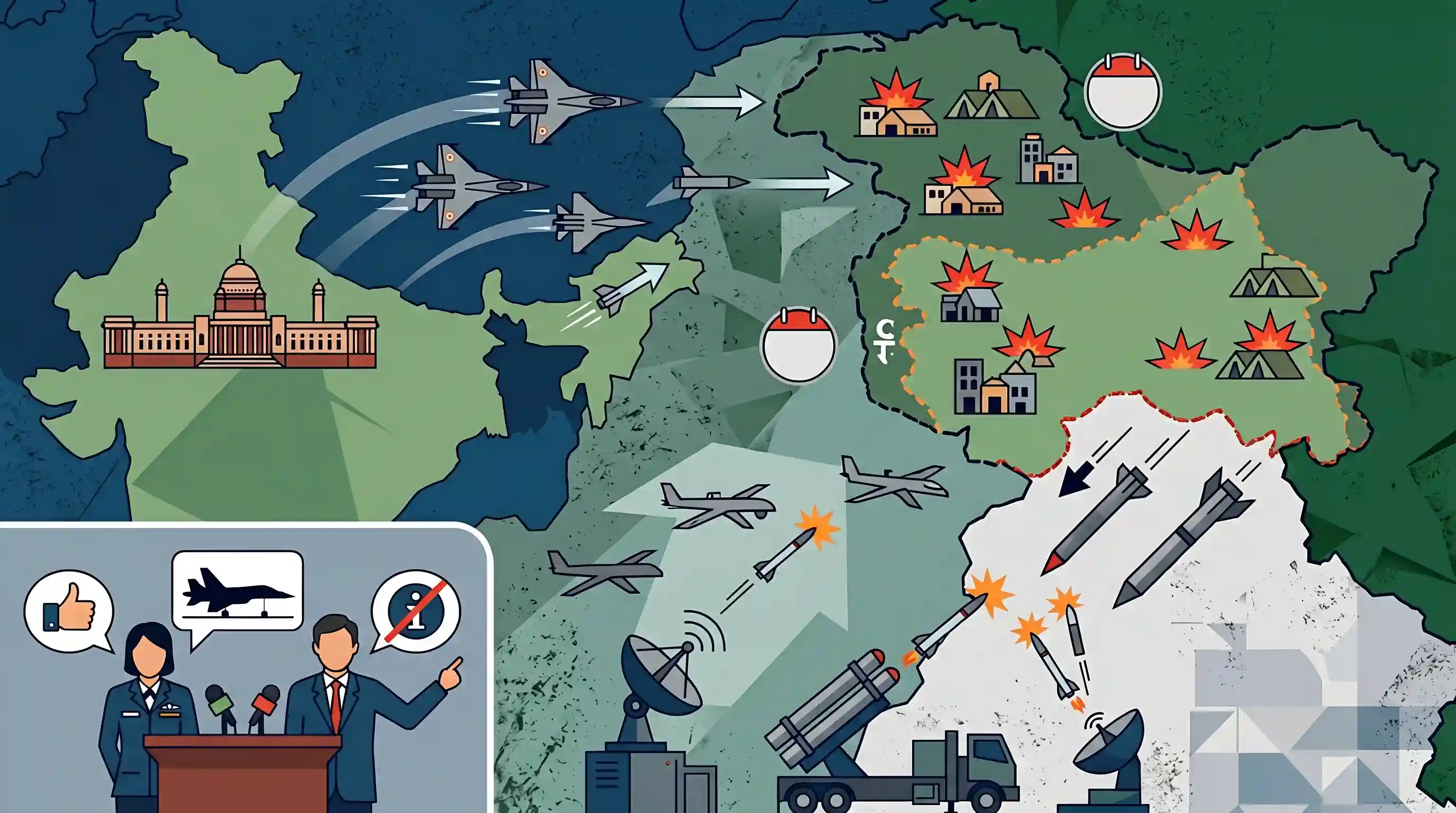
The Indian Air Force (IAF) has announced the success of 'Operation Sindoor', a series of precision strikes conducted on May 6-7, 2025, aimed at destroying terrorist camps across nine targets in Pakistan and Pakistan-Occupied Kashmir (PoK). Director General of Air Operations, Air Marshal Bharti, affirmed that the operation's objectives were met and all Indian pilots returned safely, despite ongoing speculation about aircraft losses. Additionally, India's air defence systems successfully neutralized retaliatory strikes from Pakistan involving drones, UCAVs, and missiles. Officials, including Foreign Secretary Vikram Misri, have refrained from providing specific details on casualties or losses, emphasizing operational security during an ongoing combat situation.
Key Points
- The IAF confirmed that Operation Sindoor achieved its primary objective of decimating terrorist camps via precision strikes across nine targets in Pakistan and PoK on May 6-7, 2025.
- Director General of Air Operations, Air Marshal Bharti, stated that all Indian pilots returned home safely, while confirming that 'a few' Pakistani aircraft were shot down during the conflict.
- Indian air defence systems effectively intercepted a retaliatory wave of drones, Unmanned Combat Aerial Vehicles (UCAVs), and missiles launched by Pakistan.
- The government remains cautious about disclosing specific aircraft losses or technical details, citing an ongoing combat scenario and the need to withhold operational advantages from the adversary.
Important Terms
Operation Sindoor

A multi-domain military operation by the Indian Armed Forces in May 2025, targeting nine terrorist camps in Pakistan and PoK following the Pahalgam attack.
UPSC context
GS III: Internal Security. Tests knowledge of India's 'new normal' in punitive deterrence and cross-border counter-terrorism operations.
Precision Strikes
Military attacks intended to damage a specific target with minimal collateral damage, often utilizing GPS-guided munitions, cruise missiles, or loitering munitions.
UPSC context
GS III: Security. Critical for understanding modern warfare doctrine, 'surgical strikes', and technology-led military strategy.
Unmanned Combat Aerial Vehicles (UCAVs)
An aircraft without a human pilot on board that can carry ordnance (missiles/bombs) and perform surveillance or offensive combat missions.
UPSC context
GS III: Science & Technology. Relevant for emerging threats, drone warfare, and defense technology advancements in the Indian Air Force.
Line of Control (LoC)
The de facto military border between India and Pakistan in the region of Jammu and Kashmir, first designated following the 1972 Simla Agreement.
UPSC context
GS II: International Relations. Core to India-Pakistan border management, territorial disputes, and regional security analysis.
Air Defence Systems
A protective network of sensors and interceptors (like S-400 or Akash) designed to neutralize aerial threats such as missiles, drones, and fighter jets.
UPSC context
GS III: Security. Tests understanding of India’s strategic deterrence and the role of indigenous technology in protecting sovereign airspace.
Atmanirbharta (in Defence)
The strategy of achieving self-reliance in the production of military equipment and technology to ensure strategic autonomy and reduce import dependency.
UPSC context
GS III: Economy and Security. Focuses on 'Make in India' and the Indigenization of Technology for national security.
Prelims Trap
Operation Sindoor involved precision airstrikes strictly confined to territories within Pakistan-Occupied Kashmir (PoK).
The strikes targeted locations in both mainland Pakistan and PoK. UPSC often tricks aspirants by geographically restricting the scope of such military operations.
Static Concepts Connected
What constitutes India's multi-tier air and ballistic missile defence shield?
- BMD System: Prithvi Air Defence (PAD) for exo-atmospheric and Advanced Air Defence (AAD) for endo-atmospheric ballistic missile interceptions.
- S-400 Triumf: Procured from Russia, this mobile long-range surface-to-air system tracks and destroys aircraft, UCAVs, and missiles.
- Akash & MRSAM: Indigenous and jointly-developed medium and short-range defense layers designed for intercepting hostile aerial threats.
What are the core tenets of India's 'Offensive Defence' posture?
- Proactive Deterrence: Shifting from passive territorial defense to kinetically striking threat origins (such as terror launchpads) across borders before attacks materialize.
- Sub-conventional Threshold: Conducting punitive surgical or aerial strikes strictly below the adversary's nuclear threshold to counter state-sponsored terrorism.
- Strategic Ambiguity: Withholding specific operational details to deny the adversary tactical advantages and effectively manage escalation matrices.
Cross-Topic Patterns
UCAVs in Sub-conventional Warfare
Pakistan's retaliatory use of drone swarms highlights the evolution of LoC skirmishes from artillery duels to automated, asymmetric aerial threats requiring advanced electronic warfare.
National Security vs. Transparency
The government withholding casualty and loss details exemplifies the GS-4/Polity tension between democratic public accountability and the necessity of Operational Security (OPSEC) during conflicts.

Expect a 2026 GS3 question connecting India's 'Offensive Defence' doctrine with the modernization of anti-UCAV air defence networks.
Linked PYQs · 4
Linked PYQs · 4
- 2020MainsGS3
Analyze internal security threats and transborder crimes along Myanmar, Bangladesh and Pakistan borders including Line of Control (LoC). Also discuss the role played by various security forces in this regard.
- 2023MainsGS3
The use of unmanned aerial vehicles (UAVs) by our adversaries across the borders to ferry arms/ammunitions, drugs, etc., is a serious threat to the internal security. Comment on the measures being taken to tackle this threat.
- 2015MainsGS2
Terrorist activities and mutual distrust have clouded India-Pakistan relations. To what extent the use of soft power like sports and cultural exchanges could help generate goodwill between the two countries? Discuss with suitable examples.
- 2016MainsGS2
Increasing cross-border terrorist attacks in India and growing interference in the internal affairs of several member-states by Pakistan are not conducive for the future of SAARC (South Asian Association for Regional Cooperation)." Explain with suitable examples.
