Operation Sindoor and India Evolving Multidomain Military Doctrine
Source:The Hindu ↗
Why It Matters
The push towards multidomain operations and tri-service synergy reflects a paradigm shift in India's defence strategy. For UPSC aspirants, understanding proactive operations like 'Operation Sindoor' and technological adaptations (AI, cyber resilience) is crucial for GS3 answers on border security, counter-terrorism, and defence modernization.
Summary
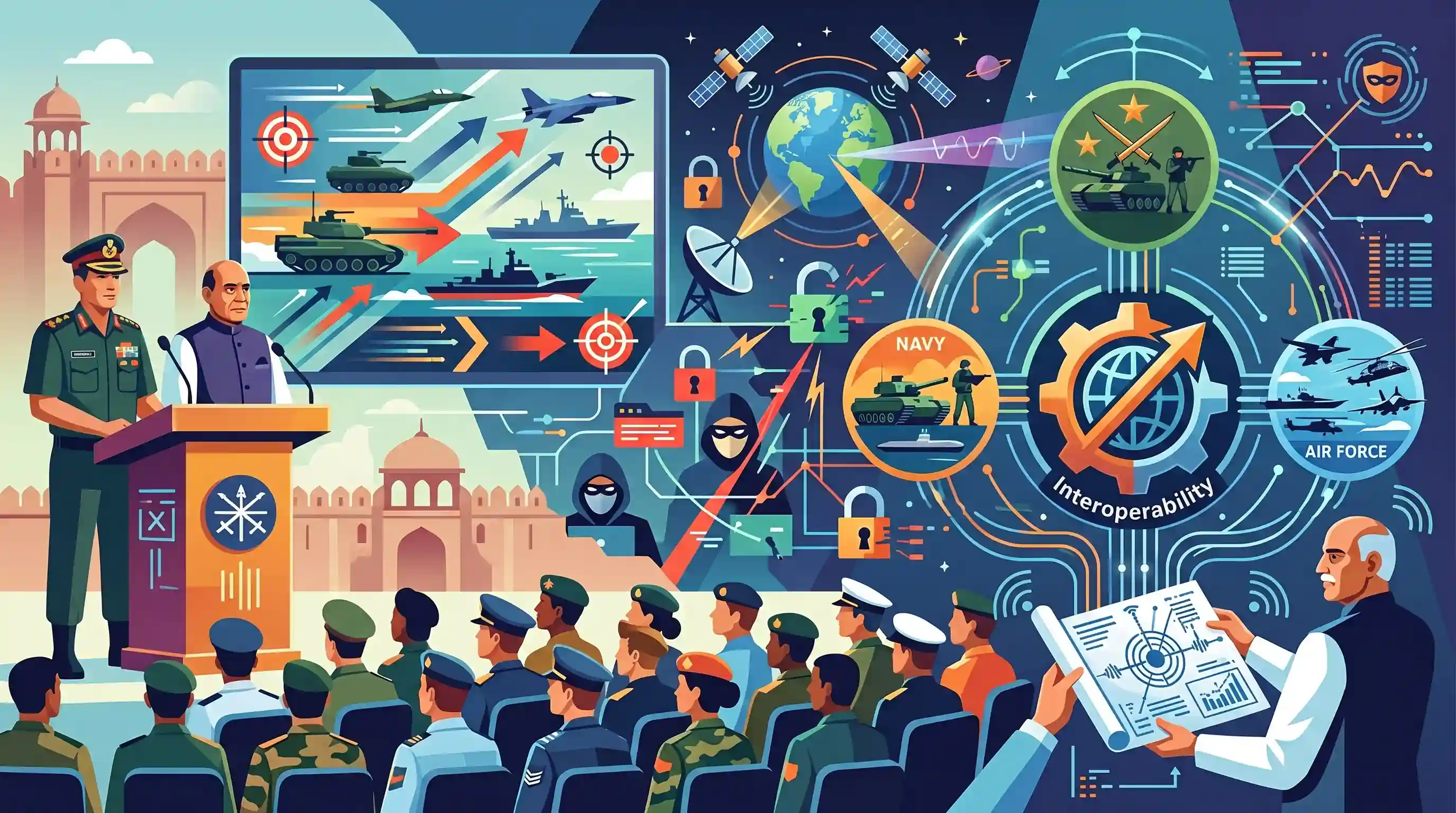
Addressing the Joint Commanders' Conference in Jaipur on the first anniversary of 'Operation Sindoor', Defence Minister Rajnath Singh highlighted the operation as a showcase of India's swift, precise, and high-intensity military capabilities. He directed the Armed Forces to prepare for future multidomain warfare characterized by hybrid threats, cyber attacks, and operations in the space and electromagnetic spectrums. Stressing the importance of tri-service synergy over mere weaponry, he released the Joint Doctrine for Integrated Communication Architecture to enhance interoperability and technological integration among the Army, Navy, and Air Force.
Key Points
- Defence Minister Rajnath Singh lauded 'Operation Sindoor' as a symbol of India's swift, deep-penetration, and high-intensity military response against terrorism.
- He emphasized that future warfare will be multidomain, involving hybrid threats and simultaneous operations across cyber, space, electromagnetic, and cognitive fields.
- The Minister urged the armed forces to adopt artificial intelligence, autonomous systems, and data analytics to maintain operational superiority.
- A Joint Doctrine for Integrated Communication Architecture was released to promote synergy, theaterisation, and interoperability among the Army, Navy, and Air Force.
Important Terms
Operation Sindoor

A high-intensity 2025 military operation involving precision strikes against cross-border terror infrastructure. It is characterized as India's first "non-contact" war, demonstrating swift, joint, and technologically driven retaliation.
UPSC context
GS Paper III: Security Forces/Internal Security. Tests understanding of India's evolving 'cost-imposition' strategy and response to cross-border terrorism.
Defence Forces Vision 2047
A strategic roadmap aiming to transform the Indian military into a technologically advanced, integrated, and self-reliant force by 2047. It focuses on multi-domain capabilities, indigenization (Aatmanirbharta), and structural reforms.
UPSC context
GS Paper III: Defence Modernisation. Crucial for discussing long-term national security goals and self-reliance in the centenary year of independence.
Joint Doctrine for Integrated Communication Architecture
A tri-service framework designed to ensure seamless interoperability and secure communication across the Army, Navy, and Air Force. It provides doctrinal clarity for integrated operations in high-tech battlefields.
UPSC context
GS Paper III: Security/Tri-Services Integration. Tests knowledge of technological integration and procedural reforms in the Armed Forces.
Multidomain Warfare
A modern combat approach where military operations are synchronized across all five spheres—land, sea, air, cyber, and space—to achieve tactical and strategic objectives simultaneously.
UPSC context
GS Paper III: Cyber Security/Defence Technology. Relevant for discussing the changing nature of warfare and the importance of space/cyber domains.
Tri-service Synergy
The functional integration and collaboration between the three branches of the military. It aims to optimize resources and operational effectiveness through unified planning and joint command structures.
UPSC context
GS Paper III: Security Forces/Structural Reforms. Key to discussions on Theatre Commands and the Office of the CDS.
Prelims Trap
"Operation Sindoor is a government initiative for women's empowerment or cultural heritage."
Aspirants might guess it is a socio-cultural scheme for women due to the name "Sindoor", but it is actually a deep-penetration counter-terrorism military operation.
Static Concepts Connected
What is 'Theaterisation' in the context of the Indian Armed Forces?
- Integrated Commands: Unifying Army, Navy, and Air Force units under a single Theatre Commander for a specific geographic or strategic boundary.
- Strategic Synergy: Aims to optimize resources, reduce duplication, and ensure a swift, cohesive response during conflicts.
- Role of CDS: The Chief of Defence Staff (CDS) was specifically created to spearhead the transition toward joint theatre commands and integrated doctrines.
What defines Multi-Domain Operations (MDO) and Hybrid Warfare?
- Five Domains: Expands traditional combat (land, sea, air) to include space and cyberspace as active warfighting domains.
- Electromagnetic & Cognitive: Involves dominating the electromagnetic spectrum (jamming enemy communications/radars) and psychological spaces (information and narrative warfare).
- Hybrid Threats: Blends conventional military force with irregular tactics, cyberattacks, economic disruption, and the use of non-state actors.
Cross-Topic Patterns
CDS mandate & Theaterisation
The release of a 'Joint Doctrine' directly stems from the Department of Military Affairs' (DMA) structural mandate to ensure jointness and facilitate the transition to integrated theatre commands.
Kinetic Operations + Cyber Security
Deep-penetration military strikes now rely heavily on secure, integrated communications, linking physical border operations with robust cyber-defence mechanisms against enemy electronic warfare and jamming.

Expect a Prelims match-the-following pairing recent operations (Sindoor, Ajay) or a multi-statement question on theatre command structures.
Linked PYQs · 3
Linked PYQs · 3
- 2016MainsGS3
The terms 'Hot Pursuit' and 'Surgical Strikes' are often used in connection with armed action against terrorist attacks. Discuss the strategic impact of such actions.
- 2021MainsGS3
Analyse the multidimensional challenges posed by external state and non-state actors, to the internal security of India. Also discuss measures required to be taken to combat these threats.
- 2021MainsGS3
Keeping in view India's internal security, analyse the impact of cross-border cyber attacks. Also discuss defensive measures against these sophisticated attacks.
