Operation Sindoor and international law on cross border self defence
Source:Indian Express ↗
Why It Matters
Understanding the intersection of national security actions (like cross-border strikes) and international law (UN Charter, right to self-defense) is critical for GS-2 (International Relations) and GS-3 (Internal Security). It provides the legal vocabulary needed to defend or critically analyze India's strategic responses to cross-border terrorism.
Summary
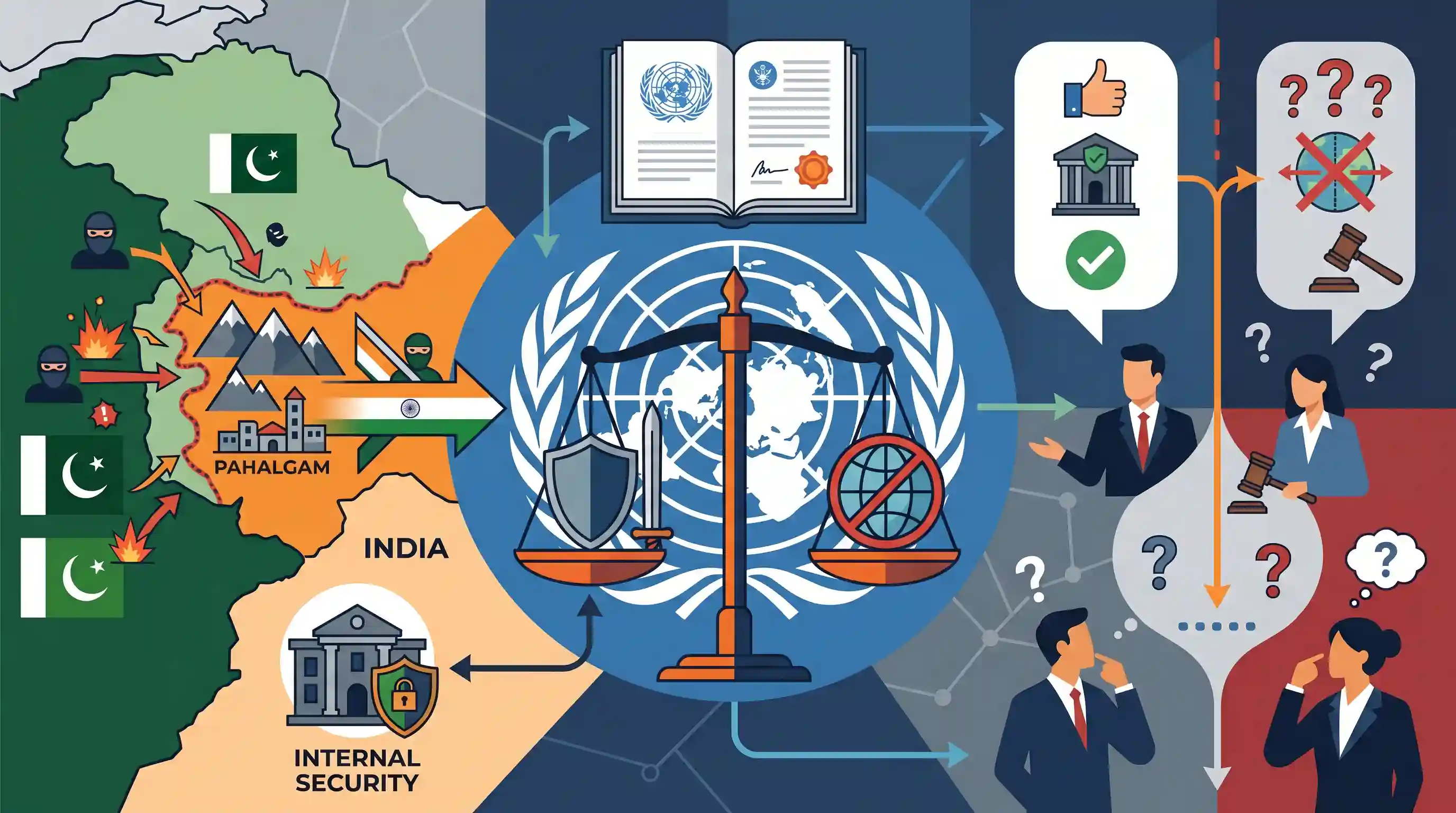
The article discusses the international legal implications of 'Operation Sindoor,' an Indian security operation involving Pakistan and the region of Pahalgam. It examines the legality of India's actions under international law, particularly focusing on the UN Charter. The core debate revolves around the interpretation of the right to self-defense (often associated with Article 51 of the UN Charter) in the context of cross-border counter-terrorism operations, highlighting the delicate balance between national security imperatives and adherence to international legal norms.
Key Points
- The article evaluates the legality of 'Operation Sindoor', a military or security operation by India involving Pakistan and the region of Pahalgam.
- It analyzes India's actions through the lens of international law, specifically examining whether they constitute a breach or are justified under the UN Charter.
- The debate likely centers on Article 51 of the UN Charter, which outlines the inherent right of individual or collective self-defense if an armed attack occurs against a Member of the United Nations.
- The discussion underscores the ongoing complexities of cross-border terrorism, border management, and the legal thresholds for conducting retaliatory or pre-emptive cross-border strikes.
Important Terms
UN Charter

The 1945 foundational treaty of the United Nations, establishing the legal framework for international relations, including the prohibition on the use of force (Article 2(4)) and exceptions for self-defense.
UPSC context
GS Paper II: International Relations. Essential for understanding global governance, sovereignty, and the legal limits of state military actions.
Article 51 (UN Charter)
A specific provision of the UN Charter recognizing the inherent right of individual or collective self-defense if an 'armed attack' occurs against a member state.
UPSC context
GS Paper II & Law Optional. Tests knowledge of legal justifications for cross-border strikes like Balakot or Operation Sindoor.
Unwilling or Unable Doctrine
A legal theory permitting a victim state to use force against non-state actors in another country if that host country is 'unwilling or unable' to stop them.
UPSC context
GS Paper II: International Relations. A key argument in India’s diplomatic strategy to hold state-sponsors of terror accountable.
Lawfare
The strategic use of international law and legal mechanisms (like the ICJ or treaties) as a tool to achieve military or diplomatic objectives against an adversary.
UPSC context
GS Paper III: Internal Security. Evaluates India's evolving strategy to complement military responses with legal pressure on global stages.
Operation Sindoor
The tri-service military response launched by India on May 7, 2025, targeting nine terror infrastructure sites in Pakistan and PoJK following the Pahalgam attack.
UPSC context
GS Paper III & Current Affairs. A case study in India's 'deterrence by punishment' strategy and military-tech adaptation.
Cross-border Terrorism
Terrorist activities where a country’s territory is used to plan or launch attacks against another, often involving non-state actors with tacit state support.
UPSC context
GS Paper III: Internal Security. Primary threat to India's security; core topic for Mains answers on Kashmir and Pak-relations.
Prelims Trap
"The UN Charter explicitly authorizes pre-emptive self-defence strikes against non-state actors under Article 51."
Article 51 only explicitly permits self-defence "if an armed attack occurs." Pre-emptive strikes and the "unwilling or unable" doctrine are debated customary interpretations, not codified text.
Static Concepts Connected
How does the UN Charter regulate the use of military force by states?
- Article 2(4): Prohibits the threat or use of force against the territorial integrity or political independence of any state.
- Article 51: Provides the exception of the "inherent right of individual or collective self-defence" if an armed attack occurs against a member state.
- Chapter VII Authorization: Allows the UN Security Council to authorize military force to maintain or restore international peace and security.
What are the core water-sharing provisions and dispute mechanisms of the Indus Waters Treaty?
- River Allocation: Eastern rivers (Ravi, Beas, Sutlej) are allocated to India; Western rivers (Indus, Jhelum, Chenab) are allocated to Pakistan.
- Permitted Usage: India has unrestricted use of Eastern rivers and limited non-consumptive, agricultural, and run-of-the-river hydroelectric rights on Western rivers.
- Dispute Resolution: A graded three-tier mechanism: Permanent Indus Commission, Neutral Expert (appointed by the World Bank), and finally, a Court of Arbitration.
Cross-Topic Patterns
Drone Warfare & Border Escalation
Pakistan's retaliatory drone strikes (Operation Bunyan-ul-Marsoos) highlight the shift from traditional artillery to UAV warfare, linking GS3 border management with GS2 geopolitical escalation.
Weaponization of Transboundary Rivers
Suspending the Indus Waters Treaty connects cross-border terrorism with hydro-diplomacy. This mirrors global trends where upper riparian states leverage transboundary water agreements for strategic coercion.

Expect a 2026 GS2 question linking UN Charter Article 51, the 'unwilling or unable' doctrine, and the legality of cross-border strikes.
Linked PYQs · 3
Linked PYQs · 3
- 2015MainsGS2
Terrorist activities and mutual distrust have clouded India-Pakistan relations. To what extent the use of soft power like sports and cultural exchanges could help generate goodwill between the two countries? Discuss with suitable examples.
- 2016MainsGS2
Increasing cross-border terrorist attacks in India and growing interference in the internal affairs of several member-states by Pakistan are not conducive for the future of SAARC (South Asian Association for Regional Cooperation)." Explain with suitable examples.
- 2020MainsGS3
Analyze internal security threats and transborder crimes along Myanmar, Bangladesh and Pakistan borders including Line of Control (LoC). Also discuss the role played by various security forces in this regard.
