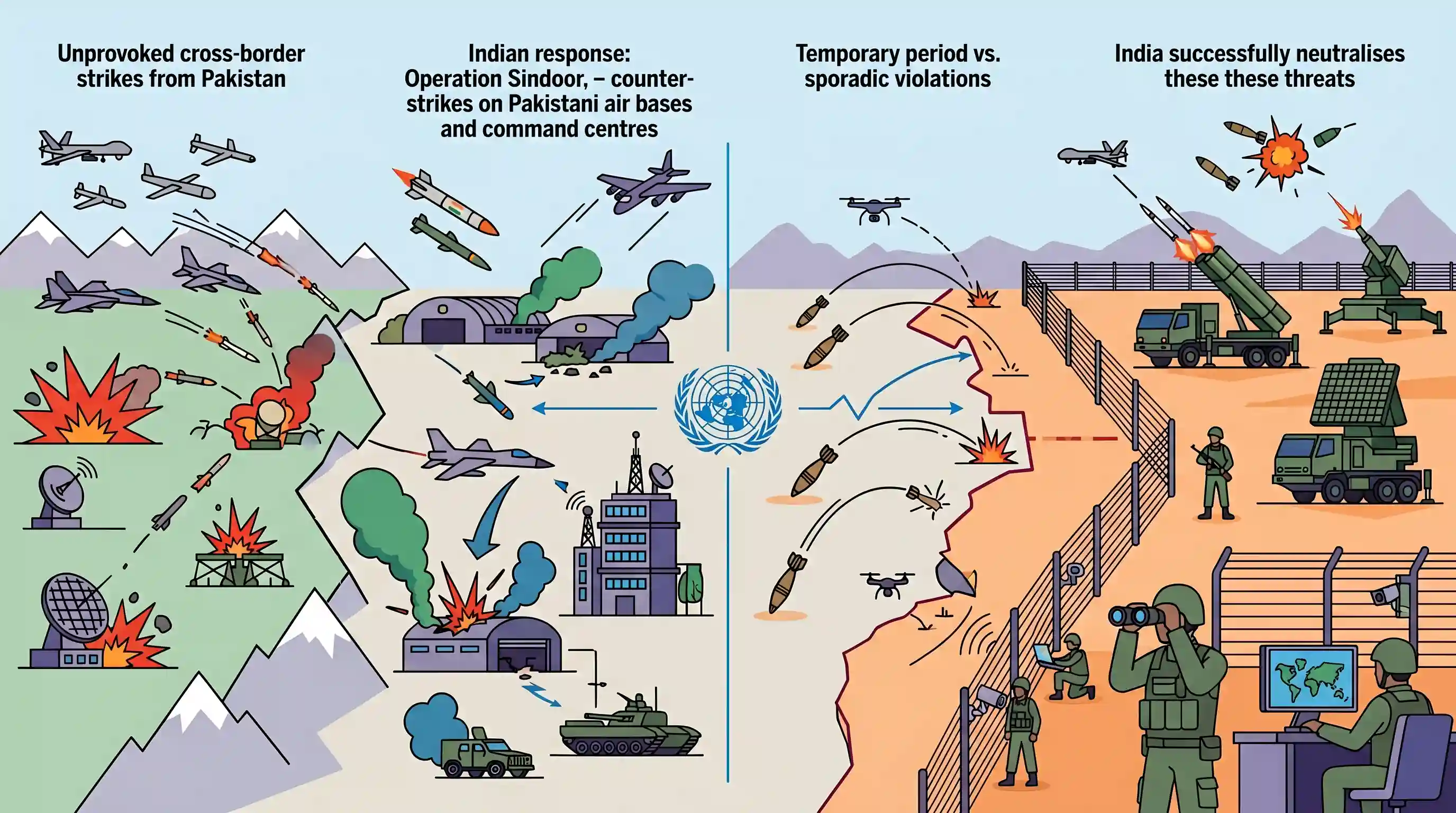
Operation Sindoor retaliatory strikes on Pakistani air bases
Source:The Hindu ↗
Why It Matters
The event highlights critical challenges in border management, the evolving nature of cross-border terrorism employing advanced tech like drones and UCAVs, and the fragility of bilateral ceasefire agreements, which are highly relevant to the GS-3 Security and Technology syllabus.
Summary
In retaliation to unprovoked cross-border strikes by Pakistan using drones, loitering munitions, and fighter aircraft, India launched 'Operation Sindoor'. The Indian Armed Forces executed precision strikes on multiple Pakistani air bases and military command centres, inflicting significant damage. Despite an internationally recognized ceasefire announcement, Pakistani forces continued ceasefire violations with shelling and drone intrusions along the Line of Control (LoC) and International Border (IB). India successfully neutralised the majority of these threats using advanced air defence systems, maintaining high operational readiness and emphasizing a stance of non-escalation if reciprocated by Pakistan.
Key Points
- India launched "Operation Sindoor" to carry out precision strikes on over 10 Pakistani air bases and military infrastructure in retaliation to unprovoked cross-border attacks.
- Pakistan utilized modern warfare technologies including Unmanned Combat Aerial Vehicles (UCAVs), loitering munitions, and fighter aircraft to target Indian civilian and military sites.
- Despite international declarations of an immediate ceasefire, Pakistan continued heavy shelling and drone intrusions along the LoC and IB, which were neutralised by Indian air defence systems.
- India maintained a high state of operational readiness and stated a commitment to non-escalation, provided it is reciprocated, while actively countering Pakistani disinformation campaigns.
Important Terms
Operation Sindoor

India's 2025 retaliatory military operation targeting terror infrastructure in Pakistan and PoJK following the Pahalgam attack; it involved coordinated precision strikes by the Indian Army, Air Force, and Navy.
UPSC context
GS Paper III (Security); tests knowledge of India's retaliatory doctrines, inter-service coordination, and strategic responses to cross-border terrorism.
Loitering Munitions
Aerial weapons, also known as 'suicide drones,' that hover over a target area to identify threats before crashing into them; they combine drone surveillance with missile-like precision.
UPSC context
GS Paper III (Science & Technology/Defence); tests awareness of modern disruptive warfare technologies and their impact on regional military balance.
Ceasefire Agreement
A formal or informal suspension of hostilities; in this context, it refers to the 2003/2021/2025 understandings between India and Pakistan to cease firing across the LoC and IB.
UPSC context
GS Paper II (International Relations); tests understanding of bilateral conflict management tools and the history of India-Pakistan diplomatic-military engagements.
Inter-Services Public Relations (ISPR)
The media and public relations wing of the Pakistan Armed Forces, responsible for official communications, narrative shaping, and managing information warfare during regional conflicts.
UPSC context
GS Paper III (Internal Security); relevant for studying hybrid warfare, narrative control, and the role of non-kinetic measures in modern security environments.
Line of Control (LoC)
The 740 km de facto border between India and Pakistan in Jammu and Kashmir, established via the 1972 Simla Agreement following the 1948 Ceasefire Line (CFL).
UPSC context
GS Paper III (Border Management); fundamental for understanding territorial disputes, infiltration challenges, and the geography of the India-Pakistan conflict.
Precision Strikes
Surgical military attacks using advanced guidance systems to destroy specific high-value targets with minimal collateral damage, reflecting a shift in India’s 'proactive' defense posture.
UPSC context
GS Paper III (Security); examines strategic military doctrines and the transition from strategic restraint to technology-led deterrence.
Prelims Trap
"Unlike conventional cruise missiles, loitering munitions cannot be aborted or recalled once their target is engaged."
False. Modern loitering munitions feature "man-in-the-loop" capabilities, allowing operators to abort a strike mid-dive, redirect it, or resume hovering if conditions change.
Static Concepts Connected
What distinguishes Loitering Munitions from traditional UCAVs and Cruise Missiles?
- Hovering capability: Unlike traditional cruise missiles, they can linger over a target area for extended periods, search for targets, and wait for the optimal moment to strike.
- Built-in expendability: They are designed for single-use kamikaze strikes like cruise missiles, whereas UCAVs (Unmanned Combat Aerial Vehicles) drop their guided payload and return to base.
- Abort capability: Operators can abort the attack mid-flight and command the munition to resume loitering if civilians appear, a key advantage over conventional artillery and older missiles.
What is the historical framework governing the LoC ceasefire between India and Pakistan?
- Shimla Agreement (1972): Formally converted the 1949 UN ceasefire line into the bilateral Line of Control (LoC) following the 1971 war, emphasizing bilateral resolution of disputes.
- 2003 Ceasefire Understanding: An unwritten confidence-building measure strictly enforced along the International Border (IB), LoC, and Actual Ground Position Line (AGPL) in Siachen.
- 2021 DGsMO Reiteration: A military-level (Director Generals of Military Operations) reaffirmation to strictly observe the 2003 ceasefire, rather than a new formal international treaty.
Cross-Topic Patterns
Hybrid Warfare + Cognitive Security
Modern military operations blend kinetic strikes with cognitive warfare. The narrative battle around Operation Sindoor highlights GS3 syllabus points on the 'role of media and social networks in internal security'.
CIBMS + Aerial Asymmetric Threats
The shift from physical fencing to Comprehensive Integrated Border Management Systems (CIBMS) is directly accelerated by the urgent tactical need to detect and counter low-flying UCAVs and drone swarms.

Loitering munitions vs UCAVs vs Cruise Missiles will likely feature as a 2026 Prelims S&T question focusing on recallability and reuse.
Linked PYQs · 3
Linked PYQs · 3
- 2020MainsGS3
Analyze internal security threats and transborder crimes along Myanmar, Bangladesh and Pakistan borders including Line of Control (LoC). Also discuss the role played by various security forces in this regard.
- 2024MainsGS3
India has a long and troubled border with China and Pakistan fraught with contentious issues. Examine the conflicting issues and security challenges along the border. Also give out the development being undertaken in these areas under the Border Area Development Programme (BADP) and Border Infrastructure and Management (BIM) Scheme.
- 2023MainsGS3
The use of unmanned aerial vehicles (UAVs) by our adversaries across the borders to ferry arms/ammunitions, drugs, etc., is a serious threat to the internal security. Comment on the measures being taken to tackle this threat.
