Operation Sindoor and Evolving Rules of Engagement in the Subcontinent
Source:Indian Express ↗
Why It Matters
Shifts in military strategy and rules of engagement are crucial for understanding India's evolving national security doctrine and its approach to managing transborder threats, which is directly relevant to GS3 (Security) and GS2 (International Relations).
Summary
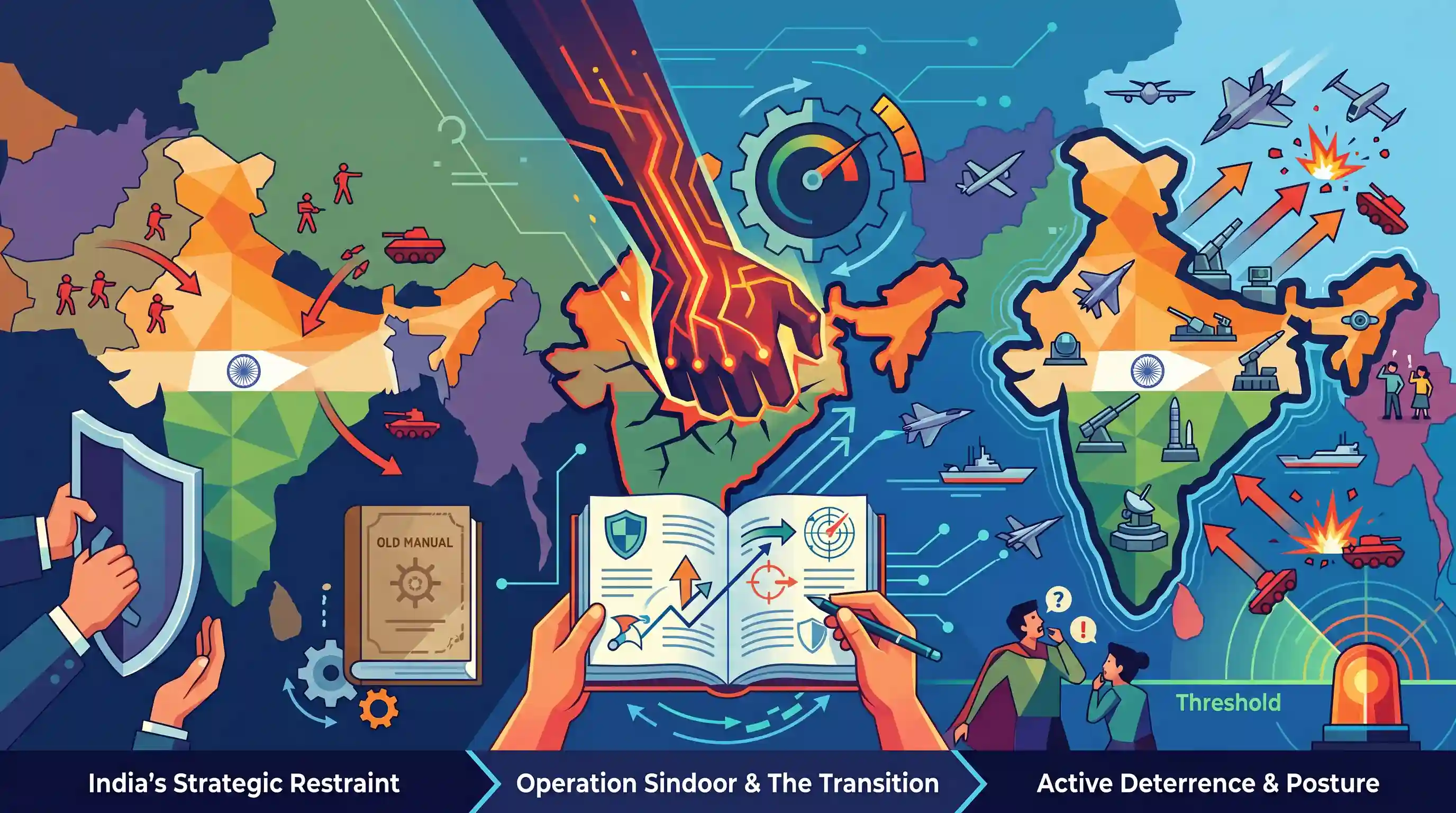
The article analyzes the strategic implications of 'Operation Sindoor', highlighting its role in rewriting the rules of engagement in the Indian subcontinent. It argues that the operation reflects India's transition from historical strategic restraint to a posture of active deterrence. This proactive military and strategic approach aims to neutralize cross-border threats more decisively, thereby altering regional geopolitical dynamics and sending a clear signal to adversaries regarding India's threshold for security challenges.
Key Points
- Operation Sindoor signifies a critical shift in India's strategic approach to addressing cross-border threats within the subcontinent.
- The operation underscores a departure from traditional strategic restraint, establishing new rules of engagement.
- By adopting a more assertive deterrence posture, India aims to proactively neutralize internal and external security challenges.
- This strategic recalibration has profound implications for regional geopolitical stability and alters the security calculus of neighboring adversaries.
Important Terms
Operation Sindoor

India’s 2025 calibrated military response to the Pahalgam terror attack, involving precision air strikes on terror infrastructure in Pakistan. it signaled a shift from historic strategic restraint to active, punitive deterrence.
UPSC context
GS Paper III (Internal Security). Tests understanding of modern Indian military doctrines and response mechanisms to sub-conventional threats.
Strategic Restraint
A long-standing security policy where a state avoids military escalation despite provocations to prevent full-scale war. For India, this historically involved absorbing terror attacks without overt cross-border conventional retaliation.
UPSC context
GS Paper II (International Relations). Analyzes the evolution of India's foreign policy and regional stability paradigms in a nuclear-armed neighborhood.
Active Deterrence
A proactive posture aiming to prevent aggression by demonstrating the capability and resolve to impose immediate, punitive costs. It shifts the focus from purely defensive measures to cost-imposition on the adversary.
UPSC context
GS Paper III (Security). Evaluates strategies to counter hybrid warfare and the shift from "deterrence by denial" to "deterrence by punishment."
Rules of Engagement (ROE)
Internal directives defining the legal and operational limits on how and when military forces use force. They ensure military actions align with political objectives and international law during crises.
UPSC context
GS Paper III (Security Forces). Examines the operational and ethical constraints on the use of force in modern multi-domain conflicts.
Non-state Actors
Organizations or individuals not officially affiliated with any government that conduct political violence. In the subcontinent, these often act as proxies for state-sponsored terrorism to bypass conventional military thresholds.
UPSC context
GS Paper III (Internal Security). Focuses on the role of external actors in creating internal security challenges and the concept of proxy war.
Cross-border Terrorism
Terrorist activities originating in one country but carried out in another, often facilitated by state support. It remains a primary internal security and border management challenge for India.
UPSC context
GS Paper III (Internal Security). Tests knowledge of border management and the nexus between state and non-state actors in hybrid warfare.
Prelims Trap
Operation Sindoor is a domestic counter-insurgency initiative aimed at eradicating Left Wing Extremism.
The name 'Sindoor' (red) might trick candidates into associating it with the 'Red Corridor'. It is actually a cross-border military posture against external state-sponsored terrorism, not LWE.
Static Concepts Connected
What is the difference between Strategic Restraint and Active Deterrence?
- Strategic Restraint: Focuses on absorbing proxy attacks and responding defensively or diplomatically to prevent conventional escalation.
- Active Deterrence: Involves proactive, calibrated cross-border kinetic action (deterrence by punishment) to neutralize threats preemptively.
- Plausible Deniability: Active deterrence specifically targets the adversary's reliance on non-state actors, raising costs for state sponsors and dismantling 'plausible deniability'.
What are the key intelligence integration frameworks countering terrorism in India?
- NATGRID: A master database linking core data sources (tax, travel, telecom, banking) to seamlessly track terror financing and suspect movements.
- Multi-Agency Centre (MAC): A nodal body operating under the Intelligence Bureau (IB) for daily intelligence sharing and coordination among 28 national and state agencies.
Cross-Topic Patterns
Active Deterrence + FATF Financial Diplomacy
Kinetic operations like Sindoor work synergistically with multilateral financial diplomacy (e.g., FATF strictures) to squeeze state sponsors of terrorism both militarily and economically.
Kinetic responses + CIBMS integration
Proactive cross-border strikes rely heavily on real-time intelligence feeds from the Comprehensive Integrated Border Management System (CIBMS) for precise, preemptive targeting.

GS3 Mains 2026 will likely test the doctrinal shift from 'strategic restraint' to 'active deterrence' in tackling state-sponsored proxies.
Linked PYQs · 2
Linked PYQs · 2
- 2016MainsGS2
Increasing cross-border terrorist attacks in India and growing interference in the internal affairs of several member-states by Pakistan are not conducive for the future of SAARC (South Asian Association for Regional Cooperation)." Explain with suitable examples.
- 2020MainsGS3
Analyze internal security threats and transborder crimes along Myanmar, Bangladesh and Pakistan borders including Line of Control (LoC). Also discuss the role played by various security forces in this regard.
