Strategic Deterrence and Proactive Counter Terror Operations
Source:Indian Express ↗
Why It Matters
Targeted operations that signify a shift in India's strategic posture—from restraint to proactive retaliation—are critical for the GS3 Security syllabus as they redefine deterrence frameworks and responses to terrorism/insurgency.
Summary
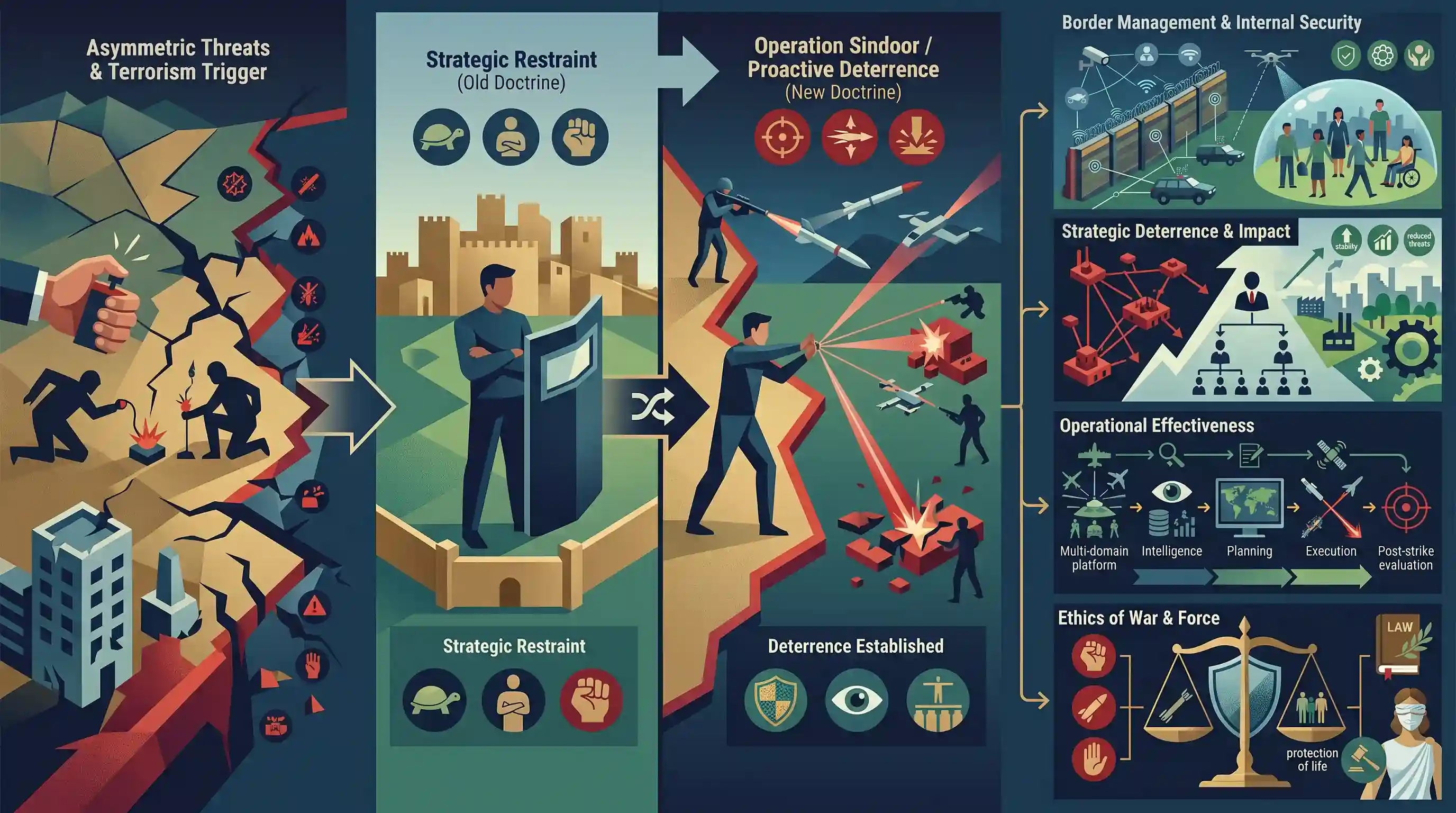
The article discusses 'Operation Sindoor,' analyzing it as a necessary and justified retaliatory measure against security threats. It highlights India's evolving national security doctrine, which increasingly favors proactive, targeted strikes to establish deterrence against terrorism and asymmetric warfare, rather than adhering strictly to strategic restraint. The piece also explores the strategic impact, operational effectiveness, and ethical justification of such counter-operations in safeguarding national sovereignty and security.
Key Points
- Analyses 'Operation Sindoor' as a justified retaliatory action and a necessary step for national security deterrence.
- Highlights India's evolving security doctrine, shifting from historical strategic restraint to proactive, targeted counter-operations.
- Evaluates the strategic impact of 'hot pursuit' and surgical strikes in dealing with asymmetric warfare and cross-border terrorism.
- Touches upon the ethical dimensions of the use of force, framing the operation as a 'just payback' to protect sovereignty and personnel.
Important Terms
Operation Sindoor

India's May 2025 tri-service military operation involving precision strikes against terrorist infrastructure in Pakistan and PoJK, following the Pahalgam terror attack; it marked a shift toward high-tech, non-contact warfare.
UPSC context
GS Paper III (Internal Security); tests understanding of recent counter-terrorism operations and evolving military strategy.
Strategic Restraint
A long-standing security posture where a state avoids military escalation despite provocations to prevent full-scale war; India is increasingly transitioning from this to proactive deterrence.
UPSC context
GS Paper II (IR) & GS Paper III; tests historical context of India's security policy.
Deterrence by Punishment
A strategy aimed at preventing aggression by threatening severe retaliation, thereby making the cost of an attack exceed any potential gains for the adversary.
UPSC context
GS Paper III; core concept for discussing national security and nuclear-threshold management.
National Security Doctrine
A comprehensive framework outlining a nation's core security interests, threat perceptions, and response mechanisms; India recently adopted a '3-Pillar Doctrine' focused on decisive retaliation.
UPSC context
GS Paper III; critical for questions on security policy reforms and institutional frameworks.
Asymmetric Warfare
Conflict between belligerents with significantly unequal military capabilities, where the weaker side (usually non-state actors) uses unconventional tactics like terrorism or guerrilla warfare to exploit vulnerabilities.
UPSC context
GS Paper III; central to discussing internal security threats like cross-border terrorism and insurgency.
Sovereignty
The supreme authority of a state to govern itself and protect its territorial integrity without external interference; often cited as the primary ethical justification for retaliatory force.
UPSC context
GS Paper II (Polity/IR) & GS Paper IV (Ethics); relevant to the ethical use of force and international law.
Prelims Trap
The right of 'hot pursuit' across international land borders is explicitly codified under the United Nations Charter.
Hot pursuit is explicitly recognized under UNCLOS for maritime boundaries. On land, it lacks a universal treaty and relies on bilateral agreements or self-defense claims under Article 51.
Static Concepts Connected
What constitutes 'Asymmetric Warfare' in the context of state-sponsored terrorism?
- Definition: Conflict where belligerents possess significantly disproportionate military power, relying heavily on unconventional, unpredictable tactics.
- Proxy Actors: State sponsors use non-state entities like terror groups to achieve strategic goals while maintaining plausible deniability.
- Cost Imposition: Strategies designed to bleed the adversary financially and psychologically, avoiding the escalation and costs of direct conventional military confrontation.
How does International Law evaluate pre-emptive cross-border strikes against terrorists?
- Article 51: The UN Charter recognizes the inherent right of individual or collective self-defense if an armed attack occurs against a member state.
- Caroline Test: Customary international law principle requiring the necessity for pre-emptive self-defense to be "instant, overwhelming, leaving no choice of means."
- Unwilling/Unable Doctrine: Emerging justification for striking non-state actors in a foreign territory if that sovereign state fails or refuses to neutralize the threat.
Cross-Topic Patterns
Cyber-kinetic warfare nexus
Modern kinetic counter-terrorism operations are simultaneously fought in the digital domain, accompanied by AI-generated misinformation and cyber-attacks meant to manipulate public perception and induce panic.
Ethics of 'Just War' in IR
The transition to proactive strikes tests GS4 concepts like 'Jus ad bellum' (right to wage war) and the moral boundaries of retaliatory force against state-sponsored terror.

GS3 Mains 2026 is highly likely to feature a question linking 'proactive deterrence' doctrines with modern non-contact warfare tech.
Linked PYQs · 4
Linked PYQs · 4
- 2016MainsGS3
The terms 'Hot Pursuit' and 'Surgical Strikes' are often used in connection with armed action against terrorist attacks. Discuss the strategic impact of such actions.
- 2021MainsGS3
Analyse the complexity and intensity of terrorism, its causes, linkages and obnoxious nexus. Also suggest measures required to be taken to eradicate the menace of terrorism.
- 2022MainsGS3
Naxalism is a social, economic and developmental issue manifesting as a violent internal security threat. In this context, discuss the emerging issues and suggest a multilayered strategy to tackle the menace of Naxalism.
- 2024MainsGS4
“It is not enough to talk about peace, one must believe in it; and it is not enough to believe in it, one must act upon it.” In the present context, the major weapon industries of the developed nations are adversely influencing continuation of number of wars for their own self-interest, all around the world. What are the ethical considerations of the powerful nations in today's international arena to stop continuation of ongoing conflicts?
