Operation Sindhu Evacuates Indian Nationals from West Asia Conflict
Source:The Hindu ↗
Why It Matters
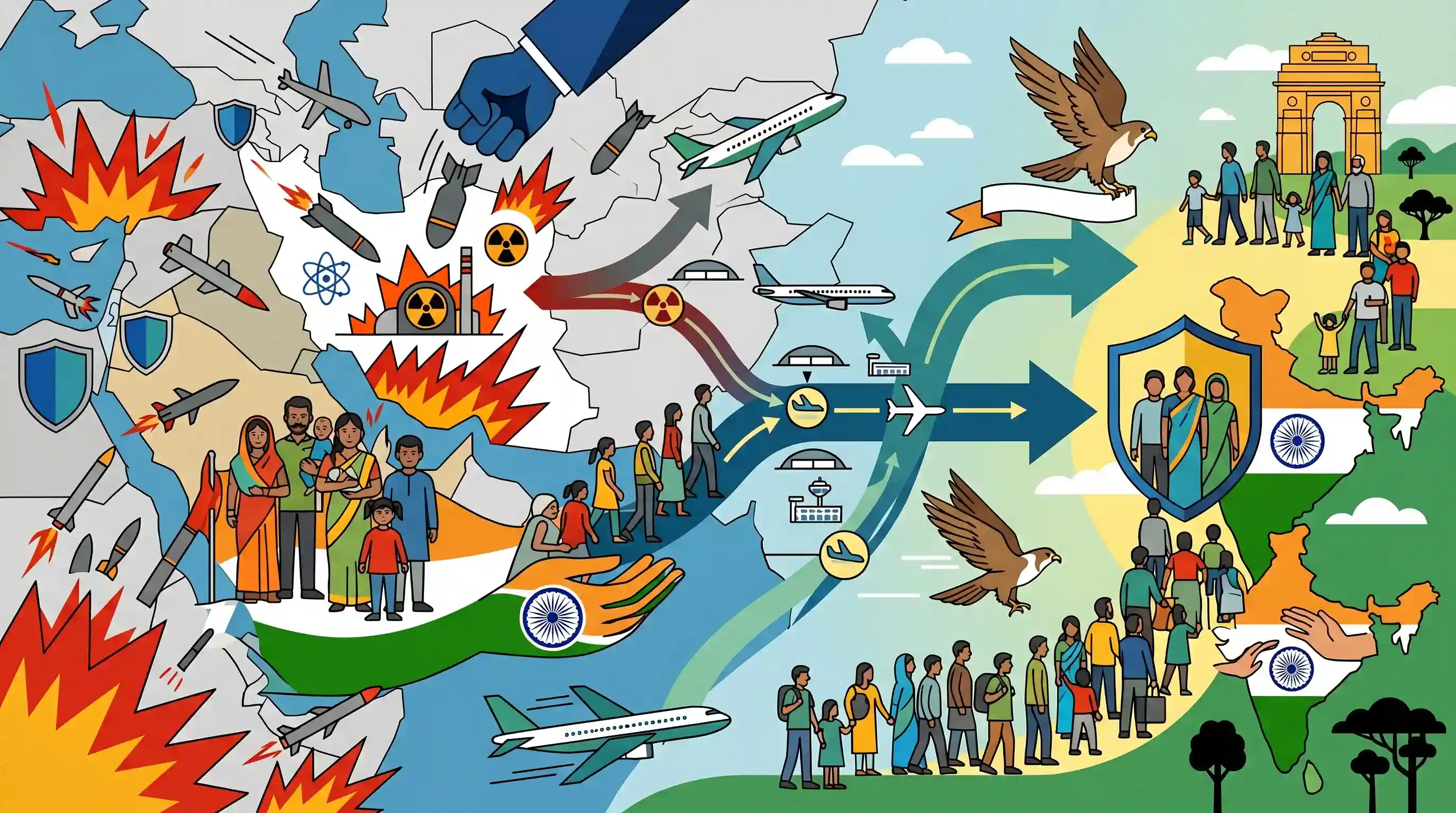
Evacuation operations like Operation Sindhu underscore the strategic and logistical challenges India faces in protecting its large diaspora in the volatile Middle East. It highlights the direct impact of regional conflicts (like the Iran-Israel tensions and US interventions) on Indian interests, necessitating swift diplomatic action.
Summary
Under "Operation Sindhu," India has successfully evacuated over 1,400 of its nationals from the escalating Iran-Israel conflict zone, utilizing chartered flights from transit cities like Mashhad, Yerevan, and Ashgabat. The accelerated rescue operations follow recent U.S. strikes on Iranian nuclear sites and intense missile and drone exchanges between Tehran and Tel Aviv, highlighting the MEA's swift response in safeguarding the Indian diaspora amid severe regional instability.
Key Points
- Operation Sindhu is an ongoing Indian evacuation mission launched to bring back citizens from Iran and Israel amidst escalating hostilities.
- Over 1,400 Indian nationals have been safely evacuated via chartered flights operating from Mashhad (Iran), Yerevan (Armenia), and Ashgabat (Turkmenistan).
- The immediate trigger for the stepped-up evacuations includes intense mutual missile/drone strikes between Iran and Israel, and recent U.S. bombings of major Iranian nuclear sites.
- The Ministry of External Affairs (MEA) coordinates these multi-nodal missions to ensure the safety of the Indian diaspora during severe Middle Eastern crises.
Important Terms
Operation Sindhu

An evacuation mission launched by India in June 2025 to rescue its citizens from the escalating Iran-Israel conflict.
UPSC context
GS Paper II: International Relations. Tests knowledge of India's crisis management and proactive 'citizens-first' foreign policy during regional instability.
Ministry of External Affairs (MEA)
The government department responsible for India's foreign relations, managing diplomatic missions, and safeguarding the interests of the Indian diaspora globally.
UPSC context
GS Paper II: Statutory/Constitutional Bodies and Governance. Relevant for roles of institutions in executive foreign policy execution.
Indian Diaspora
The global community of persons of Indian origin or Indian citizens living abroad, vital for India's soft power and economic remittances.
UPSC context
GS Paper II: Effect of policies and politics of developed and developing countries on India’s interests.
Mashhad
A major city in northeastern Iran that served as a strategic transit hub for chartered evacuation flights during Operation Sindhu.
UPSC context
GS Paper I: Geography / GS Paper II: International Relations. Tests map-based knowledge of conflict zones and strategic hubs.
C-17 Globemaster III
A heavy-lift military transport aircraft used by the IAF for high-capacity humanitarian assistance and disaster relief (HADR) missions.
UPSC context
GS Paper III: Security / Science & Tech. Tests knowledge of India's strategic airlift and defense assets.
Overseas Citizen of India (OCI)
A form of residency status available to people of Indian origin, allowing them to live and work in India indefinitely.
UPSC context
GS Paper II: Citizenship and Diaspora. Relevant for understanding legal categories of the Indian population abroad.
Prelims Trap
Operation Sindhu is a bilateral maritime security exercise or a river-water initiative.
The word 'Sindhu' instinctively points aspirants toward the Indus River system or Indian Navy maritime exercises. UPSC often exploits such naming overlaps.
Static Concepts Connected
What are the geographical boundaries of the transit nations used?
- Armenia (Yerevan): A landlocked country in the South Caucasus, bordered by Turkey, Georgia, Azerbaijan, and Iran.
- Turkmenistan (Ashgabat): A Central Asian state bordering the Caspian Sea, Iran, Afghanistan, Uzbekistan, and Kazakhstan.
How does Middle East instability structurally impact the Indian economy?
- Remittance shocks: The region accounts for a massive share of inward remittances, providing a critical cushion for India's Current Account Deficit (CAD).
- Energy security: Escalations involving major oil producers (Iran) and US strikes disrupt global supply chains, threatening India's energy security and causing imported inflation.
- Evacuation burden: Frequent geopolitical shocks require costly, rapid state-led rescue missions (e.g., Operation Raahat, Ganga, Sindhu) to protect diaspora populations.
Cross-Topic Patterns
Evacuation ops + Map locations
UPSC frequently tests crisis geographies. Expect map questions linking Operation Sindhu to transit cities like Yerevan and Ashgabat, or their adjacent water bodies like the Caspian Sea.
Diaspora + Current Account Deficit
The Middle East conflict threatens the safety of Indian workers, directly risking the vital inward remittances that act as a crucial buffer for India's Current Account Deficit.

Expect a 2026 Prelims match-the-following question pairing recent evacuations (Sindhu, Ajay, Kaveri) with their specific crisis regions.
Linked PYQs · 2
Linked PYQs · 2
- 2018MainsGS2
In what ways would the ongoing US-Iran Nuclear Pact Controversy affect the national interest of India? How should India respond to this situation?
- 2025MainsGS2
"Energy security constitutes the dominant kingpin of India's foreign policy, and is linked with India's overarching influence in Middle Eastern countries.” How would you integrate energy security with India's foreign policy trajectories in the coming years?
