Operation Epic Fury and US Iran military escalation
Source:Indian Express ↗
Why It Matters
West Asia is a critical pillar of India's extended neighborhood policy. Conflicts in this region directly threaten India's energy security (oil price shocks), macro-economic stability (Current Account Deficit), and the safety of the Indian diaspora. It also frequently appears in UPSC Prelims (geography/places in news) and Mains (energy diplomacy and strategic autonomy).
Summary
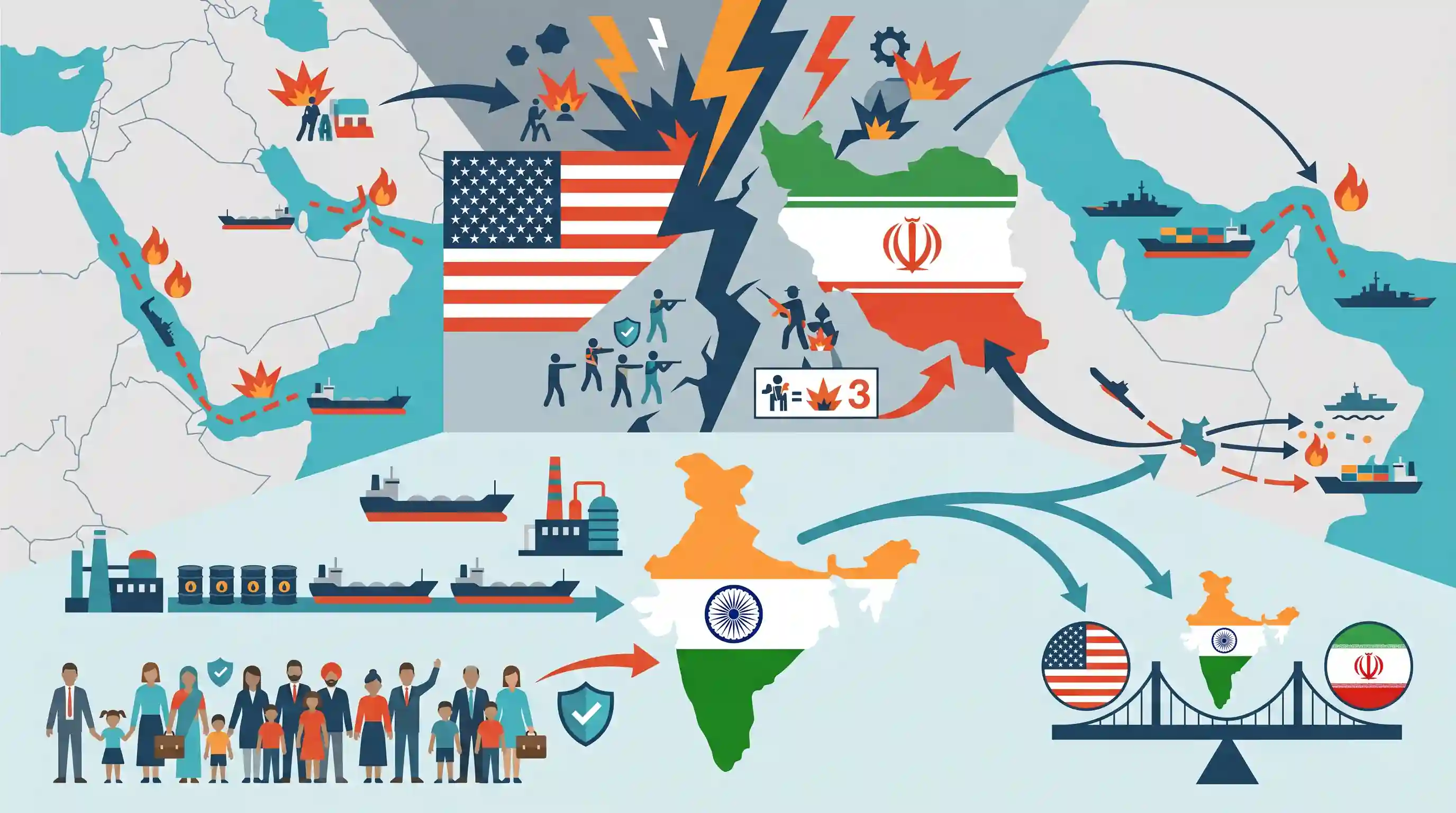
The geopolitical landscape in West Asia is witnessing severe volatility with the escalation of tensions between the US and Iran, recently highlighted by the deaths of three US troops amidst 'Operation Epic Fury'. This incident reflects a broader regional conflict fueled by proxy militias and heightens the risk of a wider military confrontation. The immediate global fallout includes potential disruptions to crucial maritime trade routes like the Red Sea and the Strait of Hormuz, threatening global supply chains. For India, the conflict is of paramount concern due to its deep reliance on Middle Eastern crude oil, the safety of millions of Indian expatriates in the region, and the need to balance its strategic partnerships with both the US and Iran.
Key Points
- The conflict between the US and Iran-aligned militias has intensified, marked by 'Operation Epic Fury' and the killing of three US troops.
- The involvement of non-state actors and proxy networks across Iraq, Syria, and Yemen complicates the regional security architecture.
- Escalation threatens critical maritime chokepoints like the Strait of Hormuz and the Red Sea, risking disruptions to global trade and shipping routes.
- For India, the crisis poses a direct threat to energy security, as the region is a major supplier of crude oil, alongside endangering the large Indian diaspora working in the Gulf.
- The situation demands a careful diplomatic balancing act for India to maintain its strategic autonomy while navigating its relations with both Washington and Tehran.
Important Terms
Operation Epic Fury

A US-led military campaign launched in 2026 targeting Iran's nuclear and ballistic programs. It marks a significant escalation in direct US-Iran hostilities, involving sustained air, land, and sea strikes.
UPSC context
GS-II: International Relations. Relevant for understanding West Asia's shifting security dynamics and the escalation of direct state-on-state conflicts.
Islamic Revolutionary Guard Corps (IRGC)
A powerful parallel military force in Iran established in 1979. It protects the Islamic regime, controls key economic sectors, and manages regional proxy groups through its elite Quds Force.
UPSC context
GS-II: International Relations. Essential for studying Iran's regional influence, unconventional warfare, and its impact on West Asian stability.
Strait of Hormuz
A strategic maritime chokepoint between the Persian Gulf and Gulf of Oman. It is the world's most critical oil transit route, handling roughly 20% of global consumption.
UPSC context
GS-I: Geography & GS-II: Energy Security. Critical for India's energy imports (40% via this route) and maritime trade stability.
Red Sea Maritime Security
A vital shipping lane connecting the Mediterranean Sea to the Indian Ocean via the Suez Canal. It facilitates 12% of global trade and 30% of container traffic.
UPSC context
GS-II: International Relations & GS-III: Security. Focuses on maritime chokepoints and the economic impact of non-state actor disruptions (e.g., Houthis).
Axis of Resistance
A geopolitical alliance of state and non-state actors (including Iran, Hezbollah, Hamas, and Houthis) opposed to Western and Israeli influence in the Middle East.
UPSC context
GS-II: International Relations. Key to understanding the 'proxy warfare' model and regional power struggles in West Asia.
Energy Security
A condition where a country has access to reliable, affordable energy. For India, it involves diversifying imports and securing supply routes like the Strait of Hormuz.
UPSC context
GS-III: Economic Development & Security. Central to India's strategic autonomy and its heavy reliance on Middle Eastern crude oil.
Prelims Trap
The Strait of Hormuz connects the Red Sea to the Arabian Sea.
The Strait of Hormuz connects the Persian Gulf to the Gulf of Oman. It is the Bab el-Mandeb strait that connects the Red Sea to the Gulf of Aden.
Static Concepts Connected
What are the key maritime chokepoints in West Asia?
- Strait of Hormuz: Connects the Persian Gulf to the Gulf of Oman and Arabian Sea. It is a vital transit route for nearly 20% of global petroleum consumption.
- Bab el-Mandeb: Connects the Red Sea to the Gulf of Aden, acting as the southern gateway to the Suez Canal for European-Asian maritime trade.
- Suez Canal: An artificial waterway in Egypt connecting the Mediterranean Sea to the Red Sea, eliminating the need to navigate around the Cape of Good Hope.
How does India balance its strategic interests between the US and Iran?
- Energy vs Sanctions: India historically reduced Iranian oil imports to comply with US CAATSA sanctions, prioritizing ties with Washington while seeking alternative crude suppliers.
- Connectivity Autonomy: India continues to develop Iran's Chabahar Port to access Central Asia and bypass Pakistan, securing US exemptions by framing it as vital for Afghan reconstruction.
- Diaspora Diplomacy: India avoids taking sides in US-Iran military escalations to ensure the safety of millions of Indian expatriates working in the Gulf region.
Cross-Topic Patterns
Imported Inflation via Crude Oil Spikes
Conflict in the Persian Gulf spikes Brent crude prices, widening India's Current Account Deficit (CAD) and importing inflation, directly testing the RBI's monetary policy frameworks.
Proxy Militias and Maritime Security
The 'Axis of Resistance' highlights the rise of non-state actors controlling strategic geography (e.g., Houthis in the Red Sea), reshaping traditional state-centric maritime security paradigms.

Mapping West Asian straits (Hormuz/Bab el-Mandeb) alongside India's Chabahar/INSTC connectivity is a highly probable 2026 Prelims question.
Linked PYQs · 4
Linked PYQs · 4
- 2025MainsGS2
"Energy security constitutes the dominant kingpin of India's foreign policy, and is linked with India's overarching influence in Middle Eastern countries.” How would you integrate energy security with India's foreign policy trajectories in the coming years?
- 2023PrelimsGS1
Consider the following pairs: Area of conflict mentioned in news Country where it is located 1. Donbas : Syria 2. Kachin : Ethiopia 3. Tigray : North Yemen How many of the above pairs are correctly matched?
- 2023PrelimsGS1
Consider the following pairs: Regions often mentioned in news Reason for being in news 1. North Kivu and Ituri : War between Armenia and Azerbaijan 2. Nagorno-Karabakh : Insurgency in Mozambique 3. Kherson and Zaporizhzhia : Dispute between Israel and Lebanon How many of the above pairs are correctly matched?
- 2024PrelimsGS1
Consider the following statements : Statement-I : Sumed pipeline is a strategic route for Persian Gulf oil and natural gas shipments to Europe. Statement-II : Sumed pipeline connects the Red Sea with the Mediterranean Sea. Which one of the following is correct in respect of the above statements?
