OpenAI ChatGPT Agent and Autonomous Task Execution Technology
Source:The Hindu ↗
Why It Matters
UPSC frequently tests candidates on emerging technologies and their applications. The shift from generative AI to autonomous AI agents represents the next frontier in the Industrial Revolution 4.0, carrying significant implications for employment, cybersecurity, data privacy, and global technological competitiveness.
Summary
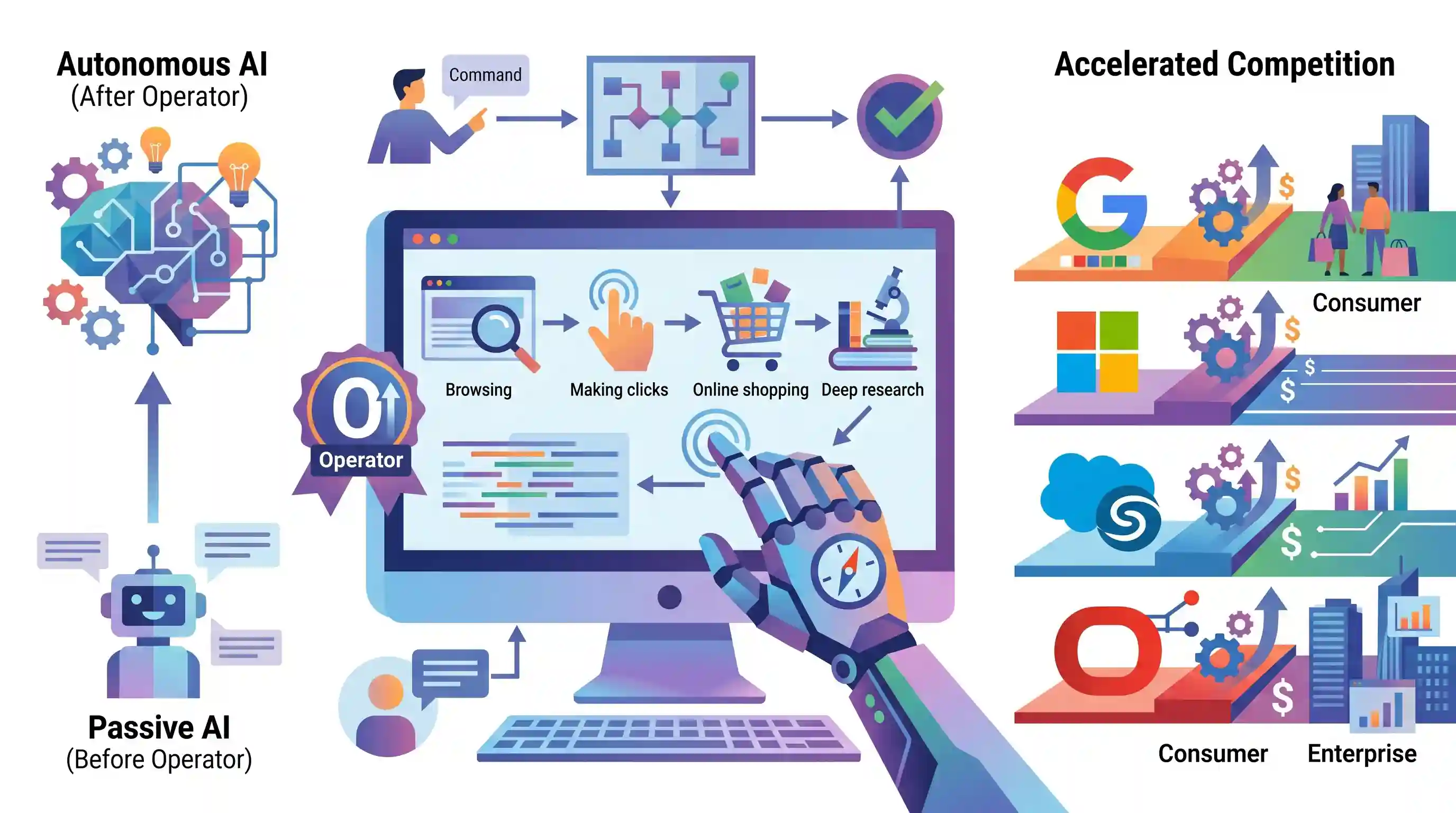
OpenAI has introduced a new "agent" capability to its ChatGPT chatbot, advancing the technology from mere text generation to autonomous task execution. The new feature, developed under the codename "Operator," equips the AI with a virtual computer to browse the web, make clicks, and complete multi-step workflows like online shopping or deep research on a user's behalf. This release escalates the competition in the tech industry, as major players including Google, Microsoft, Salesforce, and Oracle accelerate their own AI agent projects aimed at automating workflows and boosting productivity across both consumer and enterprise segments.
Key Points
- OpenAI has upgraded ChatGPT with "agentic capabilities" (internally known as Operator), allowing it to independently execute tasks on users' behalf.
- The AI agent uses a virtual computer to navigate the web, enabling it to perform complex, multi-step actions like conducting deep research or completing online purchases.
- This development signals a transition in generative AI from answering queries and generating text to proactive, autonomous task execution.
- The launch intensifies the AI race, placing OpenAI in direct competition with tech giants like Google, Microsoft, Salesforce, and Oracle, who are also developing agents for enterprise and consumer productivity.
Important Terms
AI Agent (Autonomous Agent)

AI systems that autonomously execute multi-step tasks—like booking flights or browsing the web—by perceiving digital environments and acting without constant human prompting.
UPSC context
GS Paper 3: Science and Technology. Tests awareness of emerging tech beyond Large Language Models (LLMs) and their real-world applications.
OpenAI
An American AI research organization that pioneered Generative AI with ChatGPT; currently leading the industry shift from 'text-based' chatbots to 'action-oriented' autonomous agents.
UPSC context
GS Paper 3: IT and Computers. Represents the role of the private sector in global technological leadership and AI governance.
Computer-Using Agent (CUA)
OpenAI's underlying technology for its 'Operator' agent, which uses vision and reasoning to interact with computer interfaces (clicks, scrolls) like a human user.
UPSC context
GS Paper 3: Science and Tech. Focuses on the technical mechanisms (vision-based reasoning) driving next-generation automation.
Labor Market Automation
The socio-economic shift where AI agents automate cognitive, white-collar tasks, potentially leading to job reconfiguration or entry-level job loss in sectors like IT and finance.
UPSC context
GS Paper 3: Indian Economy. Crucial for discussing employment, inclusive growth, and the need for workforce reskilling (skilling mission).
Generative AI (GenAI)
The broader category of AI models (like GPT-4) that generate content; autonomous agents represent the next evolution, moving from 'generation' to 'autonomous action.'
UPSC context
GS Paper 3: Science & Tech. The foundational technology for current developments in the IT sector and scientific innovation.
Big Tech Ecosystems
Refers to companies like Google and Microsoft whose massive data and cloud infrastructure (e.g., Azure, Google Cloud) provide the backbone for deploying AI agents at scale.
UPSC context
GS Paper 2: Governance/Global Relations. Tests understanding of market dominance, data sovereignty, and the global digital economy's power structures.
Prelims Trap
"Generative AI models can autonomously plan and execute multi-step web transactions."
Generative AI merely creates content based on prompts. It is Agentic AI that possesses the autonomy to plan, navigate the web, and execute tasks.
Static Concepts Connected
What are the three theoretical stages of AI evolution?
- Narrow AI (ANI): Designed for specific, limited tasks (e.g., facial recognition, text generation like ChatGPT). All current AI falls here.
- General AI (AGI): Machines possessing human-level cognitive abilities across multiple and generalized domains. This remains theoretical.
- Super AI (ASI): A hypothetical stage where machines surpass human intelligence in creativity, problem-solving, and social skills.
What is the "Human-in-the-loop" (HITL) mechanism in Artificial Intelligence?
- Definition: An operational model that requires human interaction to train, tune, validate, or override an AI system's decisions.
- Significance: Crucial for autonomous systems to mitigate algorithmic bias, maintain ethical guardrails, and ensure human accountability in critical sectors.
Cross-Topic Patterns
AI Agents + DPDP Act 2023
AI agents executing online transactions test user consent frameworks and data fiduciary liabilities under India's Digital Personal Data Protection (DPDP) Act 2023.
Agentic AI + Cybersecurity Threats
Autonomous AI navigating digital environments amplifies cybersecurity vulnerabilities, making automated phishing and zero-day exploitation faster and harder to detect.

Expect a 2026 Prelims statement distinguishing Generative AI from Agentic AI, testing the "human-in-the-loop" concept.
Linked PYQs · 3
Linked PYQs · 3
- 2023MainsGS3
Introduce the concept of Artificial Intelligence (AI). How does Al help clinical diagnosis? Do you perceive any threat to privacy of the individual in the use of Al in healthcare?
- 2020PrelimsGS1
With the present state of development, Artificial Intelligence can effectively do which of the following? 1. Bring down electricity consumption in industrial units 2. Create meaningful short stories and songs 3. Disease diagnosis 4. Text-to-Speech Conversion 5. Wireless transmission of electrical energy Select the correct answer using the code given below:
- 2015MainsGS3
What are the areas of prohibitive labour that can be sustainably managed by robots ? Discuss the initiatives that can propel research in premier research institutes for substantive and gainful innovation.
