Project Stargate Expansion and Debt Financing for AI Infrastructure
Source:The Hindu ↗
Why It Matters
The sheer scale of Project Stargate underscores the massive physical infrastructure, capital, and energy requirements underlying the AI revolution. It is highly relevant for GS-3 topics on Science & Technology and Infrastructure, illustrating the shift toward debt financing for technology hardware and the strategic supply-chain maneuvers required to secure critical semiconductor components.
Summary
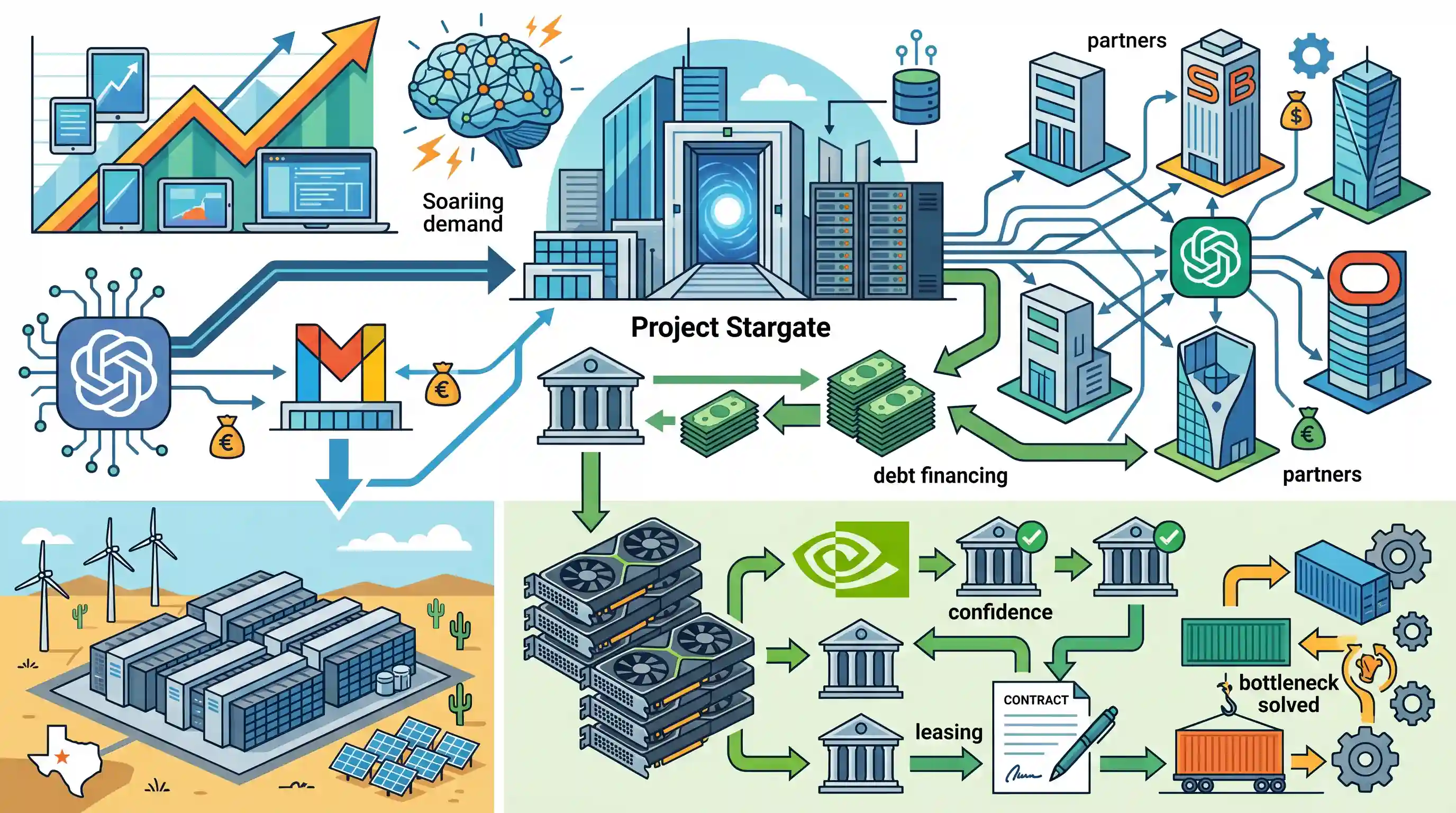
OpenAI is rapidly expanding "Project Stargate," an ambitious $500 billion infrastructure initiative designed to construct massive data centers and secure the computational power necessary to train advanced artificial intelligence models. Under pressure to meet soaring demand for AI services, OpenAI is shifting from relying solely on equity funding or single partnerships (like its historic arrangement with Microsoft) to pursuing debt financing and collaborating with multiple tech giants, including SoftBank and Oracle. A flagship data center in Abilene, Texas, illustrates the physical scale of the project. Furthermore, a new $100 billion partnership with Nvidia leverages the chipmaker's backing to give lenders confidence, enabling OpenAI to lease GPUs instead of purchasing them outright. This shift reflects a broader trend where hyperscalers use debt to finance increasingly costly AI infrastructure and navigate supply chain bottlenecks.
Key Points
- OpenAI is expanding 'Project Stargate,' a half-a-trillion-dollar infrastructure project designed to build massive data centers and secure necessary computational power for advanced AI models.
- To manage the immense capital requirements without diluting equity, OpenAI is exploring tens of billions in debt financing, backed by a strategic $100 billion partnership with Nvidia to lease GPUs.
- Reflecting a broader industry trend among hyperscalers, OpenAI has diversified its strategic partnerships beyond Microsoft to include collaborations with Oracle and SoftBank to build capacity.
- Physical infrastructure scale is immense, as seen in the flagship 1,100-acre data center currently under construction in Abilene, Texas.
Important Terms
OpenAI

A leading American AI research organization known for developing ChatGPT and GPT-4, focusing on creating safe and beneficial Artificial General Intelligence (AGI).
UPSC context
GS Paper 3 (Science & Technology); tests awareness of generative AI advancements and global technology governance.
Project Stargate
An ambitious $500 billion infrastructure initiative led by OpenAI and SoftBank to build a network of massive data centers for next-generation AI training.
UPSC context
GS Paper 3 (Infrastructure); relevant for large-scale tech investments and their impact on the global digital economy.
Nvidia
The dominant global semiconductor firm producing Graphics Processing Units (GPUs), which provide the high-performance computing power essential for modern AI workloads.
UPSC context
GS Paper 3 (Economy/S&T); critical for understanding the global semiconductor supply chain and technological sovereignty.
Crusoe Energy
A sustainable computing company that utilizes wasted energy and renewables to power modular, high-performance data centers for energy-intensive AI processing.
UPSC context
GS Paper 3 (Environment/Technology); highlights innovative solutions for balancing AI's energy demands with climate goals.
SoftBank
A Japanese investment giant and lead financial partner in Project Stargate, known for its massive Vision Fund investments in global technology startups.
UPSC context
GS Paper 3 (Economy); illustrates the influence of global venture capital in shaping high-tech infrastructure.
Oracle
A major cloud and software corporation providing the specialized high-speed networking and data center capacity required for OpenAI's "Stargate" facilities.
UPSC context
GS Paper 3 (Infrastructure); relevant for studying the competitive landscape of global cloud service providers (Hyperscalers).
Prelims Trap
"GPUs are primarily designed for sequential processing and are less energy-intensive than CPUs."
It is the exact opposite. CPUs handle sequential processing, while GPUs excel at high-speed parallel computing (crucial for AI) and consume significantly more electricity.
Static Concepts Connected
How do Graphics Processing Units (GPUs) differ from CPUs in computing?
- Architecture: CPUs typically have a few powerful cores optimized for complex, sequential serial processing.
- Parallel Processing: GPUs feature thousands of smaller, specialized cores designed to handle multiple tasks simultaneously (parallel processing).
- AI Suitability: This parallel architecture makes GPUs highly efficient for the massive matrix multiplications required to train deep learning AI models.
What is the fundamental difference between debt and equity financing?
- Ownership Dilution: Equity financing involves selling a portion of the company, leading to ownership dilution. Debt financing allows founders to retain full control.
- Financial Obligation: Debt requires regular, mandatory interest and principal repayments regardless of revenue. Equity investors share the risk without guaranteed returns.
- Liquidation Priority: In the event of bankruptcy, debt holders have priority over equity shareholders in claiming the company's assets.
Cross-Topic Patterns
AI's massive carbon and energy footprint
The 5x to 20x higher energy consumption of AI data centers intersects with global climate commitments, pushing tech giants toward nuclear energy (SMRs) and renewable power purchase agreements.
Data centers as core infrastructure
India recently granted "infrastructure status" to data centers to facilitate easier long-term domestic credit, mirroring the massive debt-financing trends seen globally among hyperscalers.

Expect a 2026 Prelims question contrasting GPU parallel processing with CPUs, linked to the immense energy demands of AI model training.
Linked PYQs · 3
Linked PYQs · 3
- 2023MainsGS3
Introduce the concept of Artificial Intelligence (AI). How does Al help clinical diagnosis? Do you perceive any threat to privacy of the individual in the use of Al in healthcare?
- 2020PrelimsGS1
With the present state of development, Artificial Intelligence can effectively do which of the following? 1. Bring down electricity consumption in industrial units 2. Create meaningful short stories and songs 3. Disease diagnosis 4. Text-to-Speech Conversion 5. Wireless transmission of electrical energy Select the correct answer using the code given below:
- 2025MainsGS3
India aims to become a semiconductor manufacturing hub. What are the challenges faced by the semiconductor industry in India? Mention the salient features of the India Semiconductor Mission.
