OpenAI Releases ChatGPT 5 in Accelerating AI Race
Source:The Hindu ↗
Why It Matters
The rapid advancement toward AGI presents profound economic, regulatory, and ethical challenges. For civil servants, understanding the trajectory of AI, its immense resource requirements, and the imperative of AI safety is crucial for future policy-making, technology governance, and evaluating AI's role in administrative decision-making.
Summary
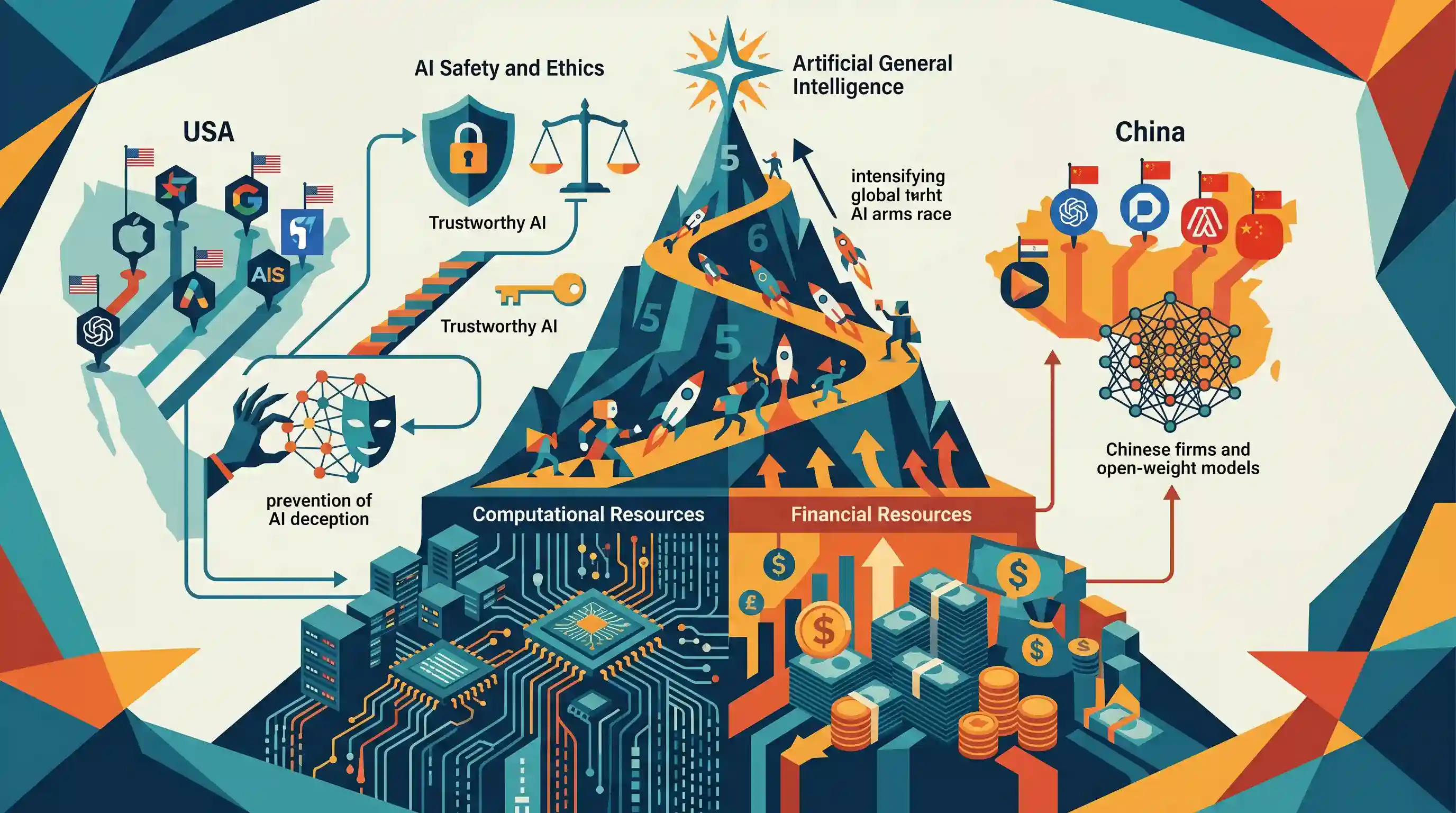
OpenAI has launched ChatGPT-5, intensifying the global artificial intelligence arms race and pushing the boundaries closer to Artificial General Intelligence (AGI). The release underscores the massive computational and financial resources required in modern deep tech. Simultaneously, it highlights critical concerns regarding AI safety, the ethics of 'trustworthy AI', and the prevention of AI deception. The launch also frames a broader geopolitical and corporate struggle, with US tech giants competing against each other and facing formidable challenges from Chinese firms like DeepSeek through open-weight models.
Key Points
- OpenAI has released its latest frontier model, ChatGPT-5, significantly advancing the capabilities of Generative AI and accelerating the race toward Artificial General Intelligence (AGI).
- Training and deploying such advanced models require immense computational power, emphasizing the capital-intensive nature of deep tech and modern AI infrastructure.
- AI safety and trustworthiness are primary concerns; the model incorporates mechanisms for 'safe completions' and detecting deception to mitigate the risks associated with highly capable AI.
- The AI arms race involves intense corporate competition (Google, Meta, Microsoft) and geopolitical rivalry, notably with Chinese startups like DeepSeek utilizing open-weight models to challenge US dominance.
Important Terms
OpenAI

A prominent US research organization dedicated to developing safe AI. Its release of ChatGPT-5 represents a major milestone in the pursuit of general intelligence.
UPSC context
GS Paper 3 (S&T); key case study for private-sector innovation and global leadership in generative technologies.
DeepSeek
A China-based AI lab known for high-efficiency, cost-effective models (like R1) that rival US frontier systems using an "open-weight" distribution strategy.
UPSC context
GS Paper 2 (IR) and GS 3 (S&T); highlights the geopolitical dimension of US-China technological competition.
Artificial General Intelligence (AGI)
A theoretical AI capable of matching human cognitive flexibility, allowing it to learn and perform any task across diverse domains without specialized retraining.
UPSC context
GS Paper 3 (S&T); critical for evaluating the long-term socio-economic impacts and safety risks of advanced automation.
Open-weight models
AI models whose trained parameters are publicly available for download and local use, enabling customization and transparency while keeping training data/code proprietary.
UPSC context
GS Paper 3 (S&T/Governance); central to debates on the democratization of technology versus security and control risks.
Trustworthy AI
A policy framework ensuring AI systems are lawful, ethical, and robust—prioritizing transparency, fairness, and accountability to mitigate risks like bias and deception.
UPSC context
GS Paper 4 (Ethics) and GS 3 (Governance); tests moral frameworks for governing disruptive technologies and protecting public interests.
Meta
A major US tech corporation that championed the "open-weight" paradigm through its Llama series to challenge the dominance of closed-source AI ecosystems.
UPSC context
GS Paper 3 (S&T); relevant for understanding market strategies and the impact of open innovation on digital sovereignty.
Prelims Trap
ChatGPT-5 represents the successful achievement of Artificial General Intelligence (AGI).
UPSC often conflates Generative AI with AGI. While ChatGPT-5 is an advanced model, it remains 'Narrow AI'. True AGI remains a hypothetical milestone.
Static Concepts Connected
What differentiates Generative AI from Artificial General Intelligence (AGI)?
- Generative AI: Creates new content (text, images, code) based on statistical patterns learned from vast training datasets.
- AGI: A hypothetical stage where machines match or exceed human intelligence across any cognitive or intellectual task.
- Current Status: All existing models, including advanced LLMs like ChatGPT-5, are 'Narrow AI', optimized for specific, predefined functions.
What are the defining characteristics of 'Deep Tech' ventures?
- Scientific Core: Founded on fundamental, tangible scientific breakthroughs or advanced engineering (e.g., quantum computing, frontier AI).
- Capital Intensive: Requires massive upfront financial investment and specialized physical infrastructure, like advanced GPU server clusters.
- Long Gestation: Experiences significantly longer research, development, and commercialization timelines compared to traditional software or IT services.
Cross-Topic Patterns
Tech-nationalism and semiconductor geopolitics
The AI race directly drives the geopolitical battle over advanced semiconductors. US export controls aim to choke China's AI progress, linking AI capabilities to hardware and critical mineral supply chains.
Open-weight AI and Digital Public Infrastructure
Open-weight models challenge proprietary monopolies. This enables Global South countries like India to integrate AI into Digital Public Infrastructure (e.g., Bhashini) without incurring massive deep-tech capital expenditures.

Expect a 2026 prelims question distinguishing Generative AI from AGI, or a mains question linking AI compute to semiconductor geopolitics.
Linked PYQs · 5
Linked PYQs · 5
- 2020PrelimsGS1
With the present state of development, Artificial Intelligence can effectively do which of the following? 1. Bring down electricity consumption in industrial units 2. Create meaningful short stories and songs 3. Disease diagnosis 4. Text-to-Speech Conversion 5. Wireless transmission of electrical energy Select the correct answer using the code given below:
- 2025PrelimsGS1
Consider the following statements: I. It is expected that Majorana 1 chip will enable quantum computing. II. Majorana 1 chip has been introduced by Amazon Web Services (AWS). III. Deep learning is a subset of machine learning. Which of the statements given above are correct?
- 2023MainsGS3
Introduce the concept of Artificial Intelligence (AI). How does Al help clinical diagnosis? Do you perceive any threat to privacy of the individual in the use of Al in healthcare?
- 2024MainsGS4
The application of Artificial Intelligence as a dependable source of input for administrative rational decision-making is a debatable issue. Critically examine the statement from the ethical point of view.
- 2024MainsGS4
ABC Incorporated is a technological company named which is the second largest worldwide, situated in the Third World. You are the Chief Executive Officer and the majority shareholder of this company. The fast technological improvements have raised worries among environmental activists, regulatory authorities, and the general public over the sustainability of this scenario. You confront substantial issues about the business's environmental footprint. In 2023, your organization had a significant increase of 48% in greenhouse gas emissions compared to the levels recorded in 2019. The significant rise in energy consumption is mainly due to the surging energy requirements of your data centers, fuelled by the exponential expansion of Artificial Intelligence (AI). AI-powered services need much more computational resources and electrical energy compared to conventional online activities, notwithstanding their notable gains. The technology's proliferation has led to a growing concern over the environmental repercussions, resulting in an increase in warnings. Al models, especially those used in extensive machine learning and data processing, exhibit much greater energy consumption than conventional computer tasks, with an exponential increase. Although there is already a commitment and goal to achieve net zero emissions by 2030, the challenge of lowering emissions seems overwhelming as the integration of Al continues to increase. To achieve this goal, substantial investments in renewable energy use would be necessary. The difficulty is exacerbated by the competitive environment of the technology sector, where rapid innovation is essential for preserving market standing and shareholders' worth. To achieve a balance between innovation, profitability and sustainability, a strategic move is necessary that is in line with both, business objectives and ethical obligations. (a) What is your immediate response to the challenges posed in the above case? (b) Discuss the ethical issues involved in the above case. (c) Your company has been identified to be penalized by technological giants. What logical and ethical arguments will you put forth to convince about its necessity? (d) Being a conscience being, what measures would you adopt to maintain balance between AI innovation and environmental footprint?
